




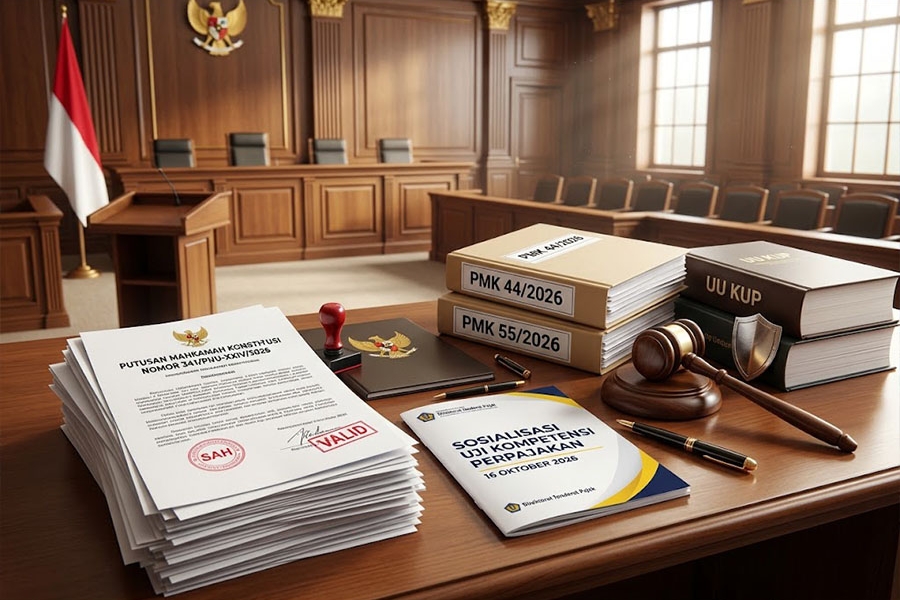
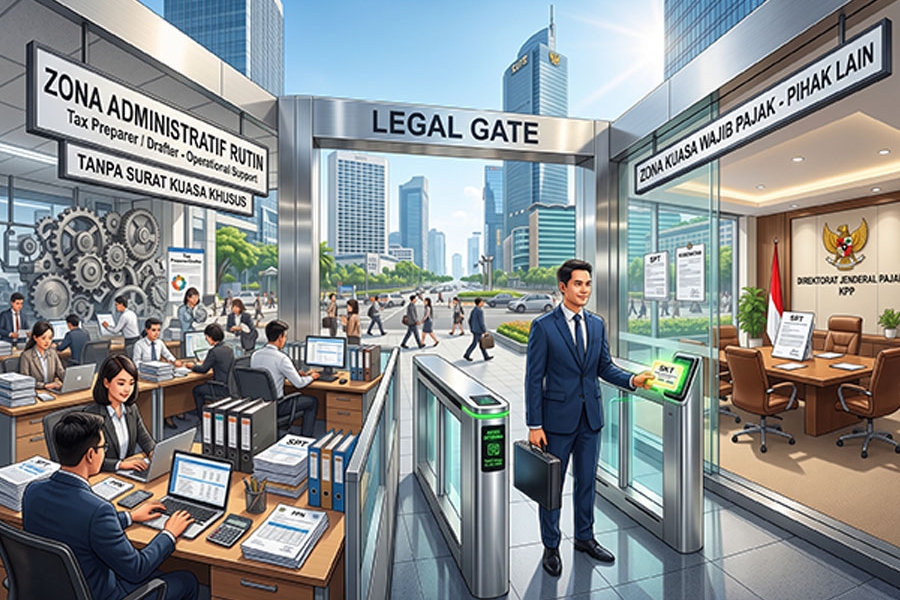
Minister of Finance Regulation Number 44 of 2026 requires company employees to hold the status of "Other Party" when acting as a Tax Proxy. These employees must take and pass the official tax Competency Exam to demonstrate their formal eligibility. The government issues a Certificate of Registration, valid for three years, as proof of legitimate proxy authorization. The Directorate General of Taxes will fully enforce this mandatory provision starting January 1, 2027. Company management must immediately map out internal tax roles to mitigate the risk of administrative sanctions and personal criminal liability..
As we know, the Indonesian Government, alongside various other nations worldwide, is currently intensifying its fight against tax avoidance practices by multinational corporations. Many of these companies utilize tax havens to bypass their tax obligations across different jurisdictions.
To address this, Indonesia and other countries have prepared various frameworks, such as the Multilateral Convention on Mutual Administrative Assistance in Tax Matters (MAAC) and the OECD's Pillar Two, to prevent such activities. Through these schemes, nations globally (including Indonesia) are collaborating to establish fair tax rates and stop multinational companies from exploiting tax rate discrepancies across jurisdictions—particularly in tax havens—for undue financial gain.
Should countries operating as tax havens be deemed illegal? Is this practice prohibited under international law? Looking from the perspective of international law, there is actually no explicit prohibition against a country adopting a tax haven status. Fundamentally, every sovereign state holds full authority to determine the tax rates applicable within its territory, even down to 0%. However, it is undeniable that the use of these tax havens as vehicles for illegal tax evasion can generate negative impacts that harm the economies of many nations globally.
The severe negative impacts have driven countries worldwide, especially those in the G20 and OECD, to aggressively pressure tax havens. These impacts include:
Multinational companies frequently shift their profits from the countries where they actually operate to subsidiaries in tax havens solely to avoid taxes.
This practice creates unfair business competition. Large corporations can evade taxes, while small local businesses are left paying their full share.
Tax haven jurisdictions typically lock down their clients' financial information. This is exploited by corrupt individuals, drug syndicates, and other criminals to hide their wealth.
Consequently, various nations, including Indonesia, are collaborating and forging international agreements to close the loopholes provided by tax havens. Some of these include:
Initiated by the OECD and G20, this is a system for the automatic exchange of financial information between countries. Through this standard, tax havens are forced to disclose the banking data of foreign nationals to their home countries.
The Multilateral Convention on Mutual Administrative Assistance in Tax Matters (MAAC) is an international treaty that serves as a legal umbrella for over 140 countries to assist each other in tax administration, including joint tax audits and assistance in tax recovery.
This initiative is a recent breakthrough in international taxation that has seen massive adoption in recent years. Under this framework, multinational corporations are subject to a minimum tax rate of 15% wherever they operate. This means if a company parks its money in a tax haven with a 0% rate, its home country has the right to collect the difference (top-up tax) of 15%. Through this initiative, tax haven status can no longer be effectively used for tax avoidance.
Fundamentally, there is no international prohibition against a country operating as a tax haven. However, because these jurisdictions are consistently exploited by multinational corporations to dodge tax obligations, the international community continues to implement multi-layered frameworks to prevent these practices and foster a more transparent global tax system.











 tpc.consulting
  tpc.consulting
  info@taxindo.co.id