Accounting and taxation are two inseparable disciplines in Indonesian business operations. Tax accounting is not merely a technique for recording transactions; it is the bridge connecting commercial financial statements with national obligations. In Indonesia, this dynamic is strictly regulated under the Law on General Provisions and Tax Procedures (UU KUP) and prevailing accounting standards. Understanding the foundations of tax accounting is the first step for any Taxpayer to achieve fiscal efficiency and sustainable compliance.
1. Recording Obligations: NPPN vs. Bookkeeping
Every Taxpayer in Indonesia is obligated to document their economic activities, but the method used depends on the business scale:
- Bookkeeping (Pembukuan): Mandatory for Corporate Taxpayers and Individuals with an annual gross turnover exceeding IDR 4.8 billion. Bookkeeping must be maintained consistently using accrual or cash principles.
- Recording (NPPN): Intended for Individual Taxpayers with turnover below IDR 4.8 billion per year. They are permitted to use the Deemed Profit Margin (NPPN) for simpler calculation but must still record their gross turnover chronologically.
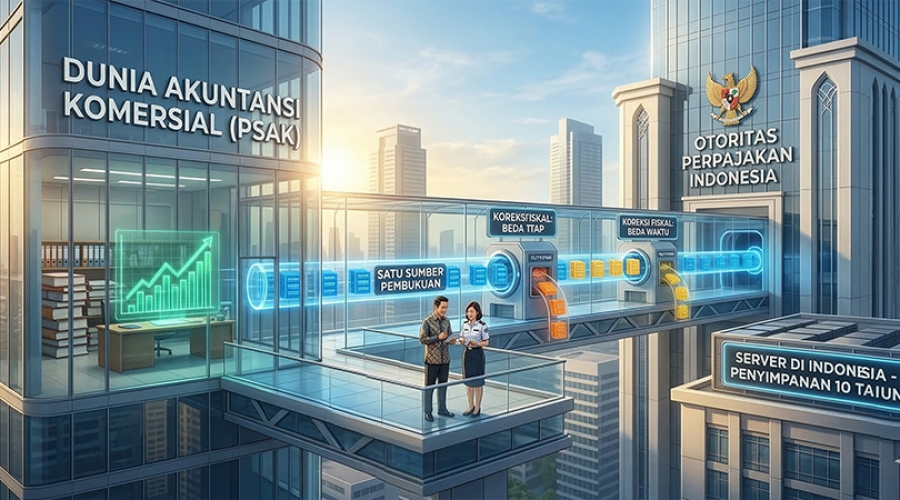
2. Tax Law and PSAK: The "Common Ground" Principle
Indonesia follows the principle that Tax Accounting follows PSAK (Financial Accounting Standards) as long as tax laws do not specify otherwise. This means that the basis for financial statement preparation remains commercial standards. However, when the Income Tax Law provides specific rules (such as depreciation methods or representation expense limits), tax rules prevail for Tax Return purposes.
3. One Bookkeeping System for All Purposes
A common misconception is that companies need "two sets of books"—one for shareholders and one for the tax office. Legally in Indonesia, this is prohibited. Indonesia adheres to the Single Bookkeeping Principle, where fiscal financial statements are derived or adjusted from the same commercial source. Data integrity starts from a single source of truth.
4. Data Storage Obligations and Server Location
Under the KUP Law, Taxpayers must store books, records, and documents serving as the basis for bookkeeping for 10 years within Indonesia.
- Data Format: Storage can be physical or electronic.
- Server Presence: If bookkeeping is electronic, tax authorities require that data and servers must be located in Indonesia, unless specific permission is granted. This ensures that tax authorities have easy access during audits or tax/customs supervision.
5. Fiscal Corrections: Timing vs. Permanent Differences
Differences in recognition between commercial accounting and tax rules are resolved through Fiscal Reconciliation. There are two primary types of differences:
- Permanent Difference (Beda Tetap): Occurs when a transaction is recognized for accounting purposes but is permanently disallowed for tax (e.g., non-qualifying donations or interest income subject to Final Tax).
- Timing Difference (Beda Waktu): Occurs due to differences in the timing of income or expense recognition (e.g., different depreciation methods or provisions for doubtful accounts).
6. Equalization: The Compliance Control Mechanism
Equalization is a technique used to reconcile one type of tax with another or with the general ledger.
- Example: Matching total salary expenses in the Profit & Loss statement with the total Tax Base (DPP) of Income Tax Article 21 reported in monthly returns.
- Function: Ensures there are no unexplained discrepancies between revenue in the Annual Income Tax Return and turnover in the Monthly VAT Returns. Equalization is a primary tool for tax auditors to detect potential underpayments.
7. Consequences of Failing to Maintain Bookkeeping
Ignoring bookkeeping obligations carries serious consequences for Taxpayers:
- Ex-Officio Determination (Penghitungan Secara Jabatan): If a Taxpayer fails to maintain bookkeeping or provide data during an audit, tax liability can be determined unilaterally by the tax office based on available data.
- Administrative Sanctions: Taxpayers may face significant fines or tax increases (ranging from 50% to 100% of the underpaid tax).
- Criminal Sanctions: If the lack of bookkeeping is deemed intentional to cause revenue loss to the state, imprisonment may be imposed.
Conclusion
Tax accounting in Indonesia demands high precision in synergizing commercial standards with fiscal boundaries. By adhering to the single bookkeeping principle and understanding reconciliation and equalization mechanisms, Taxpayers can build a strong fortress of compliance. In today's era of tax digitalization, managing electronic data according to KUP standards is an absolute prerequisite for a successful tax audit.






 tpc.consulting
  tpc.consulting
  info@taxindo.co.id