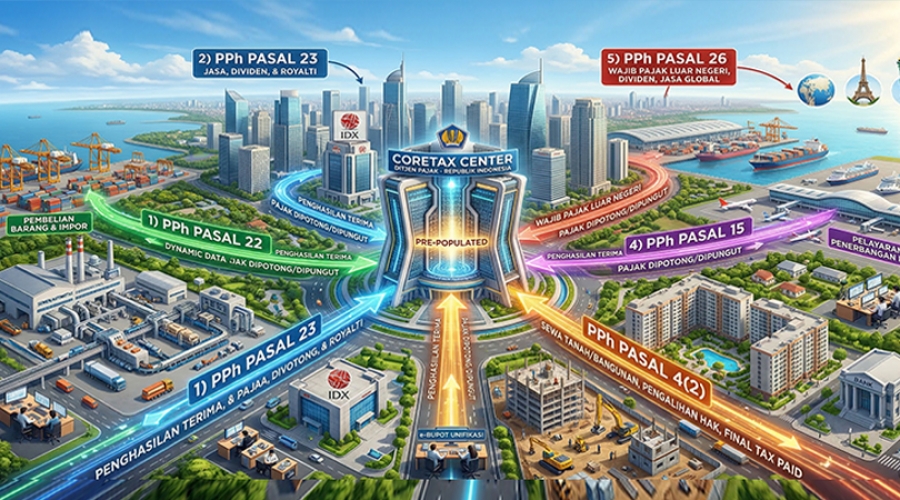
The Indonesian taxation system relies on the Withholding Tax mechanism as a primary pillar for state revenue collection. This mechanism mandates the payer (withholder) to deduct or collect taxes on income paid to the recipient and remit it to the state treasury. For corporations, a deep understanding of Income Tax (PPh) Articles 22, 23, 4(2), 15, and 26 is not only about compliance but also about preventing administrative sanctions and optimizing cash flow through effective tax credit management.
1. Article 22: Collection on Trade and Industrial Activities
Article 22 Income Tax is collected by government treasurers, certain institutions, or corporate bodies regarding payments for the delivery of goods and activities in the field of imports or business activities in other sectors.
- Objects and Rates:
- Imports: Using API (0.5% or 2.5%) and Non-API (7.5%).
- Purchase of Goods by Government Treasurers: 1.5%.
- Sale of Specific Industrial Products: Such as paper, cement, steel, and automotive (rates vary between 0.1% to 0.45%).
- Very Luxury Goods: 5%.
- Nature: Generally non-final (creditable), except for the sale of fuel and lubricants to dealers/agents.
2. Article 23: Deduction on Capital and Service Income
Article 23 Income Tax is imposed on income paid to resident Taxpayers or Permanent Establishments (BUT) other than those already deducted under Article 21.
- Objects and Rates:
- Dividends, Interest, Royalties, and Awards: 15% of the gross amount.
- Rent and Other Income related to asset use (excluding land/building rent): 2% of the gross amount.
- Technical, Management, Construction, Consulting, and Other Services (PMK-141/PMK.03/2015): 2% of the gross amount.
- Note: Taxpayers without a Tax ID (NPWP) are subject to a 100% higher rate. Article 23 serves as a tax credit for the recipient at year-end.
3. Article 4 Paragraph (2): Final Income Tax
Unlike Articles 22 or 23, Article 4(2) is final, meaning the tax deducted cannot be credited in the Annual Tax Return, and the income is not consolidated with other income at the end of the year.
Primary Objects:
- Rental of Land and/or Buildings: 10%.
- Transfer of Rights to Land and/or Buildings: 2.5%.
- Interest on Deposits and Savings: 20%.
- Construction Services: Rates vary by business qualification (1.75% to 6%) under Government Regulation No. 9 of 2022.
- Lottery Prizes: 25%.
4. Article 15: Tax on Special Industries (Special Calculation Norms)
Article 15 Income Tax is imposed on income received by specific Taxpayers engaged in industries with special calculation norms.
- Subjects and Objects:
- International Shipping or Aviation Companies: 2.64% of gross turnover (Final).
- Domestic Shipping Companies: 1.2% of gross turnover (Final).
- Parties engaged in Build-Operate-Transfer (BOT) agreements: 5% of gross value.
5. Article 26: Deduction on Foreign Transactions
Article 26 regulates tax deduction on income derived from Indonesia paid to Non-Resident Taxpayers (other than BUT).
- Standard Rate: 20% of the gross amount.
- Tax Treaty Utilization (P3B): The 20% rate can be reduced or exempted if the recipient is a resident of an Indonesian treaty partner country, proven by a valid Certificate of Residence (DGT Form).
- Objects: Dividends, interest, royalties, service fees, and insurance premiums paid abroad.
6. Administration and Reporting in the Coretax Era
In accordance with the modernization of Indonesia's tax system, the administrative process for Withholding Tax is increasingly integrated.
- Withholding Receipt: Withholders must issue receipts through the Unified (e-Bupot) system.
- Payment: Must be settled by the 15th of the following month.
- Reporting: Conducted through the Unified Monthly Tax Return by the 20th of the following month. In the Coretax system, this process is automated through pre-populated data to minimize input errors.
Conclusion
Mastering the Withholding Tax mechanism is the key to fiscal transparency for companies. By understanding the distinction between final taxes (Article 4(2), Article 15) and non-final taxes (Article 22, Article 23), as well as international obligations (Article 26), companies can perform accurate tax planning. Ensure every transaction is supported by proper PSAK documentation and clear contracts to face validation in the Coretax system.






 tpc.consulting
  tpc.consulting
  info@taxindo.co.id