



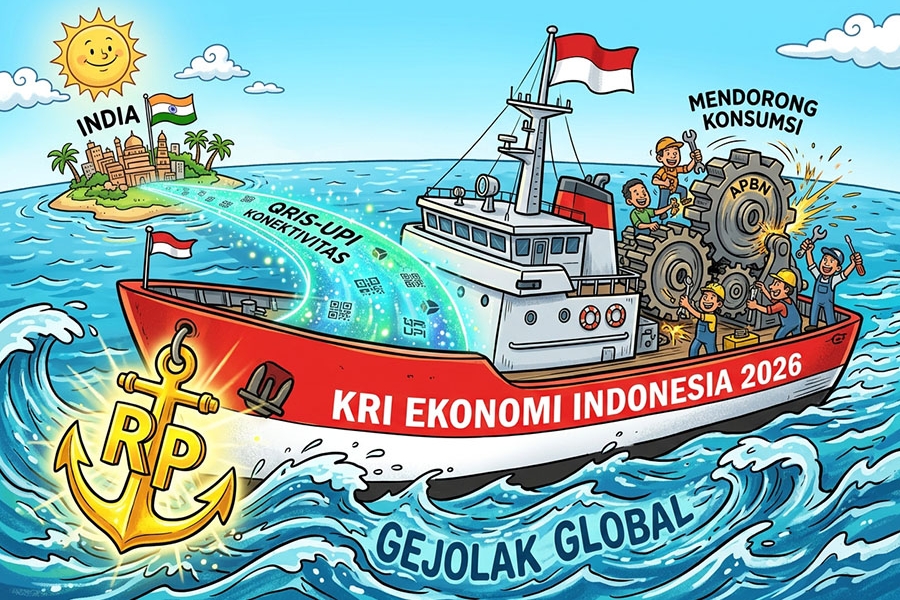
Bank Indonesia projects the rupiah exchange rate to hover in the range of Rp17,300 to Rp17,800 per US dollar throughout 2026 amid still-volatile global conditions. Indonesia and India are accelerating discussions on integrating the QRIS and UPI digital payment systems to support cross-border payment transactions for tourists from both countries, with an implementation target before the end of 2026, although several aspects remain under discussion. Meanwhile, Maybank Indonesia Chief Economist Juniman estimates Indonesia's economic growth in 2026 to reach 5.3%, noting that the driving force of State Budget (APBN) expenditure on economic growth is considered suboptimal..
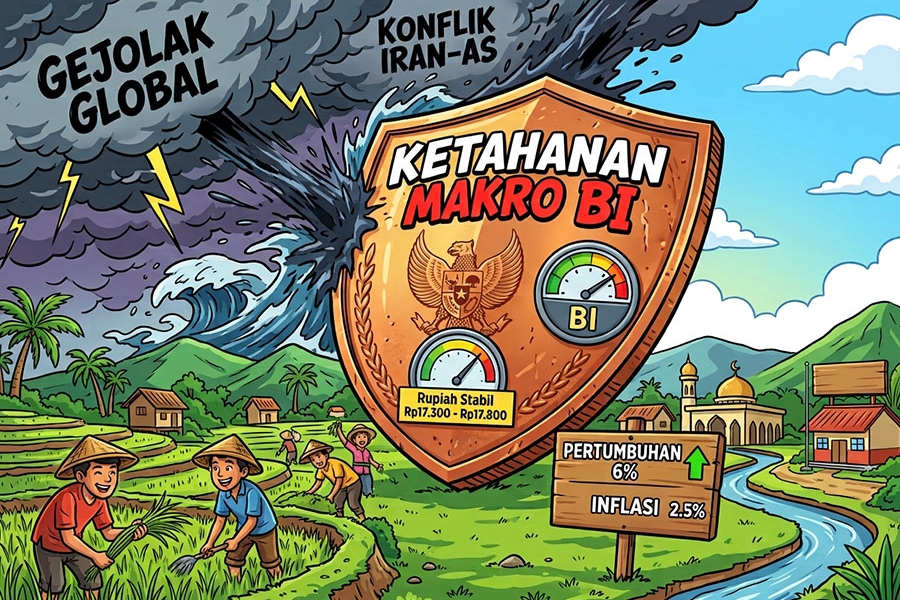
Bank Indonesia (BI) projects the rupiah exchange rate to be in the range of Rp17,300 to Rp17,800 per US dollar throughout 2026. BI also estimates national economic growth to be in the range of 5.2% to 6% and maintains its inflation projection target at 2.5% ± 1%, meaning inflation is expected to remain within the range of 1.5% to 3.5%.
Previously, the rupiah exchange rate hovered around the level of Rp17,500 per US dollar and briefly approached Rp17,400 per US dollar. However, renewed volatility in global conditions has put pressure on the rupiah exchange rate. The Governor of BI stated that the escalating Iran-US war has also influenced the movement of the rupiah in recent days. Nevertheless, he noted that the rupiah is still managing to hold at the level of Rp17,600s per US dollar.
In addition to developments in the rupiah exchange rate and economic conditions, Bank Indonesia continues to expand cross-border payment system collaborations.
Indonesia and India are accelerating the integration of digital payment systems between the Quick Response Code Indonesian Standard (QRIS) and the Unified Payments Interface (UPI) to facilitate retail payment transactions for tourists from both countries. This integration will eventually allow tourists to use their existing payment applications to scan QR codes in the destination country without needing to download a new app. However, the QRIS and UPI integration is still in the discussion phase and has not yet reached a final agreement on several aspects.
Bank Indonesia (BI) and the Reserve Bank of India (RBI) are preparing a government-to-government cooperation framework, while the Indonesian Payment System Association (ASPI) and the National Payments Corporation of India (NPCI) are discussing the technical, operational, and business aspects of the integration. Although a final agreement has yet to be reached, BI and ASPI are striving for the QRIS and UPI integration to be implemented before the end of 2026. Meanwhile, QRIS users in Indonesia have reached 67.5 million, involving 45.5 million merchants.
At the same time, Indonesia's economic growth prospects and the effectiveness of government spending are also points of concern.
The Chief Economist of Maybank Indonesia estimates that Indonesia's economic growth in 2026 will reach 5.3%, slightly below the APBN target of 5.4%. Economic growth is expected to slow down to 5.2% in the third quarter of 2026, while in the fourth quarter of 2026, it is projected to be in the range of 5.2% to 5.25%. According to Juniman, the economic growth target of 6% for next year requires a stronger push from the private sector.
The realization of APBN expenditure up to August 2026 grew by 17.1% year-on-year, while state revenue grew by 25.4%. During this period, the APBN recorded a deficit of Rp240 trillion, or 0.93% of the GDP, while the primary balance still maintained a surplus of Rp154 trillion. According to Juniman, government spending through the APBN has not been optimal in driving economic growth because government spending contributes only about 6% to the GDP, whereas household consumption accounts for nearly 54% of the GDP.
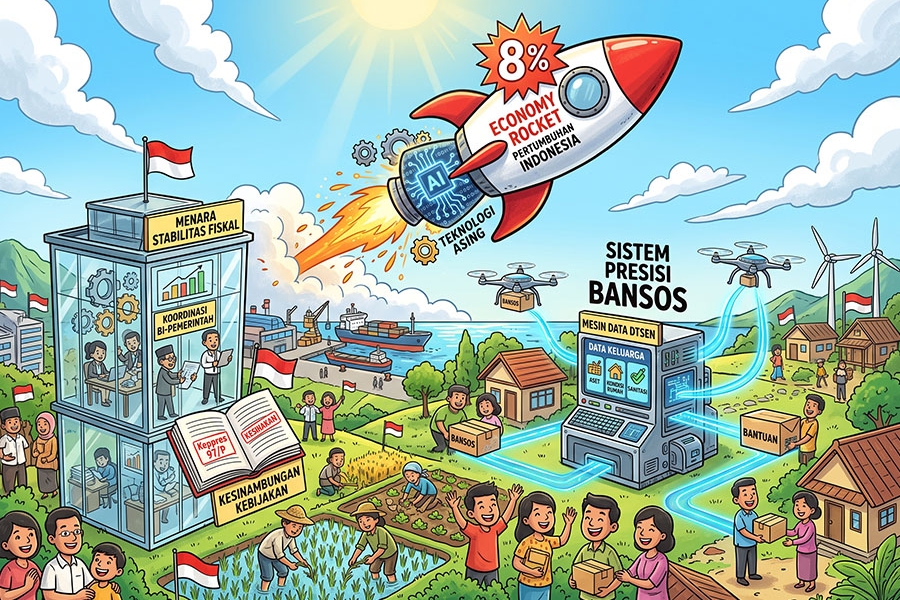
The Chief Economist of Maybank Indonesia expects pressure on the APBN deficit to increase starting in September in line with rising government spending through December, particularly for energy and non-energy subsidy payments. He estimates the APBN deficit in December could approach 2.75% of the GDP, while the projected 2026 APBN deficit sits in the range of 2.8% to 2.93% of the GDP. According to him, the government needs to implement refocusing, increase efficiency, improve spending effectiveness, and strengthen the role of the private sector to spur economic growth.
Overall, these three developments highlight the dynamics of Indonesia's economy in terms of the exchange rate, digital payment systems, and fiscal policy. Bank Indonesia projects the rupiah exchange rate to be in the range of Rp17,300 to Rp17,800 per US dollar throughout 2026 amidst turbulent global conditions. On the payment system front, Indonesia and India are accelerating discussions on the integration of QRIS and UPI to support cross-border payment transactions, targeting implementation before the end of 2026 despite several aspects not yet reaching a final agreement.
Meanwhile, on the fiscal side, Indonesia's economic growth in 2026 is projected to reach 5.3% according to Maybank Indonesia Chief Economist Juniman, while the driving force of APBN spending on economic growth is considered suboptimal. These developments demonstrate that exchange rate stability, the expansion of digital payment system connectivity, and the effectiveness of government spending are integral parts of the dynamics of the Indonesian economy throughout 2026.















 tpc.consulting
  tpc.consulting
  info@taxindo.co.id