

Home Tax Literation Corporate Income Tax
Corporate Income Tax
taxindo prime consulting, tpc transfer pricing, sengketa pph badan, koreksi biaya operasional, pengadilan pajak, banding pajak, provision for impairment, biaya outsourcing, ekualisasi pph 26
Tax Literation

Corporate Income Tax

Taxindo Prime Consulting • 31 Juli 2025
00:00
Optimized with Google Chrome
Corporate Income Tax

In the Indonesian business ecosystem, Corporate Income Tax (CIT)—locally known as PPh Badan—is a significant fiscal instrument. Following the Tax Regulation Harmonization Law (UU HPP), the corporate tax landscape has moved toward a more efficient system. Understanding CIT is a fundamental strategy for risk management and corporate financial planning.


1. Corporate Tax Subjects: Who is Obligated to Pay?

Corporate Tax Subjects include Limited Liability Companies (PT), Partnerships (CV), Cooperatives, Foundations, and Permanent Establishments (BUT). These are categorized into Resident and Non-Resident Tax Subjects, which determines their calculation methods and reporting duties.

2. Tax Objects and Gross Income

The object of CIT is income, defined as any increase in economic capability.

  • General Taxable Income: Business profits, royalties, and rents.
  • Final Tax Income: Such as interest on deposits or land/building transfers.
  • Non-Taxable Objects: Such as qualified dividends and grants with no business relationship.

3. Deductible Expenses and Their Limitations

In calculating fiscal profit, not all accounting expenses are tax-recognized. The determination of expenses is based on the following principles:

  • Deductible Expenses (Article 6 of the IT Law): Costs incurred to obtain, collect, and maintain income (known as 3M expenses). Examples: employee salaries, raw material costs, asset depreciation, and marketing expenses.
  • Non-Deductible Expenses (Article 9 of the IT Law): Costs that cannot be deducted when calculating Taxable Income. Examples include: profit distributions such as dividends, expenses for the personal interest of shareholders/members, personal insurance premiums, and the income tax itself.
  • Expenses Related to Non-Fiscal Income: Expenses incurred in relation to income subject to Final Income Tax or income that is Non-Taxable cannot be deducted from gross income (non-deductible).
  • Useful Life Over One Year: Expenditures providing benefits for more than one accounting period must be allocated proportionally through Depreciation (for tangible assets) or Amortization (for intangible assets) according to fiscal regulations.

4. PSAK as the Primary Reference

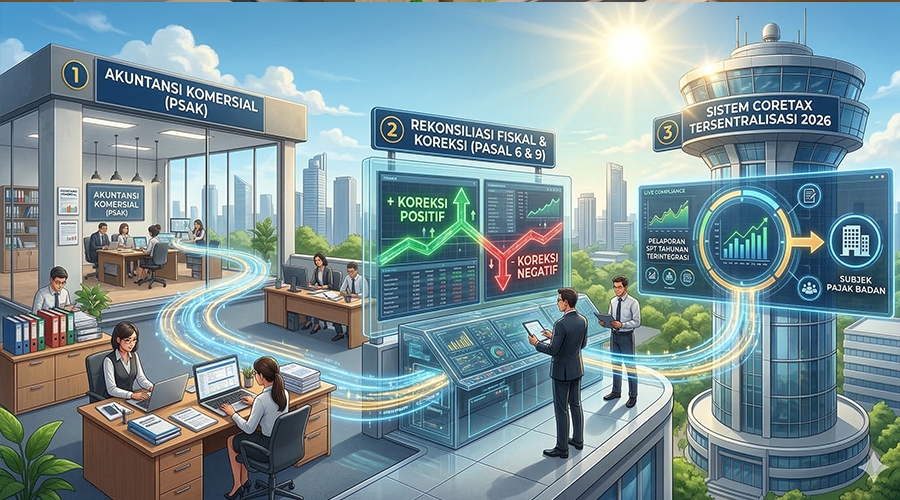
In preparing financial statements, Indonesian companies must follow Financial Accounting Standards (PSAK). In a tax context, PSAK serves as the primary reference for determining transaction values and recognizing financial elements, provided that tax laws do not dictate otherwise. Differences are addressed through fiscal reconciliation.

5. Fiscal Reconciliation: From Commercial to Fiscal Profit

This process bridges the gap between commercial accounting and tax rules.

Positive Correction: Increases fiscal profit (e.g., expenses for personal interest or costs related to Final Tax/Article 9 of the IT Law).

Negative Correction: Decreases fiscal profit (e.g., income already subject to Final Tax).

6. CIT Rates and Tax Facilities

  • Standard Rate: Currently 22% of Taxable Income.
  • Article 31E Facility: Resident corporate taxpayers with gross turnover up to IDR 50 billion receive a 50% rate reduction on the Taxable Income portion for turnover up to IDR 4.8 billion.
  • Publicly Traded Company Incentive: A 3% rate reduction for companies meeting specific public ownership criteria on the stock exchange.

7. Article 25 Tax Installments and Tax Credits

Companies pay monthly Article 25 Income Tax installments to maintain liquidity. Taxes withheld by third parties (Articles 22, 23) serve as Tax Credits to reduce the final tax liability at the end of the fiscal year.

8. Reporting Obligations: The Coretax System Era

With the modernization of tax administration, reporting is now conducted through the Coretax system. The use of traditional manual forms or e-Form/e-Filing (such as Form 1771) has evolved into an integrated reporting module within the Coretax portal.

Deadline:

The Annual CIT Return must be submitted no later than 4 months after the end of the fiscal year (April 30).

Sanctions:

Late submission through the Coretax system remains subject to administrative sanctions under the KUP Law, namely a fine of IDR 1,000,000.

9. Related Party Transactions and Transfer Pricing

Group companies must apply the Arm's Length Principle. Transfer Pricing documentation (TP Doc) is essential for companies meeting specific turnover thresholds to prove that affiliated transactions are not aimed at improper profit shifting.

10. Tax Management and Compliance Strategy

Effective tax management involves legal Tax Planning, such as optimizing tax credits and utilizing investment incentives (Tax Holiday or Super Tax Deduction), while ensuring accounting documentation remains audit-ready.


Conclusion

CIT in Indonesia requires high precision in separating fiscal and commercial expenses based on Articles 6 and 9 of the IT Law. With the transition to the Coretax administration, companies are expected to integrate their financial data more seamlessly while strictly adhering to asset useful life rules and PSAK standards to achieve optimal compliance.


Taxindo Prime Consulting (TPC) is a firm specializing in tax, accounting, business, and business law consulting.
Taxindo Prime Consulting (TPC) is established as a trusted strategic partner, providing comprehensive solutions in tax consulting, accounting, business development, and business law. Driven by a commitment to integrity and professionalism, TPC is dedicated to delivering more than just standard consultation; we provide education, tactical advice, and concrete solutions. Our services are meticulously designed to analyze and resolve clients' tax and business challenges with objectivity, in-depth insight, and full independence, ensuring both regulatory compliance and long-term business sustainability.
OFFICE
Mega Plaza Building 12th Floor
Jl. H.R. Rasuna Said Kav C-3 Jakarta 12940

Phone :
+62 21 521 2686
+62 817 001 3303

Email :
info@taxindo.co.id
Copyright © 2026 Taxindo Prime Consulting

All content on this website is provided solely for general informational and educational purposes. This information is not intended as a substitute for professional tax advice or consultation specific to your situation. We strongly encourage you to contact our team of consultants directly to receive appropriate guidance and advice.

Taxindo Prime Consulting
Tax and Transfer Pricing Calculator
Tax Calendar
×
Newsletter


