




The President of the Republic of Indonesia is pushing for the acceleration of free education in public schools and finalizing plans to waive tuition fees at state universities (PTN). This plan was discussed during a limited cabinet meeting at the Merdeka Palace with several related ministers, with discussions covering execution schemes, implementation stages, and financing needs. The government is still conducting calculations considering the state's capacity and fiscal space.
The Minister of Higher Education, Science, and Technology stated that the government is still studying a number of options to realize free higher education in accordance with the President's direction. Meanwhile, the Minister of Finance stated that the decision regarding the program's required budget is still awaiting further discussion with the President. Thus, the scheme and budget amount for free education at PTN remain in the calculation and finalization phase.
The expansion of educational access through the free public education plan aligns with the government's efforts to broaden public social and economic inclusion. One of the steps currently being prepared is the free opening of bank accounts for citizens aged 17 and older who do not yet have an account.
The government estimates that the required budget for the free account opening program reaches Rp3.84 trillion, calculated based on providing an initial balance of Rp50,000 for each account. Based on these calculations, the program is estimated to cover around 76.8 million accounts for people without a bank account. The government is still discussing the follow-up scheme with the Finance Minister, including measures to ensure that the opened accounts remain active and do not become dormant.
This follow-up program is partly targeted at individuals aged 17 and older who are unmarried and have not yet been fully reached by social assistance programs. Thus, the account openings are not only aimed at expanding banking access but are also designed to ensure the accounts can be utilized sustainably.
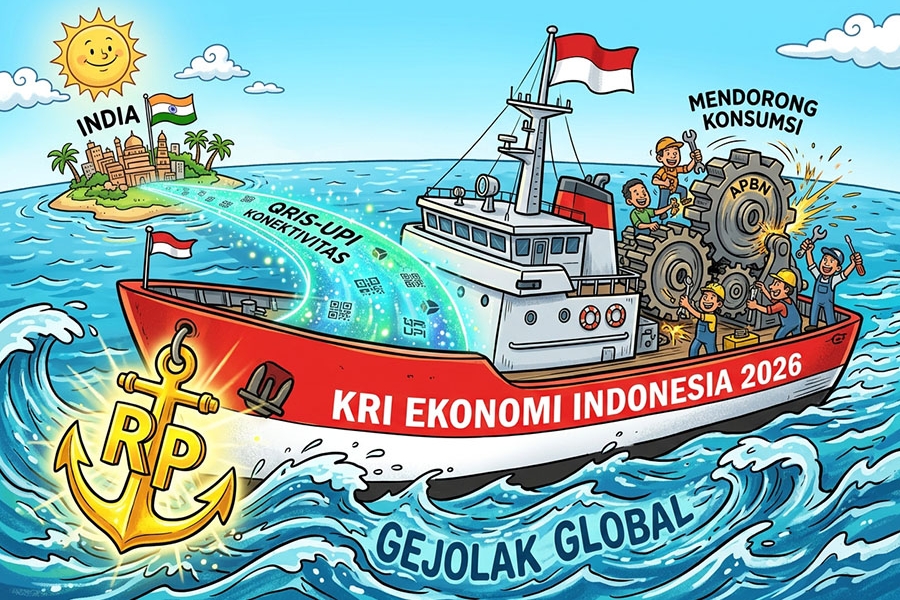
The expansion of public access to banking services is part of the development of the domestic financial sector taking place amidst global economic and financial market dynamics. In line with efforts to strengthen financial inclusion, rupiah exchange rate stability remains a key focus for Bank Indonesia in maintaining national economic and financial conditions.
Bank Indonesia maintained the BI Rate at 5.75% during the Board of Governors Meeting on September 22–23, 2026, and remains optimistic that the rupiah exchange rate will move stably amidst high global financial market uncertainty. This optimism is supported by a commitment to exchange rate stabilization, attractive yields, inflation remaining controlled within target limits, and favorable domestic economic prospects.
To strengthen rupiah stability, Bank Indonesia continues to optimize various monetary and foreign exchange market instruments, including Hedging Buying Swap instruments and Domestic Non-Deliverable Forwards (DNDF). The underlying transactions benefiting from incentives have also been expanded from previously covering portfolio inflows to including foreign borrowing by banks and Foreign Direct Investment (FDI). The rupiah was recorded strengthening in August through mid-September 2026, although it faced renewed pressure alongside rising global uncertainty.
This series of policies demonstrates the government's efforts to broaden public access to education and financial services while maintaining economic stability amidst global uncertainty. The free education plan in public schools and state universities still requires finalization of schemes and adjustments with the state's fiscal space. Meanwhile, the free bank account opening program is directed at expanding banking access for individuals without accounts and ensuring these accounts can be actively utilized. On the monetary side, Bank Indonesia maintained the BI Rate at 5.75% and optimized monetary and foreign exchange market instruments to maintain exchange rate stability.
In conclusion, the sustainability of these three agendas depends on the government's ability to balance expanding public access with financing readiness and economic stability. The government needs to finalize the free education schemes and the account opening program by taking into account fiscal space and implementation effectiveness. Meanwhile, Bank Indonesia needs to continually optimize its monetary policy mix and foreign exchange market instruments to maintain rupiah stability while supporting sustainable economic conditions.
















 tpc.consulting
  tpc.consulting
  info@taxindo.co.id