



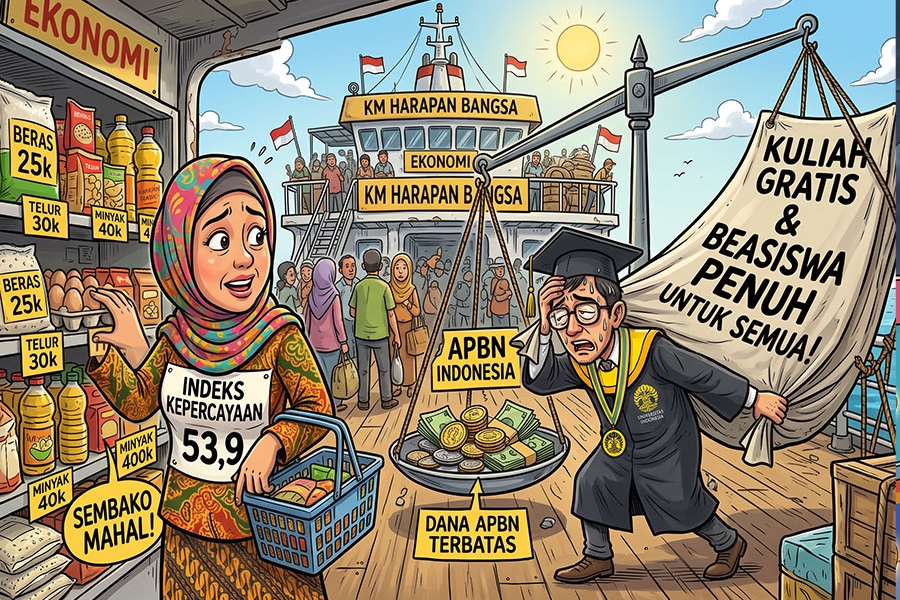
The OECD projects Indonesia's economic growth to reach 5.2% in 2026 and 5.1% in 2027, supported by strong domestic demand. On the consumption side, Indonesia's consumer confidence index reached 53.9 in August 2026, placing Indonesia fifth out of 30 measured countries, although the public remains selective in spending due to concerns over the cost of living and job security. Meanwhile, the discourse on a free tuition program at state universities faces fiscal challenges as it requires an initial budget of Rp93.7 trillion, alongside the need for further studies regarding the sustainability of its funding through the State Budget (APBN)..
The OECD projects Indonesia's economic growth to reach 5.2% in 2026 and 5.1% in 2027, with inflation expected to be at 3% in 2027. This growth is supported by strong domestic demand and government policies that help alleviate energy price pressures. Globally, the OECD forecasts economic growth of 2.9% in 2026 and 3% in 2027, although growth prospects still face several headwinds.
A number of risks that could affect these growth prospects include the Middle East conflict, which potentially disrupts energy supplies and prices, food supply disruptions, as well as the El Niño phenomenon and extreme weather that could pressure agricultural production. Additionally, investment developments in the artificial intelligence (AI) sector are also a concern; while potentially boosting growth and productivity, the high reliance of AI companies on debt, complex financing, and rising credit risks could create vulnerabilities if revenue growth weakens.
Amid growth projections that are still sustained by domestic demand, the condition of Indonesian consumers shows mixed developments. Based on the Ipsos Global Consumer Confidence Index, Indonesia's consumer confidence index reached 53.9 in August 2026, placing the country fifth out of 30 measured countries, up from 10th place in July. However, this increase has not prompted the public to spend aggressively, as concerns regarding the cost of living and job security remain high.
As many as 81% of the public expressed concern over the rising prices of basic necessities, while concerns about unemployment increased to 45% in August 2026 from 35% in April 2026. These conditions compel consumers to remain cautious and selective in determining their expenditures. For companies, this situation means that brand strength alone is increasingly insufficient to drive purchases, making product availability, distribution, and assortment crucial factors. According to Ipsos, market factors have an influence three times greater in Indonesia than the global average in translating changing consumer preferences into actual purchases, with distribution and assortment cited as being more influential than promotions and pricing.
Beyond consumption conditions, attention is also drawn to the government's fiscal space in financing various programs. One of these is the discourse on waiving tuition fees at State Universities (PTN), which requires further study regarding budget requirements, APBN usage priorities, and funding sustainability. President of the Republic of Indonesia has instructed the formulation of a tuition fee waiver scheme, including the elimination of the Single Tuition Fee (UKT) and Institutional Development Fee (IPI) for the independent admission track. The Ministry of Higher Education, Science, and Technology estimates that the initial requirement reaches Rp93.7 trillion, which still needs to be further discussed with the Ministry of Finance.
Several economists highlight the limited fiscal space, one of which is by considering Indonesia's tax ratio in 2025 at 9.3% of GDP. An economist from Universitas Gadjah Mada estimates that the budget required for this policy could reach nearly Rp400 trillion. Meanwhile, utilizing funds recovered from corruption assets as the main financing source is also deemed unsustainable by quoted economists because such revenues are irregular, whereas tuition fees are routine expenditures that must be available every year.
Besides financing capabilities, this policy also raises concerns regarding budget priorities, education quality, lecturer welfare, and the sustainability of Private Universities (PTS). The quoted economists assess that if education costs become a permanent APBN obligation, the government must ensure budget availability every year so that tuition waivers do not negatively impact the funding for lecturers, research, laboratories, and educational services. Thus, discussions on the free tuition program relate not only to fee waivers for students but also to fiscal sustainability and the overall quality of the education system.
Overall, these three news items indicate that Indonesia's economy still has positive growth prospects, with growth projected to remain above 5%. However, these prospects continue to face various risks, both from global conditions—such as conflicts, energy and food supply disruptions, and extreme weather—and from investment developments in the artificial intelligence sector. Domestically, while consumer confidence is indeed rising, cost of living pressures and job security concerns make the public remain cautious and selective in spending their income.
These conditions also run parallel with the government's challenge in managing fiscal space and determining budget priorities. The discourse on free tuition at state universities serves as an example of a policy that requires calculating budget needs, sustainable funding sources, and its impact on education quality and the survival of private universities. Therefore, positive economic growth prospects need to be accompanied by the careful management of various risks, both in terms of public purchasing power and the government's fiscal sustainability.













 tpc.consulting
  tpc.consulting
  info@taxindo.co.id