

Home Tax Literation Customs Law
Tax Literation

Customs Law

Taxindo Prime Consulting • 28 Februari 2026
00:00
Optimized with Google Chrome
Customs Law

In an increasingly integrated era of globalization, international trade activities have become the backbone of national economies. Indonesia, as one of the largest economic powers in Southeast Asia, maintains strict yet dynamic regulations to manage the flow of goods across borders. At the heart of these activities lies the Customs system, managed by the Directorate General of Customs and Excise (DJBC).

Based on Law Number 10 of 1995 concerning Customs, as amended by Law Number 17 of 2006, customs refers to all matters related to the supervision of the flow of goods entering or leaving the customs territory, as well as the collection of import and export duties. Understanding customs law is not just about compliance; it is a strategic necessity to enhance the operational efficiency of your export-import business.


1. Understanding Customs Territory and Customs Areas

Before delving deeper, it is essential to understand the geographical boundaries of Indonesian customs law.

  • Customs Territory: Encompasses the land, waters, and the air space above them, as well as specific locations in the Exclusive Economic Zone (EEZ) and the continental shelf where customs laws apply.
  • Customs Area: Areas with defined boundaries at seaports, airports, or other designated places for the movement of goods, which are entirely under the supervision of the Directorate General of Customs and Excise.

Every item entering the Customs Territory is treated as an imported good and is subject to Import Duty, unless otherwise specified by law.


2. Import Procedures: Bringing Goods into Indonesia

Importing is the activity of bringing goods into the customs territory. Broadly speaking, the import process in Indonesia follows these stages:

A. Document Preparation and Registration

Importers must possess a Business Identification Number (NIB), which functions as the Importer Identification Number (API). Additionally, importers must undergo customs registration to gain access to the Electronic Data Interchange (EDI) system.

B. Customs Declaration (PIB)

Imported goods must be declared using the Import Goods Declaration (PIB). This document contains details of the goods, the customs value (CIF: Cost, Insurance, and Freight), the classification based on the HS Code (Harmonized System), and the amount of taxes to be paid.

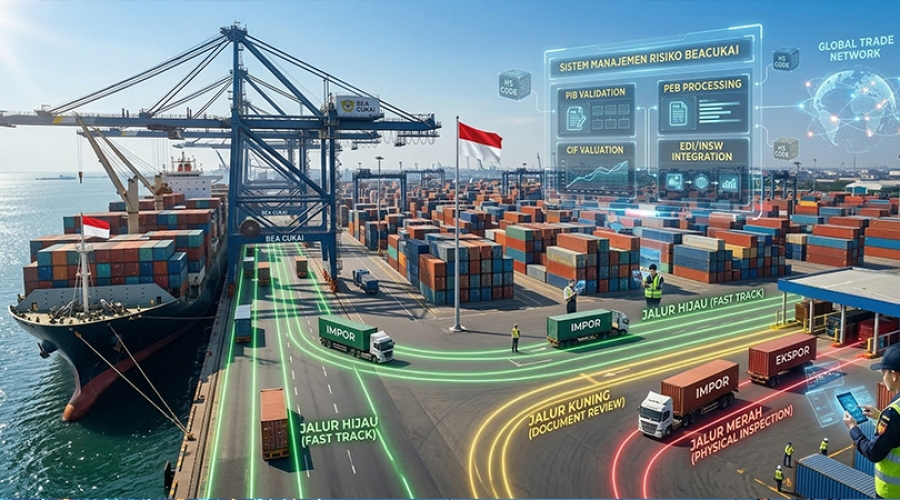
C. Service Channels (Risk Management)

Customs applies a risk management system to determine the level of supervision for imported goods:

  • Green Channel: Goods can be released immediately after the PIB is approved.
  • Yellow Channel: Requires a document examination before the goods are released.
  • Red Channel: Requires a physical inspection of the goods and a document examination.
  • Main Partner (MITA) & AEO: Special channels for importers with a high reputation for compliance.

3. Export Procedures: Sending Products to the Global Market

Exporting is the activity of taking goods out of the customs territory. Indonesia actively encourages export activities through various fiscal incentives.

A. Export Goods Declaration (PEB)

Exporters are required to submit an Export Goods Declaration (PEB). Unlike imports, most exported goods in Indonesia are not subject to Export Duty, except for certain commodities such as palm oil, wood, and raw minerals to support domestic industrial downstreaming.

B. Supervision and Loading

Once the PEB is approved, Customs will issue an Export Service Note (NPE), which serves as the permit for the goods to be loaded onto a transport means (ship or aircraft).


4. Commodity Classification and Customs Valuation

The two main pillars in calculating customs obligations are the HS Code and Customs Value.

  • HS Code: An internationally applicable system for classifying goods. Incorrect HS Code determination can lead to administrative fines or non-tariff barriers (Lartas).
  • Customs Value: The basis for calculating Import Duty. Indonesia primarily uses the transaction value as the base. Discrepancies in value may trigger a unilateral value determination by customs officials (notul).

5. Customs Facilities and Bonded Storage (TPB)

To support manufacturing and export industries, the government provides several facilities:

  • Bonded Zone (Kawasan Berikat): A storage area for imported goods to be further processed, benefiting from Import Duty suspension.
  • Bonded Warehouse (Gudang Berikat): A storage area for distribution purposes with tax suspension.
  • KITE (Import Ease for Export Purpose): A drawback or exemption of Import Duty on imported raw materials where the final products are subsequently exported.

6. Prohibitions and Restrictions (Lartas)

Not all goods can enter or exit freely. Certain categories fall under Prohibitions and Restrictions (Lartas), regulated by relevant technical institutions (such as the Ministry of Trade, Ministry of Health, or BPOM). Lartas supervision is now integrated through the Indonesia National Single Window (INSW) system, which facilitates real-time permit validation.


Conclusion

The world of customs, exports, and imports in Indonesia is undeniably complex, but regulatory compliance is the best investment for business sustainability. By understanding the Customs Law, utilizing available tax facilities, and ensuring data accuracy in PIB/PEB submissions, companies can compete on the international stage with greater confidence.


Taxindo Prime Consulting (TPC) is a firm specializing in tax, accounting, business, and business law consulting.
Taxindo Prime Consulting (TPC) is established as a trusted strategic partner, providing comprehensive solutions in tax consulting, accounting, business development, and business law. Driven by a commitment to integrity and professionalism, TPC is dedicated to delivering more than just standard consultation; we provide education, tactical advice, and concrete solutions. Our services are meticulously designed to analyze and resolve clients' tax and business challenges with objectivity, in-depth insight, and full independence, ensuring both regulatory compliance and long-term business sustainability.
OFFICE
Mega Plaza Building 12th Floor
Jl. H.R. Rasuna Said Kav C-3 Jakarta 12940

Phone :
+62 21 521 2686
+62 817 001 3303

Email :
info@taxindo.co.id
Copyright © 2026 Taxindo Prime Consulting

All content on this website is provided solely for general informational and educational purposes. This information is not intended as a substitute for professional tax advice or consultation specific to your situation. We strongly encourage you to contact our team of consultants directly to receive appropriate guidance and advice.

Taxindo Prime Consulting
Tax and Transfer Pricing Calculator
Tax Calendar
×
Newsletter


