



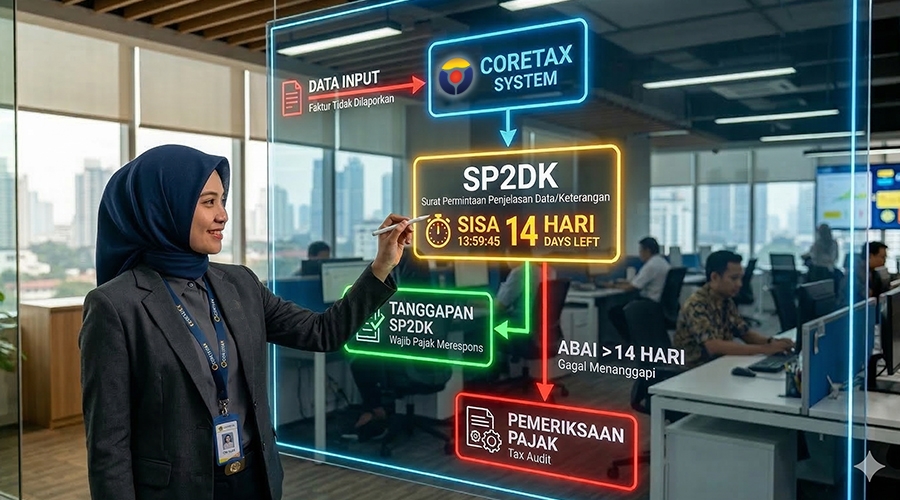
The Directorate General of Taxes (DGT) implements the Coretax system to accelerate digital tax compliance supervision. This system issues SP2DK (Request for Explanation) as an initial clarification letter upon detecting tax data discrepancies. Taxpayers are required to respond to the letter cooperatively within a deadline of 14 calendar days. Ignoring the SP2DK will compel the authorities to escalate the case status to a tax audit or criminal investigation stage. Therefore, taxpayers must manage their documents electronically to effectively mitigate the risk of penalties. .
Under Indonesia's self-assessment system, the Directorate General of Taxes (DGT) has significantly modernized its oversight through the Core Tax Administration System (Coretax). This technology renders tax supervision faster, more integrated, and transparent. For Taxpayers, distinguishing between a "request for clarification" and an "official audit" is vital to mitigating heavy administrative penalties.
Tax supervision and audits are now governed by the KUP Law (as amended by Law No. 6/2023) and specific new regulations:
An SP2DK (Request for Explanation on Data and/or Information) is issued when Coretax’s Early Warning System detects discrepancies between your filings and third-party data.
Per PMK 15/2025, audit types are now more streamlined to ensure time efficiency:
| Audit Type | Scope of Examination | Maximum Duration |
|---|---|---|
| Comprehensive | All items in the Tax Return (SPT) | 5 Months |
| Focused | Specific items in the SPT (in-depth) | 3 Months |
| Specific | Specific items or concrete data (simple) | 1 Month |
| Concrete Data | Obvious and clear data findings | 10 Working Days |
Document Rule: Requested documents must be submitted within 1 month. Late submissions will be disregarded and cannot be used as evidence during subsequent Objection or Appeal processes.
Imagine Coretax detects an unreported input tax invoice:
In the Coretax era, speed, accuracy, and digital footprints are paramount. Receiving a letter from the DGT does not imply guilt, but a slow response will close your legal doors for clarification.
Key Tips for Taxpayers:
Are you currently dealing with an SP2DK or an Audit Letter and need expert analysis to align with the latest tax regulations? Contact us here.


 tpc.consulting
  tpc.consulting
  info@taxindo.co.id