



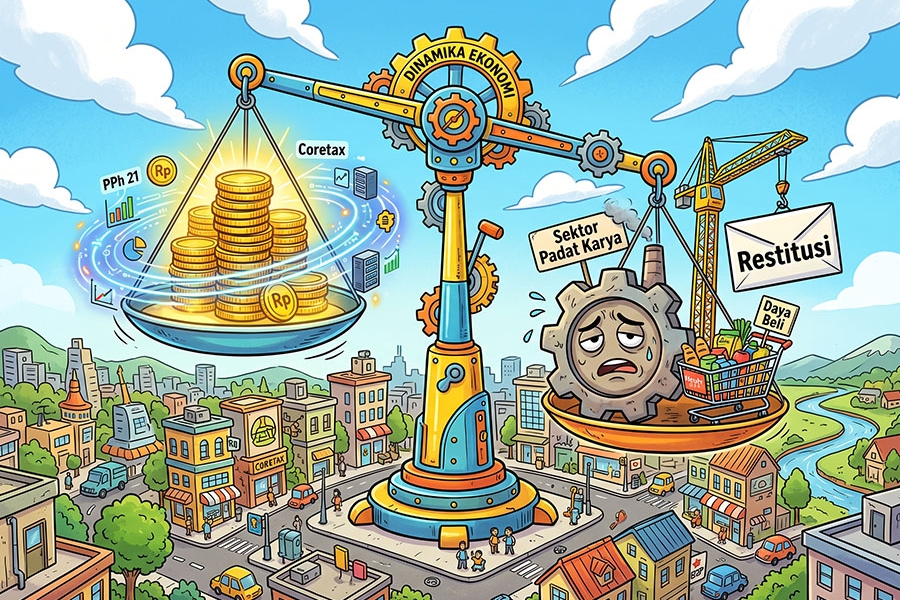
The Ministry of Finance noted that Article 21 Income Tax (PPh 21) revenue grew by 17.4% to Rp171.5 trillion as of August 2026, supported by increased employee income and improvements in tax administration through Coretax. However, this growth does not necessarily reflect an even improvement in worker welfare amidst ongoing layoffs. On the other hand, the government has allocated Rp632 trillion in tax incentives for 2027 to support purchasing power, consumption, and investment, while aligning the incentive scheme with the implementation of the Global Minimum Tax. Meanwhile, large amounts of withheld VAT (PPN) restitutions are burdening the cash flows of construction entities, prompting business actors to expect concrete solutions and timeline certainty for restitution settlements..
The Ministry of Finance noted that Article 21 Income Tax (PPh 21) revenue grew by 17.4% to Rp171.5 trillion as of August 2026, supported by increased employee income and improvements in tax administration through Coretax. However, this growth does not necessarily reflect an even improvement in worker welfare amidst ongoing layoffs. On the other hand, the government has allocated Rp632 trillion in tax incentives for 2027 to support purchasing power, consumption, and investment, while aligning the incentive scheme with the implementation of the Global Minimum Tax. Meanwhile, large amounts of withheld VAT (PPN) restitutions are burdening the cash flows of construction entities, prompting business actors to expect concrete solutions and timeline certainty for restitution settlements.
Article 21 Income Tax (PPh 21) revenue reached Rp171.5 trillion as of August 31, 2026, growing by 17.4% year-on-year. The Ministry of Finance stated that this growth was supported by improvements in the administrative system through Coretax and increases in employee income. However, the rise in PPh 21 revenue cannot be directly interpreted as an even improvement in worker welfare. During the same period, the Ministry of Manpower recorded that 53,490 workers reported being laid off through the Job Loss Guarantee (JKP) system from January to August 2026, while household consumption in the second quarter of 2026 grew by 5.06%.
This discrepancy indicates that the growth in PPh 21 revenue needs to be viewed alongside employment conditions and public purchasing power. The increase in tax revenue may be driven by income hikes among specific groups of workers and improved tax administration, whereas low-income workers, including those in labor-intensive sectors and those affected by layoffs, make a relatively small contribution to PPh 21. Thus, the growth of PPh 21 does not necessarily reflect an increase in the welfare of all workers, as income developments and economic conditions can vary across different societal groups.
The divergence between tax revenue growth and the public's economic condition suggests that tax policies must be viewed in tandem with broader fiscal policies.
This situation highlights that the increase in tax revenue must be considered alongside government policies aimed at maintaining economic activity and public purchasing power. In a broader context, the government plans to provide Rp632 trillion in tax incentives in 2027, equivalent to 2.26% of the Gross Domestic Product (GDP). These incentives are directed at various groups, with the largest allocation going to households at Rp335.2 trillion, followed by MSMEs at Rp112.4 trillion, the investment climate at Rp99.6 trillion, and the business sector at Rp63.4 trillion. The government utilizes tax expenditures as an instrument to spur economic growth to 6% and investment growth to 7% in 2027. However, the provision of incentives also affects the tax-to-GDP ratio, as a portion of potential revenue remains uncollected. According to the Minister of Finance, the uncollected funds from these incentives remain circulating within the economy and are expected to bolster consumption and investment.
On the other hand, the government is aligning its tax incentive policies with the implementation of the 15% Global Minimum Tax (GMT). The Ministry of Finance is reviewing changes to tax holiday provisions and exploring various alternative incentives that comply with global minimum tax commitments, including the Qualified Refundable Tax Credit (QRTC) and exemptions from specific import duties or taxes. The government is also studying the provision of Income Tax (PPh) and Value Added Tax (VAT) facilities on outsourcing services for the textile and textile product (TPT) industry to support this labor-intensive sector. Therefore, tax incentive policies are not only related to efforts to attract investment and sustain economic activity, but must also be harmonized with the government's efforts to maintain revenue and strengthen the tax ratio.
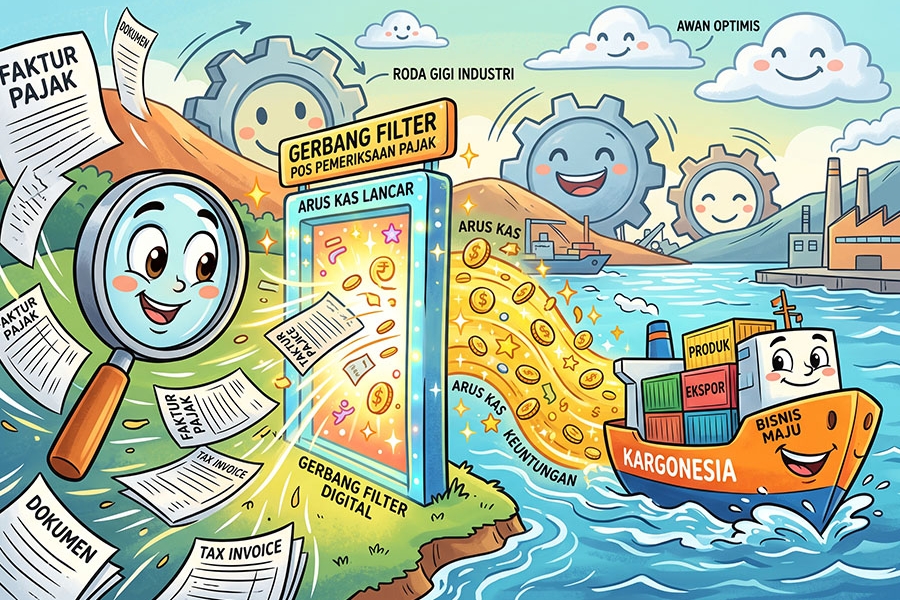
Amid the government's efforts to maintain economic activity through fiscal policies, taxation issues remain a concern for the business world, particularly regarding the disbursement of restitutions. The Indonesian Contractors Association (AKI) revealed that delayed disbursements of Value Added Tax (VAT) restitutions are beginning to burden the cash flows of national construction entities. The process from submission to the disbursement of restitutions on the ground often takes more than a year, thereby draining the working capital needed to finance project operations. This condition places further pressure on contractors, as the construction industry is facing surging building material prices and relatively thin project profit margins.
A number of state-owned (BUMN) and private contractors reportedly have substantial withheld restitutions, including PTHK (Persero) at Rp3.4 trillion, PT SBCK at Rp1 trillion, and PTNIKAR (Persero) at Rp300 billion. With profit margins of around 2%–3%, the withholding of 11% VAT funds can force companies to seek alternative, high-cost financing to maintain project continuity. AKI assesses that these cash flow disruptions could impact projects, supply chains, and the workforce. The construction services sector currently employs approximately 8.7 million workers, and there are concerns that the risk of contractor bankruptcies could have a systemic impact on more than 35 million people through economic multiplier effects. Therefore, business actors are hoping for concrete solutions and timeline certainty for the settlement of tax restitutions for the national construction industry.
Conclusion
This series of developments indicates that tax policies are not only about increasing state revenue but also about their impact on the public and the business sector. The 17.4% growth in Article 21 Income Tax up to August 2026 does not directly reflect an improvement in the welfare of all workers. At the same time, the government is preparing Rp632 trillion in tax incentives for 2027 to support consumption and investment, although this policy also affects the tax-to-GDP ratio. On the business side, the withholding of VAT restitutions demonstrates that the tax administration process can also directly impact corporate liquidity and working capital.
Thus, the evolution of these three issues highlights the importance of balancing tax revenue optimization, the provision of fiscal support, and certainty in the execution of tax rights and obligations. Tax policies are expected not only to support state revenue but also to remain attentive to the public's economic conditions and the liquidity needs of the business world. This balance is crucial to ensure that tax policies run parallel with efforts to sustain consumption, investment, and the continuity of economic activities.














 tpc.consulting
  tpc.consulting
  info@taxindo.co.id