



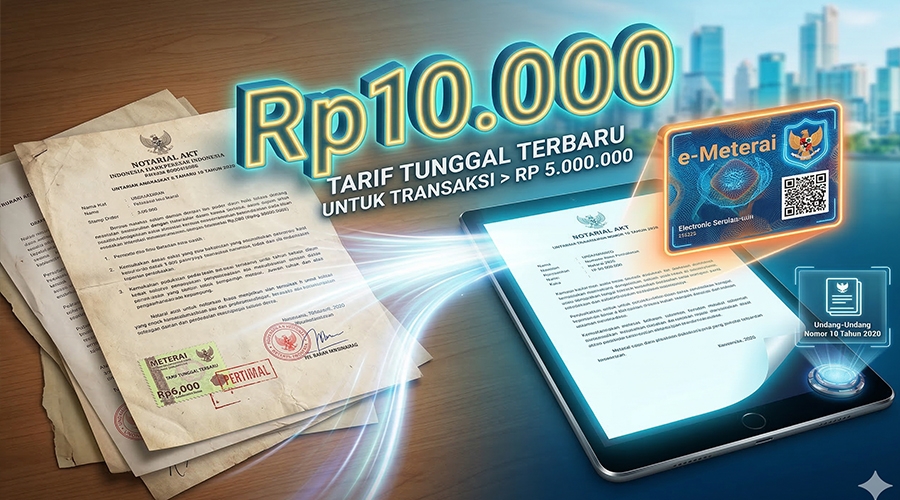
Stamp Duty (Bea Meterai) is a tax on documents that has been an integral part of legal and business administration in Indonesia for decades. In line with the massive digital economic transformation, the Government of Indonesia implemented fundamental reforms through the enactment of Law Number 10 of 2020 concerning Stamp Duty.
This new regulation replaces the old framework that had been in place for over 30 years (Law No. 13 of 1985). This change is not merely a rate adjustment but a legal repositioning to accommodate electronic documents that now dominate modern transactions. This article will thoroughly explore everything you need to know about Stamp Duty in this new era.
One of the most significant leaps in Law No. 10 of 2020 is the legal recognition of electronic documents. Previously, Stamp Duty was synonymous with paper and physical stickers. Now, the objects of Stamp Duty include:
This provides legal certainty for e-commerce players, digital banking, and international contracts conducted virtually.
Unlike the old system which had two rates (IDR 3,000 and IDR 6,000), the latest regulation enforces a Single Tariff of IDR 10,000. This policy aims to provide simplicity and certainty for the public.
Furthermore, the threshold for the nominal value of documents subject to Stamp Duty has been increased. While previously documents valued above IDR 250,000 were taxed, now only documents stating a value of over IDR 5,000,000 are mandatory subjects for Stamp Duty. Documents below this nominal value are no longer taxable objects, reflecting the government's support for Micro, Small, and Medium Enterprises (MSMEs).
Broadly speaking, documents that must be stamped include:
To support digital documentation, the government introduced the Electronic Stamp (e-Meterai). This stamp features a unique code and specific information regulated by the Minister of Finance. Its use is facilitated through official portals integrated with electronic signature systems. This simplifies the validation of document authenticity without time-consuming physical processes.
Subsequent Stamping is a procedure for documents for which the Stamp Duty was not paid or was underpaid, or for documents to be used as evidence in court. Under the latest law, the administrative penalty for subsequent stamping has been reduced to 100% of the unpaid duty, down from the previous 200%. This allows the public to rectify their administrative compliance with a lighter financial burden.
The government also provides exemptions from Stamp Duty for specific conditions to support social programs and economic recovery, including:
It is crucial for individuals and corporations to understand that failing to fulfill Stamp Duty obligations does not invalidate the legal validity of an agreement under civil law. However, the document cannot be used as valid evidence in court until subsequent stamping is performed. Additionally, forging stamps or reusing old stamps are serious criminal offenses punishable by imprisonment and significant fines.
The new Stamp Duty Law is a reflection of Indonesia's legal adaptation to technological advancement. By understanding the distinction between physical and electronic documents, as well as the applicable single tariff, the public can manage their legal administration more efficiently and remain tax-compliant. The digital era demands transparency, and e-Meterai is the answer to those challenges.


 tpc.consulting
  tpc.consulting
  info@taxindo.co.id