



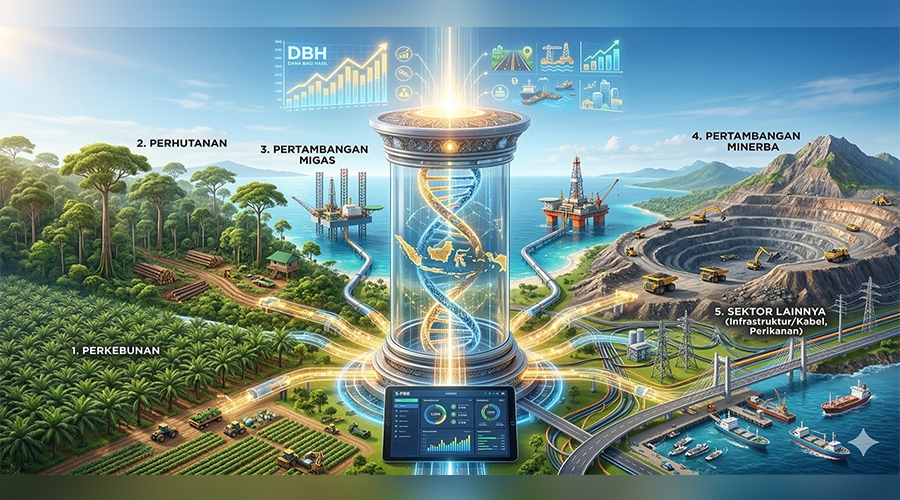
Land and Building Tax (Pajak Bumi dan Bangunan/PBB) in Indonesia serves as a vital fiscal instrument for national development. Following the regulatory transformation through the Law on Financial Relations between the Central Government and Regional Governments (UU HKPD), the management of PBB has been clearly bifurcated. While Rural and Urban PBB (PBB-P2) is managed by local governments, the central government—through the Directorate General of Taxes (DGT)—retains authority over strategic sectors known as PBB P5L.
PBB P5L encompasses Plantations, Forestry, Oil and Gas Mining, Geothermal Mining, Mineral or Coal Mining, and Other Sectors. This article provides a comprehensive overview of the characteristics, valuation bases, and the crucial role each sector plays within Indonesia's economic framework.
The Plantation sector in PBB P5L covers taxable objects in the form of land and buildings located within areas used for plantation business activities.
PBB for the Forestry sector is levied on objects used for forestry business activities, encompassing both natural forests and plantation forests.
As one of the largest contributors to national revenue, the Oil and Gas (Migas) sector is subject to highly specific tax treatment under the Production Sharing Contract (PSC) scheme.
This sector shares similar characteristics with Oil and Gas but focuses on the utilization of renewable energy from geothermal sources.
The Minerba sector is the most dynamic P5L category, covering the mining of metallic minerals, non-metallic minerals, rocks, and coal.
The "Other Sectors" category in P5L serves as a "catch-all" for strategic tax objects that do not fall under the P2 (regional) category but are not purely natural resources.
PBB P5L is more than just a financial obligation for businesses; it is a mechanism for the distribution of national wealth. Funds collected through PBB P5L are redistributed to regional governments through the Revenue Sharing Fund (Dana Bagi Hasil/DBH). This ensures that regions rich in natural resources receive economic compensation for infrastructure development and the welfare of local communities.
The government is currently accelerating digitalization through the S-PBB (PBB Information System) to facilitate registration, electronic reporting (e-SPOP), and payments. The accuracy of spatial data via GIS (Geographic Information System) integration is key to preventing overlapping land claims between the plantation and mining sectors.
Understanding PBB P5L is the first step for practitioners, academics, and business actors to navigate tax regulations in Indonesia's strategic sectors. With its broad scope and technical valuation methods, PBB P5L remains the most stable fiscal instrument in maintaining economic sovereignty over the land, water, and natural riches contained therein.


 tpc.consulting
  tpc.consulting
  info@taxindo.co.id