



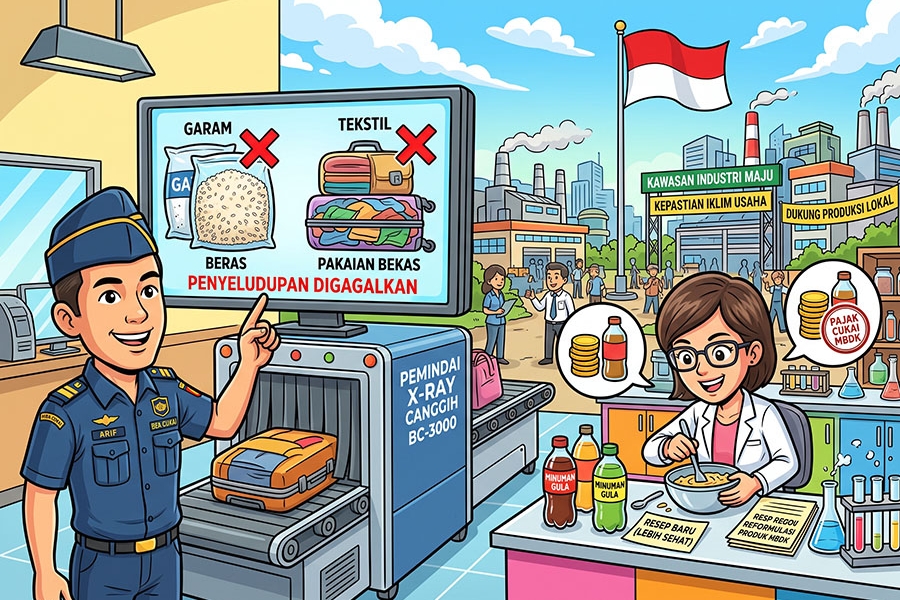
The government is considering various tax incentive schemes as alternatives to replace the tax holiday in line with the implementation of the Global Minimum Tax, without reducing national investment attractiveness. On the other hand, the Directorate General of Customs and Excise is strengthening supervision over the circulation of illegal imported goods, including rice and used clothing, with the value of Enforcement Result Goods (BHP) reaching Rp12.16 trillion as of September 21, 2026. Additionally, the Indonesian House of Representatives (DPR RI) and the government have agreed to increase the excise revenue target in the 2027 Draft State Budget (RAPBN) to Rp237.21 trillion, while the excise policy on Packaged Sweetened Beverages (MBDK) is still in the design evaluation stage and is targeted to contribute around Rp1.6 trillion
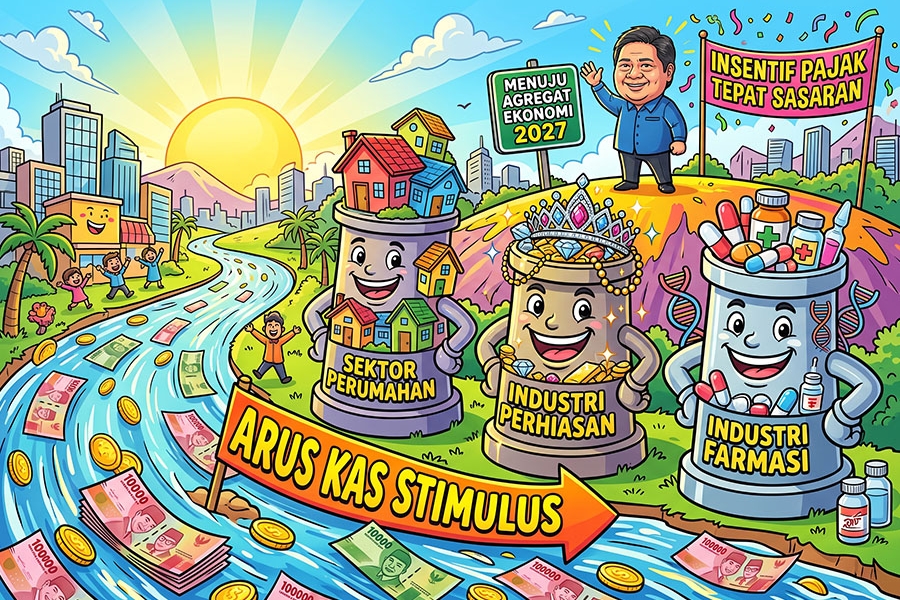
The Indonesian government is considering various tax incentive schemes as an alternative to the Corporate Income Tax (PPh Badan) reduction facility, or tax holiday, to maintain investment interest. This policy is being prepared in line with the implementation of the Global Minimum Tax (GMT) based on Minister of Finance Regulation (PMK) No. 136 of 2024. Under the GMT provisions, Indonesia has a taxing right of 15% on global corporations with a turnover of at least EUR 750 million per year, thus requiring the government to adjust the form of its incentives to align with international tax commitments.
One of the options being considered is the Qualified Refundable Tax Credit (QRTC) or other forms of incentives compatible with the OECD/G20 Pillar 2. However, the government has not designated QRTC as the sole replacement for the tax holiday, as it is still reviewing various forms of incentives. In addition to tax incentives, the government is also considering business facilitations, such as expediting licensing processes and exempting import duties and taxes for specific products, goods, or transactions.
Beyond restructuring incentive policies to maintain investment attractiveness, the government is also continuously strengthening supervision over the flow of goods entering Indonesian territory.
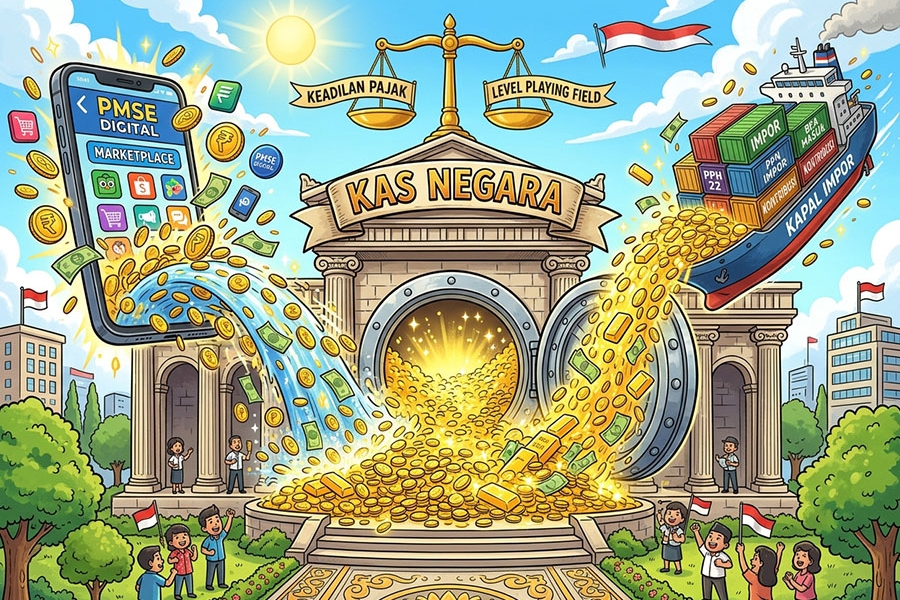
The Directorate General of Customs and Excise of the Ministry of Finance recorded that the value of Enforcement Result Goods (BHP) related to customs violations reached Rp12.16 trillion as of September 21, 2026. These enforcements cover various violations, including illegal imports of used clothing, rice, salt, and other goods. In one case, Customs discovered 30 containers holding imported rice valued at approximately Rp15.85 billion.
The government assesses that the prevalence of illegal imported goods is driven by high domestic market demand and limited supervision in several border areas and entry points. The government is also pushing for stronger supervision through the utilization of technology, examination of documents and Harmonized System (HS) codes, and the enhancement of Customs officers' integrity. These enforcements are necessary to reduce potential losses in state revenue and to protect domestic business competition and industries from the impacts of the shadow economy.
In addition to strengthening supervision over illegal imported goods, the government continues to optimize state revenue through policies in the excise sector. The Budget Committee of the DPR RI, together with the government, agreed on an increase in the excise revenue target in the 2027 RAPBN from Rp235.26 trillion to Rp237.21 trillion, an increase of 0.82%. One of the factors driving this target increase is the inclusion of the Packaged Sweetened Beverages (MBDK) excise policy in the 2027 RAPBN.
The government estimates that MBDK excise revenue in 2027 will reach approximately Rp1.6 trillion. However, the government is still evaluating the design of this policy, including considering the sugar, salt, and fat content in the products that will be subject to the excise. This MBDK revenue target is also lower than the 2026 target of Rp7.6 trillion.
The government is restructuring various policies in the fields of taxation, customs, and excise to safeguard state revenue while supporting economic activities. Adjustments to investment incentives are being made in line with the implementation of the Global Minimum Tax, while the strengthening of customs supervision is directed at suppressing the circulation of illegal imported goods that potentially reduce state revenue and affect business competition. On the other hand, the government and the DPR RI have agreed on an increase in the 2027 excise revenue target, with the MBDK excise policy becoming one of the policies included in the 2027 RAPBN.
These three developments indicate the government's policy adjustments in response to the changing tax and trade environments. The government is still reviewing various alternative incentives to replace the tax holiday, strengthening supervision over the traffic of goods, and evaluating the design of the MBDK excise, including the products that will be subject to it. These policy developments need to be proactively monitored by business actors as they can affect taxation, customs, and excise aspects in their business operations.












 tpc.consulting
  tpc.consulting
  info@taxindo.co.id