




The Directorate General of Taxes (DJP) recorded 15,015 taxpayers applying for administrative sanction reductions or eliminations (PSA). Through PMK Number 71 of 2026 and KEP-239/PJ/2026, the government is providing up to a 100% penalty reduction under specific conditions. However, this policy is running head-on into the challenge of supervising Voluntary Disclosure Program (PPS) participants suspected of failing to meet their disclosure and repatriation commitments, with indicated asset values exceeding Rp406 trillion..
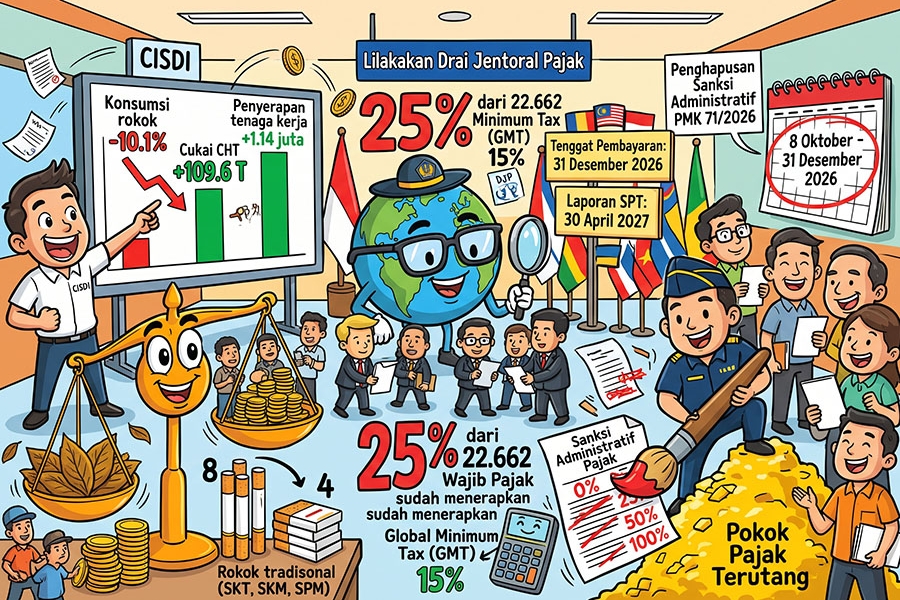
The government is deploying the Administrative Sanction Reduction or Elimination (PSA) facility to ease taxpayer burdens while accelerating the settlement of tax obligations. The DJP noted that 15,015 taxpayers have already applied for this facility. Regulated under Minister of Finance Regulation (PMK) Number 71 of 2026—which refines PMK Number 118 of 2024 and took effect on October 2, 2026—the technical implementation is further detailed in the Director General of Taxes Decree Number KEP-239/PJ/2026.
The PSA facility covers several categories, including penalty reductions for late Annual Income Tax Return (SPT) submissions up to Tax Year 2025. A 100% sanction reduction is granted if the SPT is submitted between October 8 and December 31, 2026. This reduction drops to 50% for submissions from January 1 to March 31, 2027, and 25% for April 1 to June 30, 2027. Crucially, the utilization of this facility does not waive the fundamental obligation to pay the principal tax owed.
Additionally, KEP-239/PJ/2026 regulates administrative sanction reductions for Voluntary Disclosure Program (PPS) participants whose undisclosed or under-disclosed assets are subsequently discovered through active tax audits. Reductions apply to administrative interest penalties (Article 13(2)) and surcharges (Article 15(2)) under the General Provisions and Tax Procedures (KUP) Law. The discount reaches 100% if the principal tax is paid within one month of the tax assessment letter (SKPKB/SKPKBT) issuance, 50% if paid between one and two months, and 25% after two months. Eligible tax assessment letters must be issued between October 8, 2026, and December 31, 2027, with the principal tax paid no later than December 31, 2027.
Despite the sweeping relief, this facility is not a new tax amnesty program. For PPS participants, it does not reopen the door for voluntary asset disclosure without an audit. Taxpayers must meet strict requirements, including waiving the right to file lawsuits or other legal remedies, or withdrawing existing ones. The facility strictly aims to reduce the administrative sanction burden on eligible tax obligations, not to erase the principal tax.
Concurrently, the DJP faces massive hurdles in enforcing initial PPS participant commitments. Based on DJP data reported to Kontan in May 2026, 2,424 taxpayers have allegedly failed to realize their foreign asset repatriation commitments worth Rp23 trillion. Furthermore, 35,644 taxpayers are suspected of failing to disclose or under-disclosing assets worth approximately Rp383 trillion. In total, the value of indicated undisclosed or unrepatriated assets exceeds a staggering Rp406 trillion.
PPS participants failing to meet commitments can be aggressively pursued by the DJP under prevailing tax regulations, including the issuance of warning letters and the imposition of additional final income tax (PPh final) under PMK Number 196 of 2021. Therefore, granting sanction reductions must run perfectly parallel with strict oversight and compliance enforcement. The DJP must differentiate between unintentional administrative errors and deliberate, repeated non-compliance to ensure fairness for taxpayers who have fully met their obligations.
For taxpayers, this facility offers a strategic opportunity to settle outstanding obligations with a significantly lighter administrative burden. However, settling the principal tax remains a primary hurdle for those facing liquidity constraints. For PPS Policy II participants, the principal tax—which can reach 30% of the under-disclosed net assets—represents a massive financial burden, as KEP-239/PJ/2026 only mitigates the administrative sanctions. Tax consultants note that clients currently undergoing audits are hoping their tax assessment letters are issued swiftly so they can settle the principal and secure the 100% sanction reduction before December 31, 2026. While some taxpayers target this date for immediate relief, the ultimate deadline for principal payment under KEP-239/PJ/2026 remains December 31, 2027.
Another operational challenge is the DJP's limited time and capacity to audit all taxpayers flagged for unmet PPS commitments. Tax observers assess that fully deploying the new Coretax system and leveraging the Automatic Exchange of Information (AEoI) will significantly bolster the tax authority's ability to detect asset discrepancies. Furthermore, the planned 2027 implementation of the Crypto-Asset Reporting Framework (CARF) will expand visibility into digital assets. Nevertheless, supervision must be prioritized based on data quality and risk levels, targeting cases with robust evidence of non-compliance.
Ultimately, the success of the PSA policy will not be measured merely by the volume of reduction applications, but by the actual cash settlement of tax obligations and the strict enforcement of PPS commitments. The government must strike a delicate balance between offering incentives, maintaining legal certainty, and enforcing the rules, ensuring that relief facilities do not undermine supervisory effectiveness or erode the sense of justice for inherently compliant taxpayers.

















 tpc.consulting
 tpc.consulting
 info@taxindo.co.id