




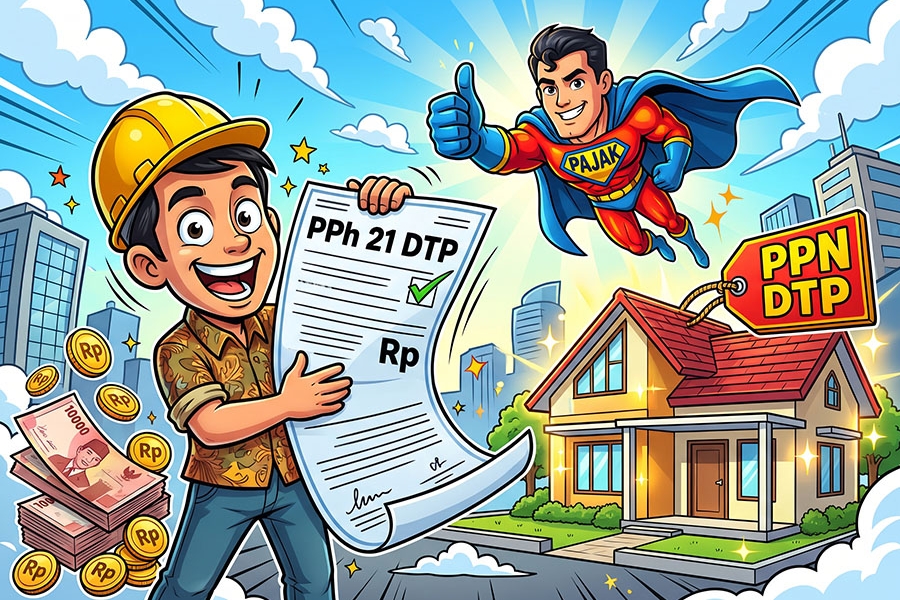
The government is formulating a Government-Borne Income Tax (PPh DTP) incentive of up to Rp10 million as a direct intervention to strengthen the purchasing power of the middle class. This program is planned to encompass all sectors and forms part of a broader economic safety net currently under preparation. This move has drawn significant attention following reports that 9.5 million to 11 million Indonesians have experienced downward economic mobility in recent years. However, the government has yet to release the detailed mechanisms and specific eligibility requirements for this incentive.
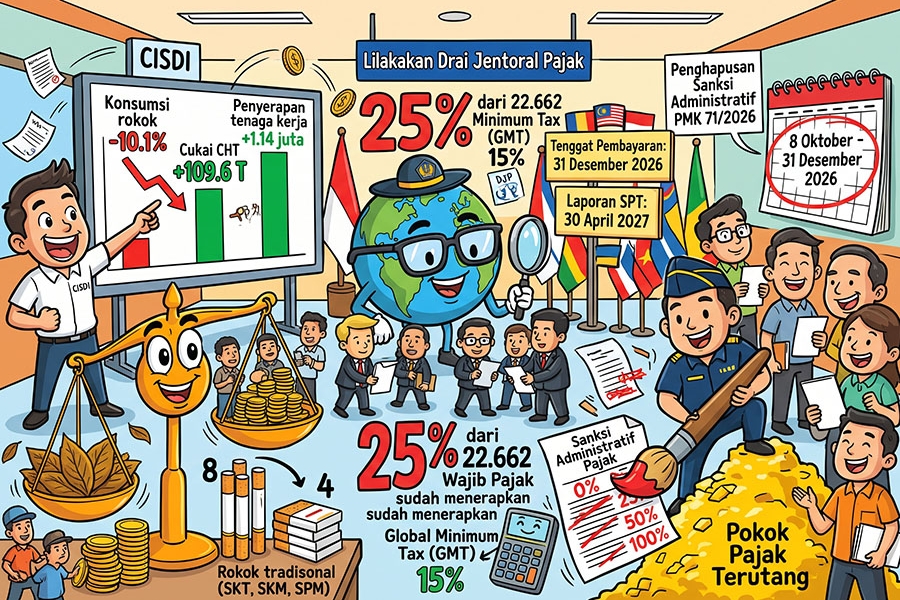
While attempting to sustain public consumption, the government must simultaneously safeguard state revenue, particularly from Tobacco Excise (CHT). The phenomenon of "downtrading"—where consumers shift to cheaper cigarette tiers—has emerged as a primary threat to excise targets. Data indicates that the market share of Tier I Machine-Rolled Clove Cigarettes (SKM) plummeted from 64% in 2018 to just 29% by August 2026. This shift severely skews revenue composition because lower-tier tobacco products are subject to significantly lower excise tariffs.
Interestingly, national tobacco production actually increased by 5.5% to 235.3 billion sticks by September 2026 compared to the same period last year. Yet, this production bump has not erased the revenue shortfall. CHT realization currently stands at Rp159.5 trillion, or 70.7% of the Rp225.7 trillion State Budget target. The government projects year-end revenue at Rp223.2 trillion, while CORE Indonesia offers a more conservative estimate of Rp213 trillion to Rp219 trillion. In contrast, CITA optimistically projects realization could hit 101% to 102% of the target. To secure future revenues, observers are urging a gradual simplification of the excise tariff structure, narrowing the gaps between tiers, and intensifying crackdowns on the circulation of illegal cigarettes.
Public scrutiny over tax policies has also recently pivoted toward the imposition of VAT on sanitary pads. The DJP clarified that sanitary pads traded in Indonesia are classified as Taxable Goods (BKP) and are subject to VAT as long as their distribution meets standard tax provisions. For non-luxury goods, the government applies a 12% VAT rate with a Tax Imposition Base (DPP) set at 11/12 of the selling price, resulting in an effective VAT burden of exactly 11%.
The DJP emphasized that sanitary pads are not currently included in the category of goods eligible for VAT exemption under prevailing laws. This tax is not a specific levy targeting women or menstruation, but rather a standard application of the VAT system on general consumable goods. To date, no official study or proposal has been submitted to the government advocating for a VAT exemption on these products. Any future discussions regarding exemptions would need to rigorously evaluate product characteristics, tax regulations, and the broader societal impact.
Ultimately, the government must rapidly clarify the PPh DTP mechanisms so that both the public and business sectors understand the eligibility criteria and can factor this relief into their financial planning. Concurrently, evaluating the tobacco excise tariff structure and addressing public concerns over consumption taxes on essential sanitary products will be critical. Navigating these interconnected issues requires transparent policymaking and regulatory certainty to successfully balance the urgent need for state revenue with the imperative to protect public purchasing power.













 tpc.consulting
 tpc.consulting
 info@taxindo.co.id