


A series of tax and excise policy developments took center stage at the end of October 2026. The Center for Indonesia’s Strategic Development Initiatives (CISDI) is pushing for an increase in Tobacco Excise (CHT) rates and tariff simplification, projected to boost state revenue and yield positive economic impacts. Meanwhile, the Directorate General of Taxes (DJP) noted that only about 25% of eligible taxpayers have begun implementing the Global Minimum Tax (GMT) regulations. Concurrently, the Ministry of Finance is offering up to a 100% reduction or elimination of administrative tax sanctions under specific conditions, without waiving the principal tax debt..
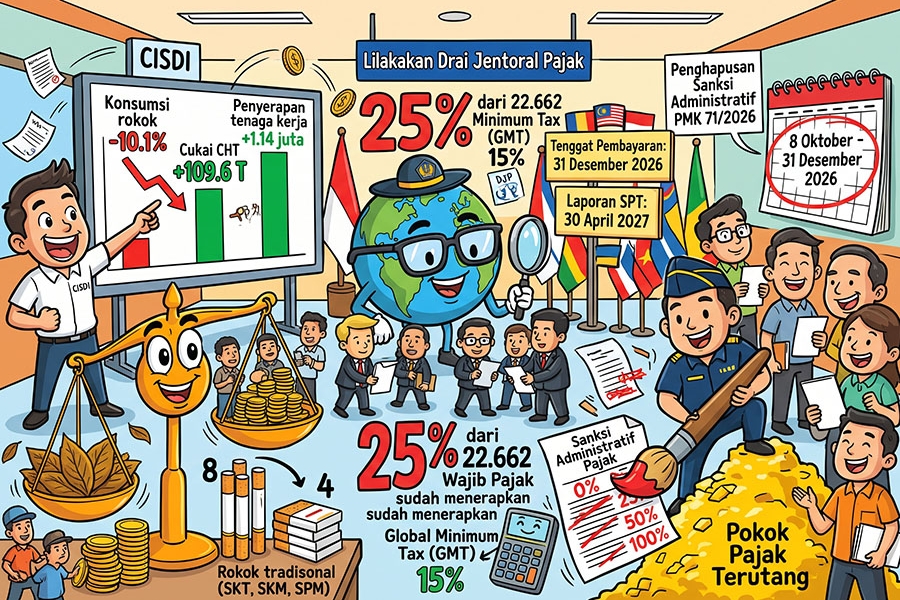
The Center for Indonesia’s Strategic Development Initiatives (CISDI) is urging the government to increase the Tobacco Excise (CHT) tariff while simplifying the tariff tiers for Hand-Rolled Clove Cigarettes (SKT), Machine-Rolled Clove Cigarettes (SKM), and Machine-Rolled White Cigarettes (SPM) from eight tiers down to four. Based on CISDI's research, this reform—featuring an average tariff hike of 50%—is projected to reduce cigarette consumption by 10.1% while adding Rp109.6 trillion to excise revenue. The policy is also estimated to increase economic output by Rp315.1 trillion, boost household income by Rp81.7 trillion, and potentially create around 1.14 million new jobs. CISDI assesses that the economic impact must be viewed comprehensively, considering shifts in household spending patterns and the long-term transitional needs of tobacco sector workers.
From a public support perspective, a CISDI survey of 500 respondents indicated that roughly seven out of ten support the hike in excise and cigarette prices. Notably, this support was also found among active smokers, with 64% expressing approval for the price increase policy. CISDI views these findings as solid backing for the government to proceed with excise reforms. However, implementation faces steep hurdles, including conflicts of interest between public health protection and tobacco industry sustainability, resistance from other government agencies, limited resources for evidence-based studies, and inconsistent leadership commitments. Consequently, CISDI urges the government to strengthen cross-sector coordination and draft a clear, transparent economic transition roadmap for tobacco workers.
On the international taxation front, the Ministry of Finance's DJP recorded that 5,757 out of 22,662 taxpayers covered by the Global Minimum Tax (GMT) provisions have begun implementing the regulations as of October 20, 2026. This figure equates to approximately 25% of the total eligible taxpayers, originating from 1,988 multinational corporate groups. These provisions apply to multinational groups meeting a consolidated revenue threshold of at least EUR 750 million based on the preceding fiscal year, as determined by GloBE rules. The DJP is urging covered taxpayers to verify their status, prepare consolidated group data, and carefully observe their obligations regarding additional tax payments.
The GMT aims to prevent profit shifting to low-tax jurisdictions through the application of a 15% minimum effective tax rate based on Global Anti-Base Erosion (GloBE) calculations. The implementation relies on three primary mechanisms: the Qualified Domestic Minimum Top-up Tax (QDMTT), the Income Inclusion Rule (IIR), and the Undertaxed Profits Rule (UTPR). Indonesia has enforced QDMTT and IIR since January 1, 2025, and UTPR since January 1, 2026, under Minister of Finance Regulation (PMK) Number 136 of 2024.
For the 2025 GMT tax year for groups using a calendar financial year, the general payment deadline falls on December 31, 2026. Following payment, taxpayers must submit their Annual Income Tax Returns under the GloBE framework no later than April 30, 2027, with a possible extension to June 30, 2027. Covered multinational companies must therefore ensure data readiness and compliance to meet these impending payment and reporting deadlines.
Alongside these developments, the Ministry of Finance is offering facilities for the reduction or elimination of administrative tax sanctions based on PMK Number 71 of 2026 and the Director General of Taxes Decree Number KEP-239/PJ/2026. The government stressed that this facility is neither a tax amnesty nor a blank pardon, as the principal tax owed must still be paid in full. The available sanction reductions range from 25%, 50%, to 100%, depending on the type of sanction, requirements, and applicable periods.
For specific categories, a 100% reduction can be granted for late reporting fines and late payment interest on Annual Tax Returns up to Tax Year 2025 and Periodic Tax Returns up to September 2026, provided they meet the criteria, including an underpayment status. The settlement or reporting period to obtain this maximum facility runs from October 8 to December 31, 2026.
Based on KEP-239/PJ/2026, relaxation periods for categories regulated in this policy can extend to June 30, 2027, or December 31, 2027, including certain provisions related to the Voluntary Disclosure Program (PPS) Policy II. However, these deadlines do not imply that all types of sanctions receive a 100% waiver until the end of the relaxation period. Taxpayers must pay close attention to the specific conditions applying to each sanction category. The facility is not granted automatically; applications must be submitted according to the established procedures.
These three developments carry distinct implications for the business world. CISDI's proposed tobacco excise reform highlights potential revenue and economic gains while necessitating transitional safety nets for tobacco workers. The GMT implementation requires eligible multinational groups to consolidate data, calculate potential top-up taxes, and meet strict reporting obligations. Concurrently, the administrative sanction reduction facility offers conditional relief for non-compliant taxpayers, though companies must thoroughly review their outstanding obligations, ensure principal payments, and strictly adhere to application deadlines to properly manage their tax risks.














 tpc.consulting
 tpc.consulting
 info@taxindo.co.id