


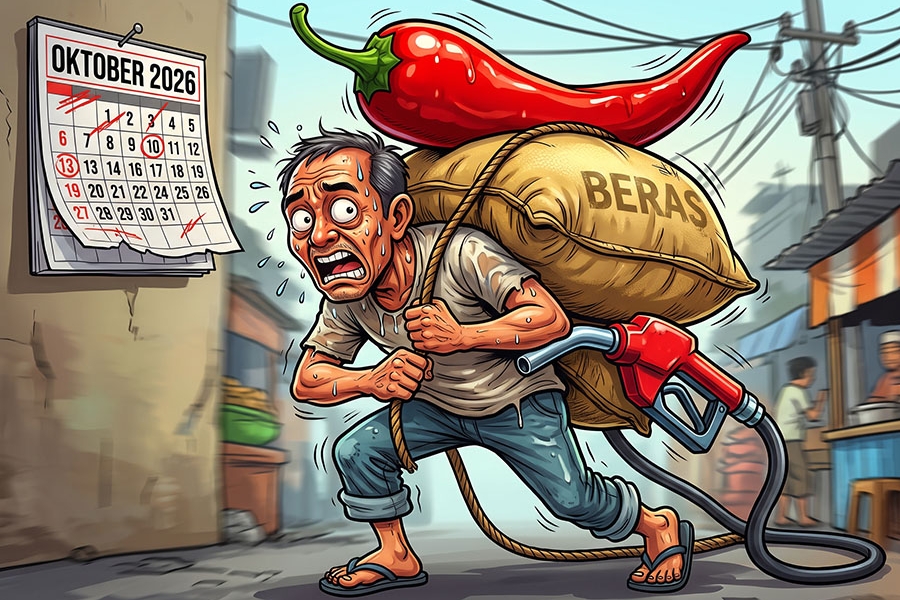
Indonesia's inflation in October 2026 eased to 0.22% on a monthly basis, yet annual inflation remained elevated at 3.23%. Surging prices in food, transportation, and gold jewelry were the primary catalysts influencing price developments. Conversely, the personal care and other services group actually experienced deflation for two consecutive months..
The Central Statistics Agency (BPS) recorded Indonesia's October 2026 monthly (month-to-month/MtM) inflation at 0.22%, lower than September 2026's 0.30%. On an annual basis (year-on-year/YoY), inflation reached 3.23%, while calendar year (year-to-date/YtD) inflation was recorded at 2.40%. The BPS Deputy for Distribution and Services Statistics explained that the Consumer Price Index (CPI) rose from 112.31 in September to 112.56 in October 2026. This realization fell slightly below the median projection of 11 economists and analysts in the BIG Consensus Insights, who had forecasted a monthly inflation rate of 0.24% and an annual rate of 3.25%. These results indicate that the pace of price increases is beginning to decelerate, although pressure from specific commodities warrants continued scrutiny.
The food, beverage, and tobacco group became the largest contributor to monthly inflation, recording a 0.51% inflation rate and a 0.15 percentage point contribution. Red chilies contributed 0.13 percentage points, followed by cayenne peppers at 0.05 percentage points and tomatoes at 0.04 percentage points. Based on the components driving inflation, volatile foods recorded a 0.77% inflation rate (0.13 percentage point contribution). Meanwhile, the core component experienced 0.12% inflation (0.07 percentage point contribution), and administered prices saw a 0.09% increase (0.02 percentage point contribution). Bank Indonesia previously explained that food price hikes were driven by production declines in several agricultural centers due to weather disruptions and rising production costs. This situation underscores that food supply and distribution logistics remain critical factors in maintaining price stability.
Annually, three expenditure groups provided the largest contributions to the October 2026 inflation rate. The food, beverage, and tobacco group experienced 4.82% inflation with a 1.40 percentage point contribution, primarily driven by the prices of cayenne pepper, fresh fish, rice, cooking oil, purebred chicken meat, machine-rolled clove cigarettes, and beef. Next, the transportation group saw 4.87% inflation with a 0.59 percentage point contribution, largely due to rising gasoline prices, airfares, engine lubricants, vehicles, and vehicle maintenance costs. Lastly, the personal care and other services group experienced 4.52% inflation with a 0.32 percentage point contribution, driven primarily by the rising price of gold jewelry. These developments demonstrate that annual inflationary pressure stems not only from basic necessities but also spans transportation costs and other commodities.
Breaking down the annual inflation components, core inflation reached 2.56% with the largest contribution at 1.64 percentage points. The rising prices of gold jewelry, cooking oil, rice with side dishes, mobile phones, laptops, and engine lubricants were among the commodities influencing this component. Furthermore, administered prices experienced 3.24% inflation (0.63 percentage point contribution), driven largely by gasoline, airfares, machine-rolled clove cigarettes, and household fuel. Meanwhile, the volatile food component recorded the highest inflation rate at 5.81% (0.96 percentage point contribution), driven primarily by cayenne pepper, rice, purebred chicken meat, beef, tomatoes, and red chilies. Regionally, all 38 provinces experienced annual inflation. North Sulawesi recorded the highest inflation at 8.07%, while DKI Jakarta recorded the lowest at 2.52%. Thus, although national inflation remains within Bank Indonesia's 2.5% ± 1% target for 2026, its position sits perilously close to the upper limit of 3.5%.
Amidst the rising prices of food necessities, the personal care and other services group actually experienced deflation for two consecutive months. In September 2026, the group recorded 0.14% deflation with a 0.01 percentage point deflationary contribution. This trend continued in October 2026 with 0.06% deflation and a 0.01 percentage point deflationary contribution. The decline in the price of gold jewelry was the dominant factor driving the group's monthly deflation. This development does not contradict the group's 4.52% annual inflation rate, as the two figures use different comparative baselines. BPS also emphasized that CPI changes reflect market price developments and do not directly indicate shifts in household consumption patterns. Therefore, the deflation in this specific group cannot be used as a definitive basis to conclude that the public is reducing secondary and tertiary spending to afford basic necessities.
These inflationary developments possess the potential to severely impact public purchasing power, corporate operational cost structures, and investment decisions. Rising food prices increase household expenditures while simultaneously inflating raw material costs for businesses, particularly the food and beverage industry. Meanwhile, rising fuel prices and transportation tariffs threaten to inflate distribution and logistics costs across the board. Business actors must meticulously monitor the movement of raw material and energy prices through rigorous inventory management, distribution efficiency, and highly measured budget planning.
Ultimately, the deceleration of October 2026's inflation is a positive development for price stability, but it has not fully eradicated the underlying pressures from the food and transportation groups. The government must aggressively strengthen food supply controls, secure distribution channels, and anticipate energy price developments approaching the end of the year. Concurrently, business actors need to enhance cost efficiencies and adjust procurement strategies to maintain competitiveness without burdening consumers with excessive price hikes.









 tpc.consulting
 tpc.consulting
 info@taxindo.co.id