



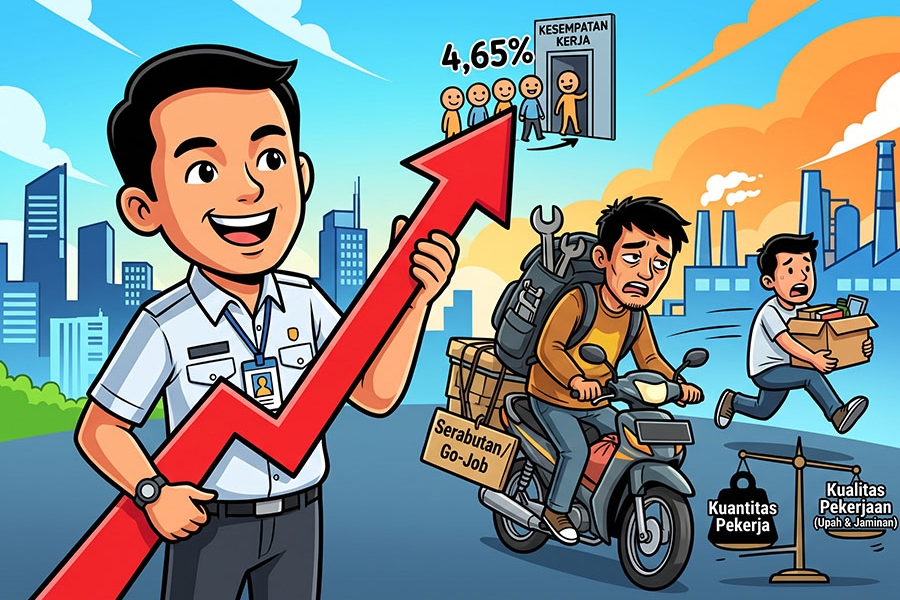
Indonesia's Open Unemployment Rate (TPT) has dropped to 4.65% in 2026, nearing the historic 1994 low of 4.36%, even as the national labor force swells to 155.41 million. While the government views this as a successful indicator of real sector strengthening and investment-driven labor absorption, economists caution that this headline figure obscures the reality of low-quality jobs and high informality. Many workers are forced into subpar employment due to a lack of financial resilience post-layoff, underscoring the urgent need to ensure economic growth translates into productive, high-quality formal employment..
The decline of Indonesia's Open Unemployment Rate (TPT) to 4.65% in 2026 has become a focal point in evaluating the national economy's health. According to the Coordinating Ministry for Economic Affairs, Indonesia's labor force has reached 155.41 million people, nearly double the 83.32 million recorded in the 1990s. The government assesses that driving down the unemployment ratio amidst such a massive surge in the labor force reflects the tangible contributions of real sector strengthening programs and investments in supporting labor absorption.
However, a shrinking unemployment rate is not sufficient to paint a complete picture of the labor market. Macroeconomic researchers from the Institute for Economic and Social Research at the Faculty of Economics and Business, University of Indonesia (LPEM FEB UI), highlighted that many workers affected by layoffs lack the financial capacity to remain unemployed for extended periods. Consequently, they are forced to immediately seek alternative income to survive, even if the available jobs lack adequate quality or security. Informality rates and real wage levels remain critical indicators in assessing true employment conditions and worker welfare.
This underlying issue reveals that the sheer number of employed individuals does not necessarily reflect the quality of available jobs. Under current labor statistical methodologies, anyone who performs economic activity for at least one hour during a one-week reference period is categorized as employed. Therefore, the TPT decline must be analyzed alongside other metrics—such as underemployment, informality, wages, and productivity—to obtain a comprehensive view of the labor market's actual health.
The correlation between economic growth and unemployment was also highlighted in an academic review of Indonesia's conditions during the 2020–2024 period. A study from Pamulang University noted that the TPT fell from 7.07% in 2020 to 4.91% in 2024. During this same period, Indonesia's economic growth rebounded from a 2.07% contraction in 2020 to a positive 5.03% expansion in 2024. This trend demonstrates that economic recovery occurred simultaneously with falling unemployment, a pattern aligning with Okun's Law, which illustrates the inverse relationship between output growth and unemployment rates. However, because the study relied on literature reviews and descriptive analysis, it does not statistically prove a direct cause-and-effect relationship, reminding policymakers that economic structure and business sector characteristics heavily dictate how effectively economic growth creates jobs.
Addressing the challenge of job quality, the government stated it will continue efforts to elevate workforce competencies through vocational training, upskilling, and the optimization of industrial capacity. These measures are directed at supporting the absorption of a high-quality workforce and elevating the public's standard of living. Aligning workforce skills with modern industrial demands remains a crucial aspect of supporting broader business productivity and competitiveness.
Ultimately, the drop in the TPT to 4.65% is a highly positive macroeconomic indicator on the surface, but it does not inherently prove that job quality has improved equitably across the board. Labor evaluations must look past headline employment numbers and scrutinize informality, wage stagnation, productivity, and the characteristics of the jobs being created. The ensuing challenge for the government is ensuring that future economic growth and surging investments genuinely support the creation of formal, productive, and sustainable employment capable of tangibly improving public welfare.
















 tpc.consulting
 tpc.consulting
 info@taxindo.co.id