



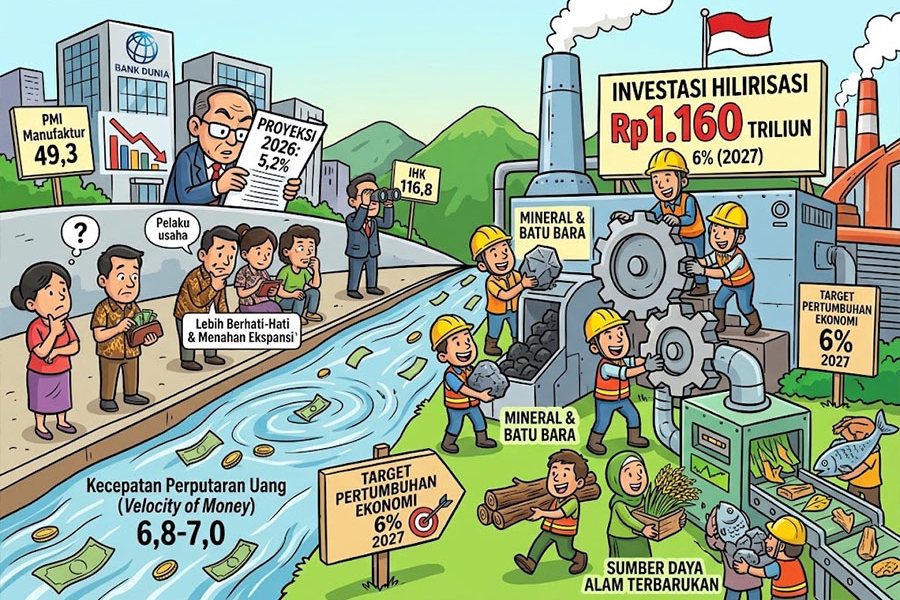
The World Bank highlighted signs of a slowdown in Indonesia's domestic economic activity, even though the 2026 economic growth projection reached 5.2%. At the same time, the velocity of money in Indonesia is projected to slow down in 2026. The government is pushing for a downstreaming investment of Rp1,160 trillion as part of the effort to achieve the 6% economic growth target in 2027..
The World Bank highlighted signs of a slowdown in Indonesia's domestic economic activity after the economy grew by 5.4% in the first half of 2026. This growth was supported by private consumption and the acceleration of government spending during the Ramadan and Eid al-Fitr periods, as well as the implementation of the Free Nutritious Meal program. However, domestic economic activity began to show weakness, reflected in the decline of the manufacturing PMI to 49.3 in August 2026 and the consumer confidence index to 116.8 in July 2026.
Despite observing a weakening in several domestic indicators, the World Bank raised Indonesia's economic growth projection for 2026 to 5.2%. The World Bank assessed that the impact of rising energy prices is relatively controlled, while state-owned enterprise (BUMN) investments, energy subsidies, and priority government programs continue to support economic activity. However, the World Bank also warned of the risk of an increasing current account deficit, which is estimated to reach 1.5% of GDP in 2026.
Amid these signs of a slowdown, the development of the velocity of money is also an indicator that needs attention when observing economic activity in 2026.
Bank P projects the velocity of money in Indonesia in 2026 to be in the range of 6.8–7.0 times, with a midpoint of 6.9 times. This projection is lower than the 2025 achievement of 7.03 times. Meanwhile, narrow money supply, or M1, is still growing in the range of 10%–14.4%, higher than nominal GDP growth.
This slowdown in the velocity of money is related to a more cautious public attitude in spending their income, while businesses are holding back on expansion. This condition indicates that the growth in money supply has not been fully followed by an increase in transaction speed within the economy. This development provides an important context for the government in strengthening the sources of economic growth in 2027.
In this context, the government is placing investment and downstreaming as part of the strategy to strengthen economic growth and achieve the 6% growth target in 2027.
The government is targeting a downstreaming investment of Rp1,160 trillion in 2027 to support the 6% economic growth target. The government is also expanding the scope of downstreaming from non-renewable commodities such as minerals and coal to renewable natural resources encompassing forestry, agriculture, and fisheries.
The government has formulated a downstreaming roadmap covering 28 strategic commodities across eight sectors, requiring an investment of up to US$618 billion by 2040. Meanwhile, the realization of downstreaming investments in the first half of 2026 reached Rp300.1 trillion, growing by 6.9% year-on-year. The government hopes that the expansion of downstreaming and the strengthening of the manufacturing industry can increase manufacturing's contribution to GDP to over 20% and drive an increase in national export value.
For business actors and investors, the slowdown in economic activity and money circulation needs to be balanced with selective expansion strategies, while the downstreaming agenda opens opportunities in the processing industry and related supply chains. For the public, the development of consumption and purchasing power remains a crucial factor in maintaining domestic economic activity. Thus, the success of the government's agenda depends not only on the size of the investments realized but also on its ability to stimulate broader economic activity.
The slowdown in economic activity and the velocity of money highlights the importance of maintaining growth momentum by strengthening the real sector. On the other hand, the downstreaming investment target of Rp1,160 trillion indicates the direction of government policy to make investment and value-add enhancement a key part of the 2027 growth strategy. The government needs to ensure that the downstreaming agenda runs effectively, while businesses and investors can observe the opportunities emerging from the development of related industrial chains.
















 tpc.consulting
  tpc.consulting
  info@taxindo.co.id