




The government is preparing a national investment target of approximately Rp2,900 trillion in 2027, with downstreaming as one of the primary sectors. By 2040, the government targets downstreaming investments of around US$618 billion across 28 commodities, which are expected to boost exports and create approximately 3 million jobs. On the other hand, the development of downstreaming still faces challenges regarding raw material supply, energy, technology, and environment-based global trade demands.l, and one-degree family ties.
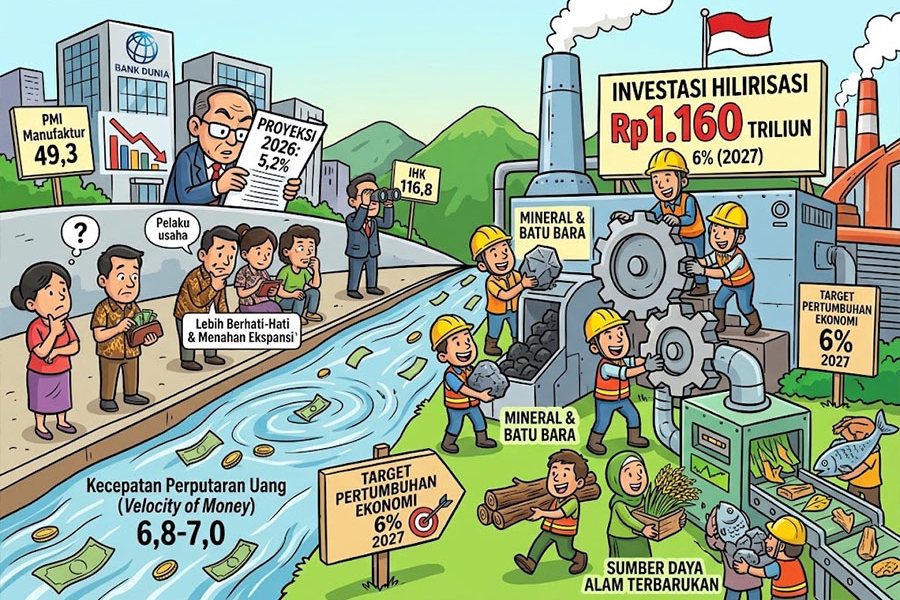
The government is setting a national investment target of approximately Rp2,900 trillion in 2027 to help underpin the achievement of 6% economic growth. Out of this total, the downstreaming sector is projected to contribute around 40%, equivalent to Rp1,160 trillion. The government continues to make minerals and coal the focus of downstreaming, while also beginning to prepare for the development of other metal commodities.
The development of downstreaming is also being expanded to renewable natural resources. The government is encouraging the development of industries based on forestry, agriculture, plantations, as well as marine and fisheries. This development is directed at increasing commodity value-add while strengthening the national industry. This direction is subsequently broadened through a downstreaming roadmap that encompasses various commodities and sectors.
The government has formulated a downstreaming roadmap for 28 commodities covering eight sectors. Up to 2040, the investment required for the development of these 28 commodities is estimated to reach around US$618 billion. These investments are targeted to boost exports to US$857 billion and generate an economic value-add of US$235.9 billion.
The government also recorded a realized downstreaming investment of Rp300.1 trillion in the first half of 2026, growing by 6.9% year-on-year. This value contributed 29.7% to the total national investment realization of Rp1,010.6 trillion during the same period. The mineral sector investment was the largest contributor at Rp206.5 trillion, followed by the plantation and forestry sector at Rp54.4 trillion, oil and gas at Rp35.4 trillion, and marine and fisheries at Rp3.8 trillion.
The progress of downstreaming is also reflected in the increased export value of several commodities. Indonesia's nickel exports are projected to reach around US$34 billion in 2025, a massive increase compared to approximately US$1.3 billion in 2016. The government is also developing downstreaming for coconut and rubber commodities and encouraging the agricultural sector to produce food, feed, and fuel products. At the same time, the government assesses that downstreaming is an integral part of industrialization; therefore, strengthening other manufacturing sectors remains necessary, including automotive, textiles and textile products, FMCG, and other strategic sectors.
The magnitude of this downstreaming agenda coincides with the restructuring of coordination at the government level. The government has established the Coordinating Ministry for Downstreaming and Energy Transition under the leadership of Bahlil Lahadalia as part of the effort to respond to global geopolitical dynamics.
Meanwhile, the Ministry of Investment and Downstreaming/BKPM continues to operate and fulfill its role. Minister of Investment and Downstreaming/Head of BKPM Rosan Roeslani stated that his party is still waiting for further directives regarding the division of tasks with the Coordinating Ministry for Downstreaming and Energy Transition. Rosan also emphasized that inter-agency coordination will continue to be rigorously carried out.
Strengthening the downstreaming agenda continues to face execution challenges, particularly regarding the availability of raw materials and energy. These challenges are increasingly complex as the global market is paying closer attention to the energy sources used in production processes.
Coordinating Minister for Economic Affairs Airlangga Hartarto stated that mineral commodities still face challenges in raw material supply and energy availability. Gas supply for industrial needs is also an issue, as gas prices are rising and not all demands can be met domestically. The government assesses that LNG storage facilities are needed to support domestic energy supplies.
In addition to energy issues, Indonesian industries face demands for green energy use from global buyers, as well as environment-based trade barriers. Airlangga highlighted the European Union Deforestation Regulation (EUDR) and the Carbon Border Adjustment Mechanism (CBAM). The CBAM can be applied to industries with high carbon emissions or those whose electricity use does not come from green energy. This condition challenges Indonesian industries to improve efficiency while reducing emissions in their production processes.
To face these challenges, the government is pushing for technology-driven downstreaming development through digitalization, semiconductors, and artificial intelligence (AI). The government is also preparing human resource development with a target of 15,000 AI and semiconductor talents over the next three years. This step is aimed at driving Indonesian industries toward higher technological levels and greater value creation.
For business actors and investors, the investment targets and downstreaming roadmap open up business development opportunities across various commodities and sectors. However, these opportunities go hand-in-hand with the need to ensure the availability of raw materials and energy while meeting global market demands. For the public, the downstreaming development of 28 commodities is targeted to create around 3 million jobs.
Overall, the government positions downstreaming as a crucial part of the strategy to increase natural resource value-add and strengthen the national industry. Achieving these investment targets requires not only the development of downstreaming projects but also the readiness of supply chains, energy grids, technology, and human resources. Business actors need to carefully observe the direction of downstreaming development while strengthening industrial readiness to capitalize on investment opportunities and remain competitive amid rigorous global market demands.














 tpc.consulting
  tpc.consulting
  info@taxindo.co.id