




Indonesian purchasing power continues to face pressure in the third quarter of 2026, primarily driven by weakened income perceptions, rising living costs, and job insecurity. While the government is evaluating the effectiveness of ongoing stimuli, economists propose tax policy adjustments and the creation of quality jobs to safeguard consumption. Heading into the end of the year, the precision of incentives and the sustainability of public income will be crucial factors in supporting economic growth..
Household consumption in Indonesia is estimated to continue growing in the third quarter of 2026, but the recovery of purchasing power is not evenly distributed. The Chief Economist of PermataBank projects household consumption to grow by 5.16% year-on-year (yoy), slightly higher than the Q2 2026 realization of 5.06%. However, several indicators point to mounting pressure on household finances. The Consumer Confidence Index fell from 118.5 in August to 118.1 in September 2026, while the Current Economic Condition Index weakened from 109.4 to 107.5. During the same period, the portion of income allocated to consumption rose from 74.2% to 74.9%, whereas the savings portion dropped from 15.8% to 15.4%. This shift indicates that a segment of the public must allocate more income to daily necessities, leaving increasingly limited room for savings.
This pressure is also reflected in retail sales. Sales in September 2026 are estimated to contract by 2.3% month-to-month (mtm), although still recording a 1.4% yoy growth. The Chief Economist of Bank Central Asia (BCA) also noted a slowdown in business transaction and consumption indicators based on internal BCA data. Business transaction index growth slowed from 9.4% in August to 8.4% in September, while consumption index growth slipped from 1.8% to 1.4%. Although these indicators point to softening demand, the condition is not yet severe enough to conclude that national consumption is contracting. Entering Q4 2026, rising oil prices and El Niño risks could add inflationary pressure, though holiday spending for Christmas and New Year, coupled with government stimuli, may still prop up consumption.
Purchasing power pressures are becoming more visible through the "downgrade lifestyle" phenomenon widely discussed on social media. Many citizens report changing their habits—opting for cheaper products, reducing recreational activities, selling vehicles, or accepting lower-paying jobs. This reflects how households are adjusting expenses to match their financial capacity. Data cited in the reports show that the middle-class population shrank from 60.8 million people (23% of the population) in 2018 to 46.7 million people (16.6%) in 2025. Concurrently, 63,789 workers were laid off between January and September 2026. While a lifestyle adjustment does not automatically equate to falling into poverty, the situation becomes alarming if households continuously cut essential needs or rely on debt to cover routine expenses.
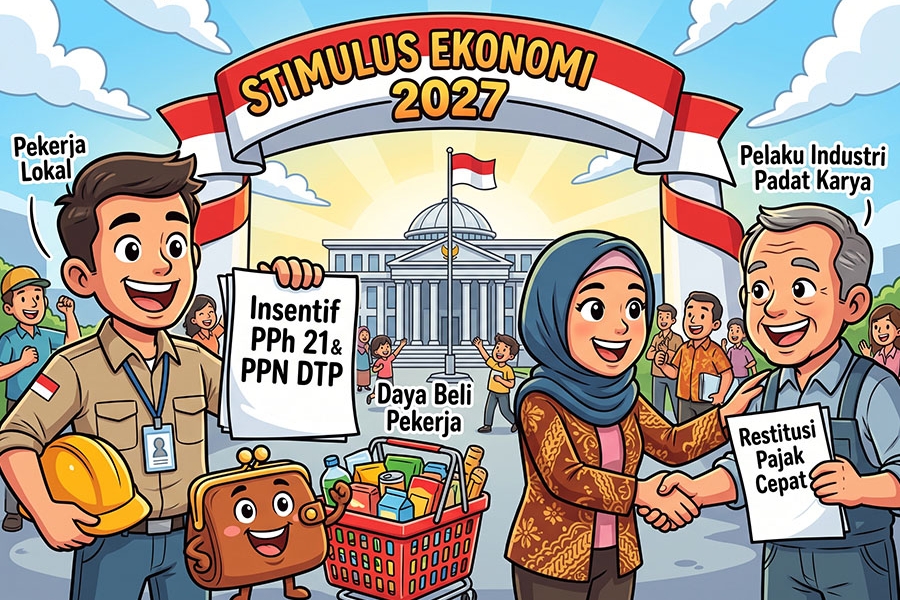
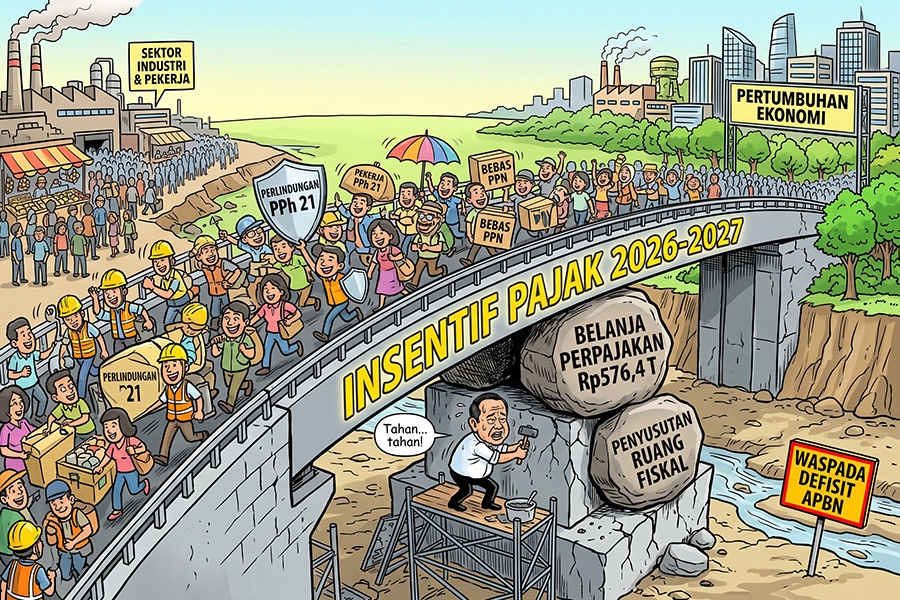
The weakening of the middle class has drawn attention to social protection policies and fiscal incentives. The 2027 social protection budget is planned at Rp549.9 trillion, an increase from the 2026 projection of Rp500 trillion. However, economists argue that the available support does not fully reach the middle class directly. Prominent proposals include periodic adjustments to the Non-Taxable Income (PTKP) threshold to account for inflation or minimum wage developments. Furthermore, the government is urged to expand the Government-Borne Article 21 Income Tax (PPh 21 DTP) facility for workers earning under Rp10 million per month. The planned PPh 21 DTP facility for 2027 reportedly targets around 7.5 million workers. These proposals are expected to increase after-tax income and help households maintain consumption, though they still require further fiscal calculation and policy deliberation.
The government is currently evaluating the effectiveness of various ongoing incentives and exploring opportunities to strengthen support for the middle class. Existing programs include People's Business Credit (KUR), financing for labor-intensive industries, PPh 21 DTP for specific sectors, VAT DTP for housing, transportation discounts, internship programs, food assistance, and energy subsidies. The Indonesian Employers Association (Apindo) emphasized that the government must ensure these facilities can actually be utilized by the public and businesses. Administrative and implementation bottlenecks must be resolved so that the benefits of the programs do not stop at mere budget availability. Future policies must prioritize targeting accuracy, ease of access, and tangible impacts on income and business activities, rather than simply increasing the number of incentives.
For business actors, purchasing power pressures require companies to be more astute in reading shifting consumption patterns, setting prices, and managing production and distribution costs. Investors also need to factor in household purchasing power and job quality when assessing growth prospects. The government, meanwhile, must secure food supplies and distribution, accelerate spending that directly impacts the public, and bolster labor-intensive industries to expand formal employment with decent wages. These efforts must go hand-in-hand with evaluating tax incentives and reducing the burden of living costs, particularly for housing, education, and transportation.
Overall, Indonesian household consumption continues to demonstrate resilience, but the pressure on the middle class serves as a warning that economic growth has not been fully accompanied by an increase in public spending capacity. Several economists project the Indonesian economy to grow by 5.26% throughout 2026, despite the risk of a slowdown in the fourth quarter. The government must ensure that every incentive has clear targets, is easily accessible, and delivers measurable benefits. At the same time, the business world must strengthen productivity and create sustainable job opportunities. The recovery of purchasing power cannot rely solely on short-term stimuli; economic growth must be paired with sustained improvements in income, job quality, and household economic certainty.















 tpc.consulting
  tpc.consulting
  info@taxindo.co.id