



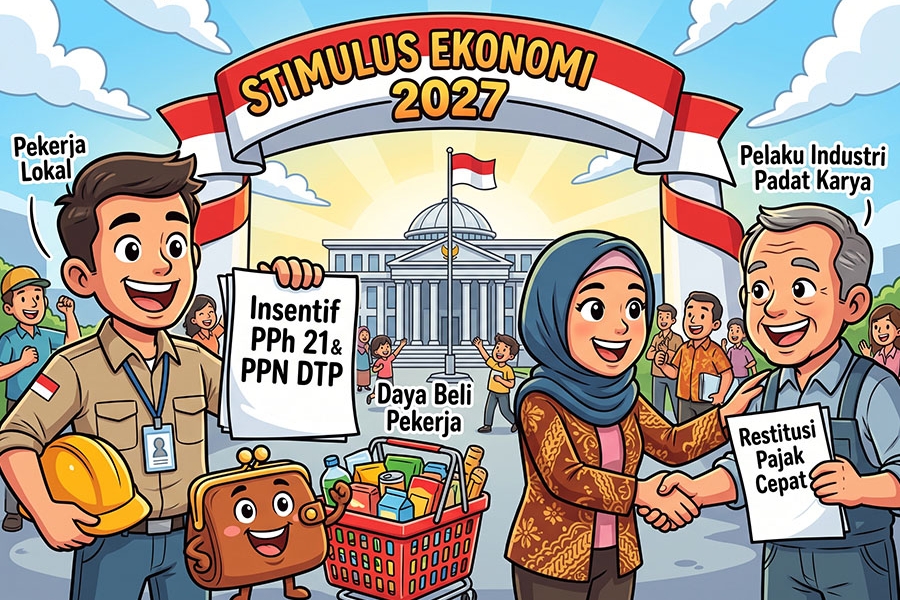
The government plans to expand the Article 21 Income Tax (PPh 21) incentive for workers earning below Rp10 million to all business sectors, as well as extend the Government-Borne VAT (VAT DTP) facility for housing until 2027. On the other hand, the Minister of Finance has instructed the acceleration of tax restitution processing for labor-intensive industries and MSMEs to support corporate cash flows. Both agendas require careful calculation so that economic benefits remain aligned with state revenue management..
The Indonesian government is currently preparing a number of tax incentives for 2027 to support public purchasing power and achieve the 6% economic growth target. One of its primary plans is to expand the Article 21 Income Tax (PPh 21) facility for employees earning below Rp10 million per month across all business sectors, targeting approximately 7.5 million workers. The government is also discussing the extension of the Government-Borne Value Added Tax (VAT DTP) facility for home purchases until 2027 and reviewing the VAT standard for 99.9% purity precious metals. However, the implementation details and budget requirements for these various incentives are still being discussed with the relevant ministries and agencies.
In addition to supporting workers' purchasing power, the government hopes these incentives can strengthen domestic consumption. The Chief Economist of PT Bank Central Asia Tbk. assessed that the expansion of the PPh 21 facility has the potential to boost consumer confidence, particularly among the middle class and the aspiring middle class. However, the Strategic Research Manager of the Center of Reform on Economics (CORE) assessed that its benefits might be limited because some low-income workers do not actually have a PPh 21 obligation. The additional disposable income for eligible formal workers is estimated to range from tens of thousands to about Rp250,000 per month, depending on their income level. He also emphasized the importance of aligning the incentive plan with potential adjustments to the Non-Taxable Income (PTKP) so that fiscal costs do not escalate without commensurate additional economic benefits.
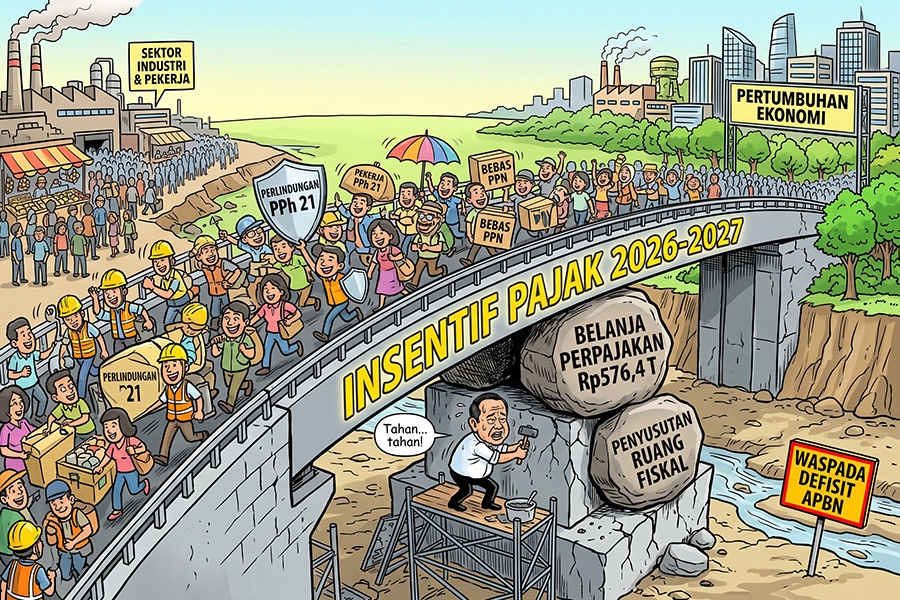
On the state revenue side, the Directorate General of Taxes (DJP) is assessing the impact of the incentive expansion on the 2027 tax revenue projection, which is targeted to reach Rp2,593.3 trillion. The DJP stated it will recalculate the potential revenue shortfall and provide input on the policies currently being planned by the government. The Chairman of the Taxation Committee of the Indonesian Employers Association (Apindo) principally supports incentives that can aid purchasing power and stimulate the economy. However, he hopes that the potential revenue decline resulting from the provision of incentives will not be immediately countered by tax intensification that adds burdens to business actors. Thus, policy design must consider the benefits for the public alongside the sustainability of state revenue.
Besides discussing new incentives, the government is also focusing on fulfilling taxpayers' rights through the acceleration of restitutions. On October 9, 2026, the Minister of Finance instructed the Director General of Taxes to accelerate the processing of restitutions for eligible taxpayers, particularly labor-intensive industries and MSMEs that require cash flow support. Based on data cited by Bisnis.com, the realization of restitution disbursements up to the end of August 2026 reached Rp191.82 trillion, down 37% compared to Rp304.29 trillion in the same period the previous year. This instruction reaffirms the government's attention to the smooth refunding of tax overpayments as one of the factors affecting the liquidity of the business world.
Business circles assess that delayed restitutions can disrupt cash flows and pressure corporate productivity. The Vice Chairman for Industry of the Indonesian Chamber of Commerce and Industry (Kadin) also warned that restitution issues could influence foreign investors' perception of Indonesia's business climate. Meanwhile, the General Chair of Apindo emphasized the importance of fulfilling the taxation rights of the business world in a timely manner. Nevertheless, the acceleration of restitutions must still be implemented with due regard to the examination process and applicable regulations. Certainty in restitution processing is expected to help companies manage operational needs while maintaining business continuity.
Overall, the plans to expand tax incentives and accelerate restitutions reflect two government efforts in supporting the economy: safeguarding public purchasing power and facilitating smooth corporate cash flows. The government needs to finalize its fiscal calculations and clarify the implementation mechanisms for the 2027 incentives, while simultaneously ensuring that restitutions for eligible taxpayers are processed according to regulations. Business actors also need to monitor policy developments and maintain complete tax documentation. A balance between economic benefits, certainty of taxpayer rights, and state revenue sustainability is key to ensuring that tax policies can support economic growth sustainably.

















 tpc.consulting
  tpc.consulting
  info@taxindo.co.id