



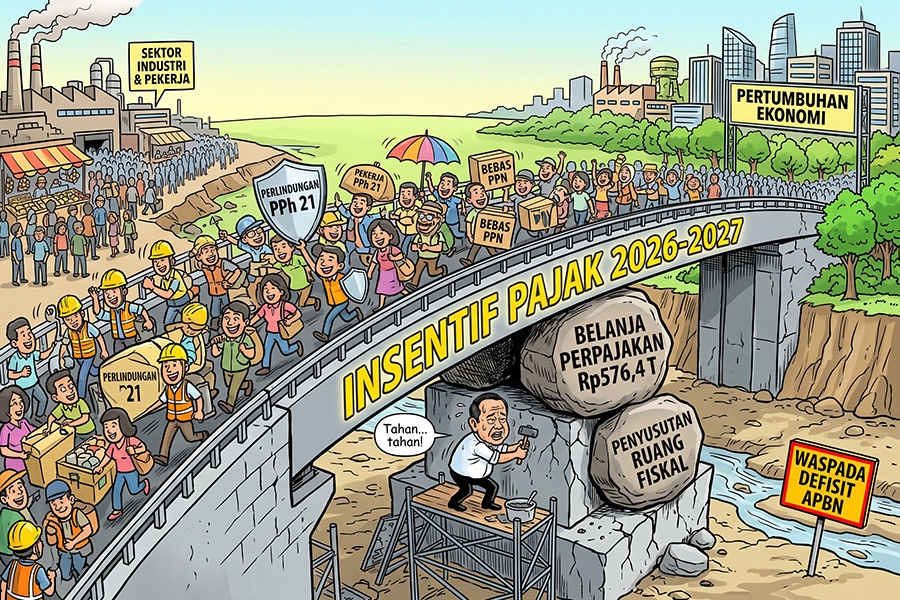
The government is preparing various tax incentives in 2026 to safeguard public purchasing power and spur economic activity. The government also plans to extend and expand the Article 21 Income Tax (PPh 21) incentive for workers earning below Rp10 million in 2027. On the other hand, the increase in tax expenditure is a concern as it could narrow the government's fiscal space..
The government is preparing a number of tax incentives throughout 2026 to safeguard public purchasing power while boosting economic activity. One of the ongoing facilities is the Government-Borne Article 21 Income Tax (PPh 21 DTP) for workers in the tourism and labor-intensive sectors with a fixed and regular maximum gross income of Rp10 million per month. The government is also providing PPh 21 DTP for participants of specific internship programs, as well as Government-Borne VAT (PPN DTP) for eligible housing purchases and economy-class domestic flight tickets.
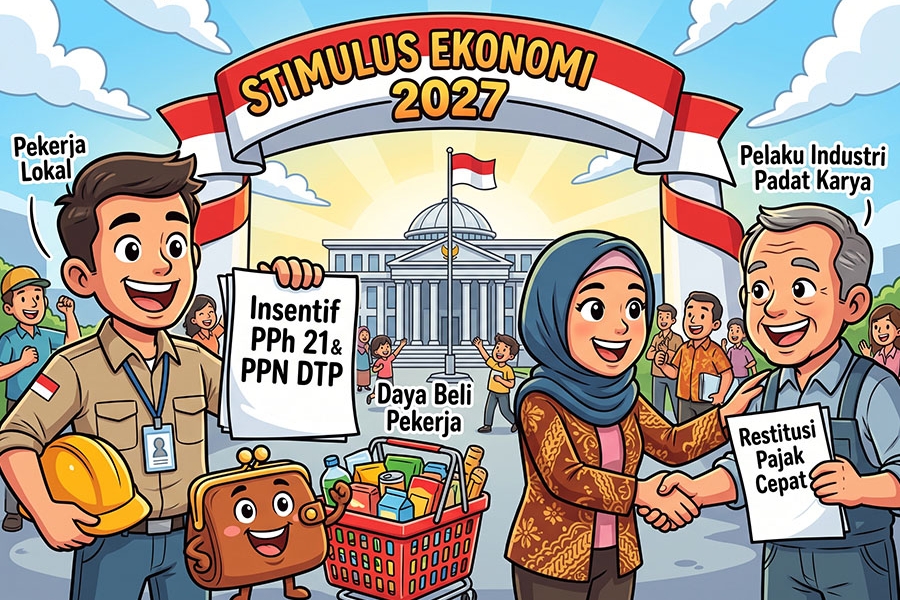
The incentive policy for these workers will also continue into 2027. The government is preparing to re-issue the PPh 21 incentive for workers earning under Rp10 million per month and plans to expand its coverage to all business sectors. According to the Coordinating Minister for Economic Affairs, this policy is estimated to benefit around 7.5 million workers.
This expansion represents a shift compared to its implementation in 2026, which targeted workers in labor-intensive and tourism sectors. The government is also discussing an adjustment to the Non-Taxable Income (PTKP) threshold by taking inflation into account. Thus, the continuation of PPh 21 in 2027 is part of a broader policy to sustain fiscal support for the public and economic activities.
In addition to PPh 21, the government is preparing various other tax facilities throughout 2026. The government is maintaining a final Income Tax (PPh final) of 0.5% for eligible MSME taxpayers, while individual MSME taxpayers with a turnover of up to Rp500 million a year are exempt from Income Tax. The government is also providing PPN DTP for the housing sector and economy-class domestic flight tickets, and preparing a final PPh on national authors' royalties at a rate of 1.5%, although this royalty facility has not yet taken effect because the Minister of Finance Regulation (PMK) serving as its legal basis has not been issued.
On the other hand, several facilities for the textile and textile product (TPT) industry are still under discussion. The government is reviewing VAT facilities for outsourcing services, accelerated tax restitution for export-oriented textile industries, and the possible provision of tax holidays. The government also previously prepared tax incentive options for electric vehicles, but their implementation has not been realized as the regulating PMK has not yet been issued.
These various facilities reflect the extensive tax support prepared by the government in 2026. The government estimates that the value of tax expenditure in 2026 will reach approximately Rp576.4 trillion, reflecting tax revenues left uncollected due to various tax facilities. The government also noted that the 2026 tax ratio stands at 10.1% of the Gross Domestic Product (GDP), whereas, without tax incentives, this figure could mathematically reach 12.3% of GDP.
The magnitude of tax expenditure subsequently raises concerns regarding fiscal space. The Executive Director of the IEF Research Institute warned the government to be cautious in providing additional incentives, especially those that are sector-based, given on an ad hoc basis, lack clear deadlines, and have minimal open evaluation. According to him, this pattern could narrow the government's fiscal space because every new incentive must compete with existing fiscal needs.
He also noted that tax expenditure increased from Rp362.5 trillion, or 1.73% of GDP, in 2023 to Rp400.1 trillion, or 1.81% of GDP, in 2024. For 2026, the government projects tax expenditure at Rp563.6 trillion, an increase of about 6.3% compared to the 2025 projection of Rp530.3 trillion. He also highlighted the projected 2026 tax revenue shortfall of around Rp46.9 trillion from the target.
These concerns are also linked to fiscal needs in 2027. The 2027 State Budget (APBN) sets state expenditure at Rp4,106.26 trillion with a deficit of Rp671.16 trillion, or 2.4% of GDP, while the tax revenue target is set at Rp2,593.35 trillion. According to him, additional new incentives will add to the challenge of achieving this revenue target, so the government needs to ensure that every facility provides economic benefits commensurate with the uncollected state revenue.
This series of tax incentives has the potential to benefit workers by reducing the burden of Article 21 Income Tax, thereby supporting public purchasing power. For business actors, various tax facilities can help support activities in targeted sectors, including labor-intensive and TPT industries. However, from a fiscal perspective, the government must ensure that every incentive has clear targets and evaluation mechanisms so that its economic benefits are proportional to the uncollected tax revenue.
The government needs to maintain a balance between providing incentives to support purchasing power and economic activity and its ability to safeguard fiscal space. Every new facility must have clear targets, deadlines, and evaluation mechanisms so that its economic benefits can be accurately measured. For business actors and workers, the utilization of incentives should be carried out in accordance with applicable regulations while closely monitoring tax policy developments in 2027.
















 tpc.consulting
  tpc.consulting
  info@taxindo.co.id