



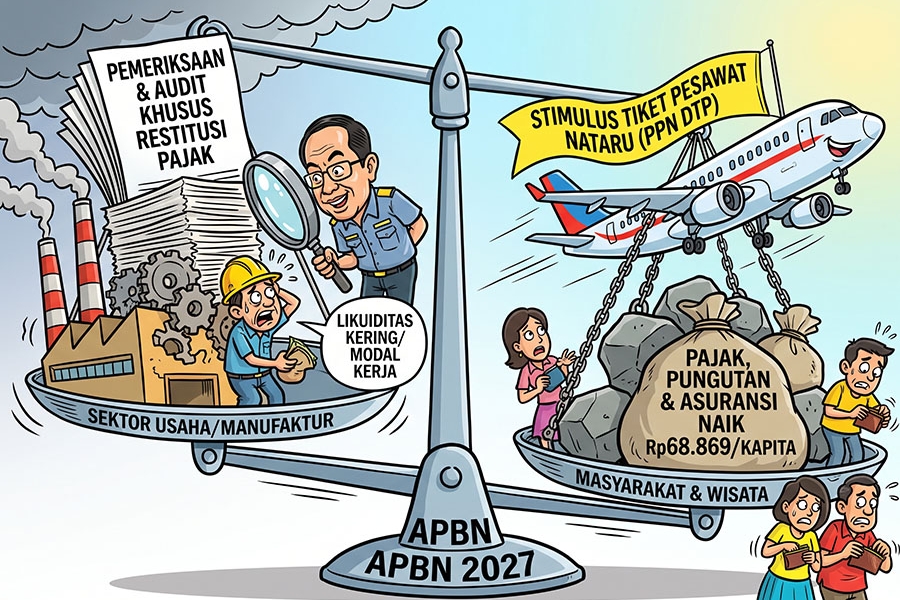
The government has granted the authority for special examinations and audits on tax restitution in the 2027 State Budget Law, raising concerns regarding business liquidity and the performance of the manufacturing sector. At the same time, the government is preparing a tax stimulus for flight tickets during the 2026/2027 Christmas and New Year (Nataru) period as public expenditure on taxes, levies, and insurance continues to increase..
The authority of the Minister of Finance to conduct special examinations and audits on tax restitution is stipulated in Article 37 of the 2027 State Budget Bill. The government explained that this authority is intended to ensure compliance regarding invoices, transactions, and inter-taxpayer relations, while continuing to respect taxpayers' rights to restitution disbursement. However, observers assess that elevating technical processes such as restitution audits to the ministerial level has the potential to severely drag out disbursements.
Delays in restitution are feared to pressure corporate liquidity, especially in export-oriented manufacturing industries. According to economists, withheld funds can lock up working capital, force companies to seek bridge financing from banks, and potentially delay payments to suppliers. If this continues, the condition could disrupt operations and production processes, slow down economic turnover, and suppress the manufacturing PMI.
While liquidity pressure becomes a concern for the business world, the government is preparing a stimulus to maintain the affordability of flight tickets during the 2026/2027 Christmas and New Year period. The government is currently drafting regulations regarding a Government-Borne Value Added Tax (VAT DTP) for flight tickets. The amount of this facility is estimated to be around 11%, but the final figure is still awaiting the completion of the Minister of Finance Regulation (PMK) and the harmonization process.
The government is also discussing other components that affect ticket prices, including the Passenger Service Charge (PSC) and fuel surcharges. These discussions are conducted to support efforts to keep flight prices affordable as public mobility increases during the Nataru period. Thus, flight stimuli serve as one of the government's measures to maintain affordable travel costs at the end of the year.
On the other hand, the public continues to face rising expenditures for taxes, levies, and insurance. Statistics Indonesia (BPS) data cited by Kontan shows that expenditure for this group reached Rp68,869 per capita per month in March 2026, an increase of 6.43% compared to the previous period. This rise in expenditure is a point of concern because it can reduce the disposable income available for other needs.
This condition indicates that pressure on purchasing power is not only related to the prices of goods and services but also to the rising overhead expenditures borne by the public. As the portion of income used for taxes, levies, and insurance increases, the public's ability to allocate income for other consumption could be affected. This development provides an important context for the government's efforts to keep travel costs affordable through flight ticket stimuli.
This series of three developments highlights distinct challenges for the business world and the public. For companies, certainty and the smooth processing of tax restitutions are vital to maintaining working capital and cash flows. Meanwhile, for the public, flight ticket stimuli can help maintain affordable travel costs when demand surges, even though expenditures for taxes, levies, and insurance are simultaneously rising.
The government needs to strike a balance between strengthening restitution oversight and providing certainty for taxpayers in obtaining their rights. The government must also ensure that flight ticket stimulus provisions are finalized clearly and on time, while business actors need to strengthen their liquidity management and adapt their business strategies to the prevailing conditions of public purchasing power.
















 tpc.consulting
  tpc.consulting
  info@taxindo.co.id