



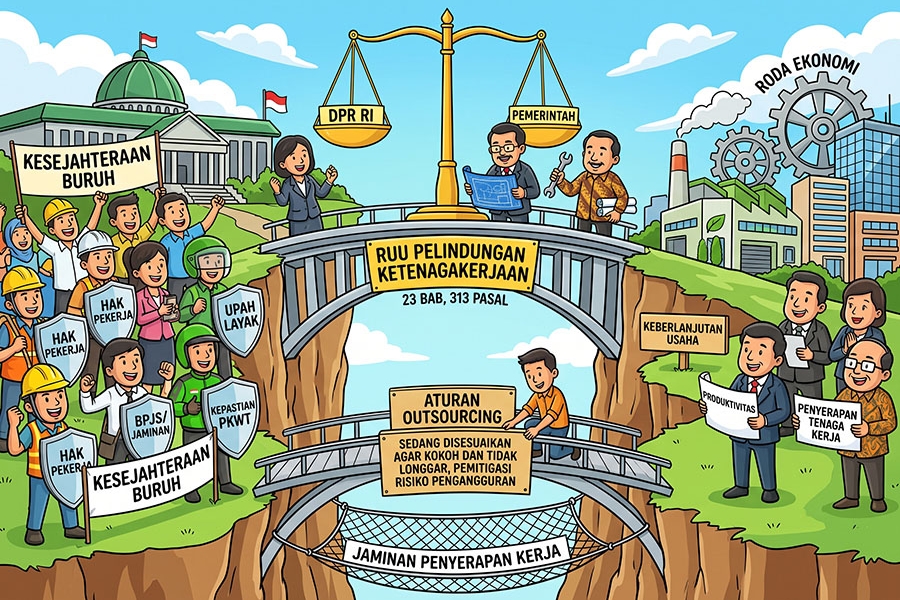
The Indonesian House of Representatives (DPR RI) and the government have agreed to pass the Employment Protection Bill, which contains 23 chapters and 313 articles to strengthen protection and certainty in employment relations. Ahead of its passage, labor unions highlighted several issues, including wages, fixed-term employment contracts (PKWT), protection for digital platform workers, severance pay, and outsourcing. Among these issues, the restriction on outsourcing has become a primary concern; while it garners support from labor unions, it also raises concerns regarding workforce absorption..
The DPR RI and the government agreed to bring the Employment Protection Bill (RUU Pelindungan Ketenagakerjaan) to the DPR RI Plenary Session. This agreement was reached after Commission IX of the DPR RI and the government completed the level I discussions. The Employment Protection Bill contains 23 chapters and 313 articles regulating various aspects of employment and is directed at strengthening worker protection and providing legal certainty in employment relations.
The government and the DPR then finalized the discussions on the bill before entering the ratification stage. The Minister of Manpower emphasized that the final deliberations of the bill remained focused on maintaining a balance between industrial progress and improving worker welfare. Leading up to its passage, several provisions in the bill remained a concern for labor unions, who assessed that the protection of workers' rights needed further strengthening.
The Confederation of Indonesian Trade Unions (ASPEK Indonesia) highlighted five points in the Employment Protection Bill. These points include the determination of the minimum wage based on Decent Living Needs (KHL), limitations on the duration of Fixed-Term Employment Contracts (PKWT), protection for digital platform workers, severance pay reserve funds, and restrictions on outsourcing.
ASPEK Indonesia considers these regulations essential for strengthening the protection of workers' rights and welfare. Among the highlighted issues, outsourcing regulation has become a focal point as it directly relates to the use of outsourced labor by companies. The focus on outsourcing subsequently led to discussions regarding the types of jobs that can be outsourced and the extent to which this scheme continues to provide certainty of rights for workers.
The Employment Protection Bill limits the types of jobs that can be outsourced and prohibits the use of outsourcing for core production activities or core business functions. This provision gained support from the Confederation of All Indonesian Workers' Unions (KSBSI), which assesses that outsourcing restrictions can provide certainty regarding workers' rights.
KSBSI believes that flexibility in employment relations is still needed by the business world, but its implementation must go hand in hand with the fulfillment of workers' rights. Protection of wages, occupational safety, and social security is part of the certainty that must be provided to workers employed under outsourcing schemes.
However, restricting the scope of outsourcing also raises concerns regarding workforce absorption, particularly for workers who have been employed through outsourcing service providers. The Indonesian Outsourcing Business Association (ABADI) estimates that around 320,000 workers potentially will not be absorbed by user companies due to the outsourcing restrictions.
This estimate emerged from an ABADI survey of approximately 650,000 outsourcing workers, with around 490,000 workers potentially impacted by the restrictions. Of this number, ABADI estimates that about 320,000 workers are at risk of not being absorbed by user companies. This figure is an estimate by ABADI and does not represent the number of workers who have already lost their jobs.
For user companies and outsourcing service providers, this regulatory change may prompt a review of jobs that have traditionally utilized the outsourcing scheme. Companies need to understand the scope of work that can be outsourced and prepare adjustments to their labor utilization patterns. For workers, outsourcing restrictions can strengthen the certainty of rights protection, but its implementation must also consider the sustainability of employment opportunities.
The passage of the Employment Protection Bill brings changes to the regulation of employment relations, including the use of outsourced labor. Differing views on outsourcing highlight the importance of implementing rules that continue to protect workers while providing certainty for the business world. Following the bill's ratification, the government and business actors must pay close attention to the implementing regulations and prepare adjustments so that the rule changes can be applied in an orderly manner.

















 tpc.consulting
  tpc.consulting
  info@taxindo.co.id