



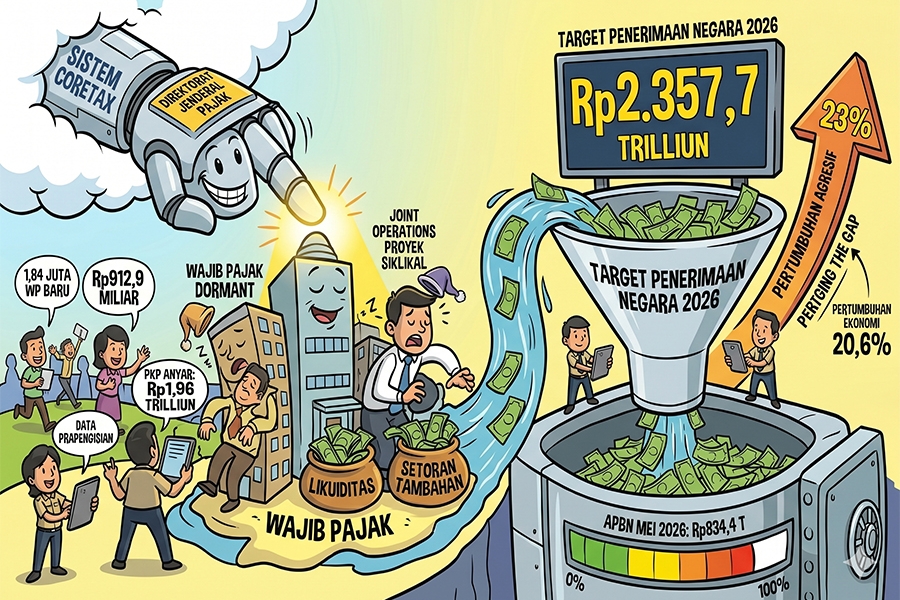
The Directorate General of Taxes is mobilizing the Coretax administration system to reactivate tens of thousands of dormant taxpayers to secure the 2026 state revenue target, firmly set at Rp2,357.7 trillion. The digital platform's third-party transaction detection capacity has successfully extracted tens of trillions of rupiah in liquidity from previously passive business entities. This extensification maneuver is specifically engineered to bridge the discrepancy between fundamental economic growth projections and aggressive fiscal financing targets for the current year.
National fiscal authorities shoulder the essential mandate of securing Rp2,357.7 trillion in state revenues for 2026. Attaining this ambitious figure necessitates an annual growth trajectory hovering around 23 percent, posing an absolute challenge considering fundamental economic projections only promise an organic growth rate of 20.6 percent. By the end of May 2026, accumulated revenues had merely breached the Rp834.4 trillion mark, equating to the fulfillment of 35.4 percent of the overarching State Budget (APBN) target. This realization grew 22.1% (yoy), an increase of around IDR 188.1 trillion from April 2026.The gap between organic revenue projections and year-end deadlines compels the taxation agency to pivot its strategy from conventional intensification methodologies toward the comprehensive exploitation of digital data assets.
The implementation of the Coretax infrastructure plays a critical role in dissecting unreported economic activities. The pre-populated data feature enables the government to autonomously detect third-party transaction footprints, directly exposing the active status of dormant taxpayers, such as joint operation entities resuming procurement projects. Through this automated cross-validation mechanism, authorities successfully reactivated 24,672 passive entities and extracted an additional Rp20.63 trillion in revenue collections by mid-June 2026. The optimization of this database transmits a stern signal that tax evasion maneuvers masquerading behind operational vacuums possess no further maneuverability.
This tax base expansion was also strengthened by the voluntary registration of 1.84 million new taxpayers who injected Rp912.9 billion into the state treasury as a result of the tax base expansion, followed by deposits from new taxable entrepreneurs (PKP) worth Rp1.96 trillion. The accuracy of the Coretax system simultaneously triggered a drastic increase in the identification of underpaid Tax Return (SPT) obligations, with the non-employee individual segment skyrocketing by 970 percent to Rp3.1 trillion and the corporate segment growing by 54 percent. Meanwhile, the value of underpaid annual personal income tax (PPh OP) employee returns increased by Rp9.09 trillion or grew by 80% (yoy). This digital architectural transformation has conclusively restructured the overarching posture of public compliance toward absolute transparency.
The tax authority's reliance on Coretax big data analytics to ensnare dormant taxpayers marks a fundamental shift toward predictive policing within the financial sector. For the corporate landscape reliant upon cyclical project-based business models, such as construction and government procurement, this system thoroughly eradicates the latency between the commencement of cash inflows and fiscal reporting obligations. On a macroeconomic scale, this cutting-edge oversight ecosystem will compress the shadow economy ratio, compelling the business sphere to continuously uphold bookkeeping transparency standards without awaiting formal audit cycles from law enforcement apparatus.
The transformation of digital oversight architecture has successfully converted raw transaction footprints into tangible and measurable state revenue assets. Business operators are highly recommended to immediately restructure their internal financial reconciliation systems to achieve absolute precision with government algorithms, while stakeholders can project this fiscal decisiveness as the foundational financing stability for the sustainability of national economic development.














 tpc.consulting
  tpc.consulting
  info@taxindo.co.id