



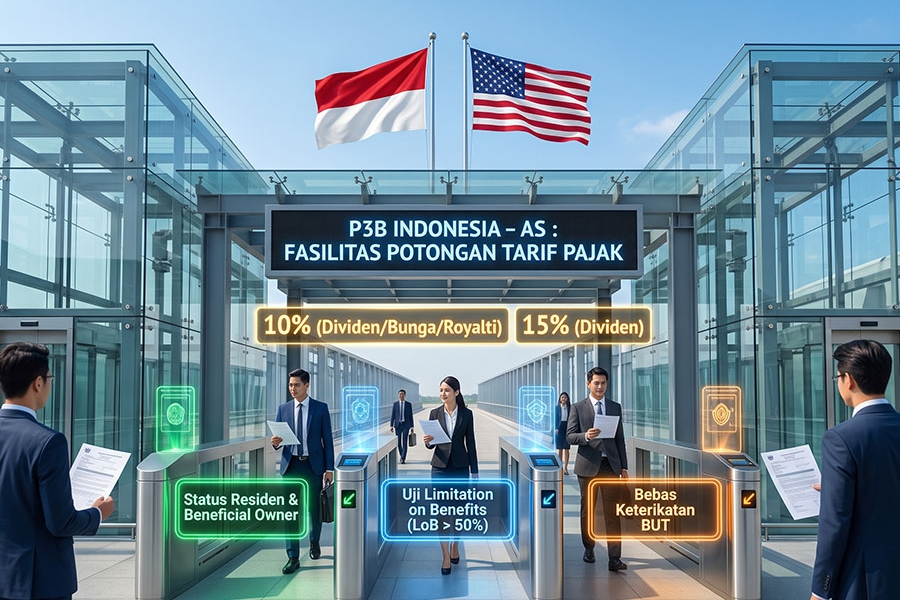
The Agreement for the Avoidance of Double Taxation (P3B) or Tax Treaty between the Government of the Republic of Indonesia and the United States was created to prevent double taxation and encourage investment between the two countries. One of the main benefits most frequently sought by business actors and investors from both countries in this agreement is the reduced tax rate on domestic tax calculations.
However, this reduced rate is not automatically granted to just anyone, as there are terms and conditions that must be met for a Taxpayer to enjoy this facility. The terms and conditions in question are as follows:
This reduced rate facility only applies to individuals or bodies/companies that are Residents (Domestic Taxpayers) of one or both of the contracting states. It should be noted that this resident status is determined based on domicile, residence, place of incorporation, or place of management that is legally recognized under the tax laws of each respective country. In the event of dual residence for an individual, their status will be determined through indicators such as a permanent home, center of vital interests, habitual abode, and citizenship.
Reduced tax rates (taxes withheld in the source country of income) are most frequently applied to the following three types of passive income:
The tax rate on dividends paid by a company in one country to a resident of the partner country is limited to a maximum of:
The tax rate on interest income is limited to a maximum of 10% of the gross amount of the interest. Furthermore, interest can be tax-exempt in the source country if such interest is derived by the Government of the partner country, the Central Bank, or a financial institution owned/controlled by that Government.
The tax rate on the use of copyrights of scientific/artistic works, patents, designs, trademarks, up to the rental of industrial/commercial equipment is limited to a maximum of 10% of the gross amount of the royalties.
This is the most crucial provision for corporate/company taxpayers. Based on Article 28 paragraph (6), non-individual entities are not entitled to reduced rates or tax relief unless they meet the following ownership and base erosion tests:
More than 50% of the beneficial interest (or number of shares) in the company is owned, directly or indirectly, by a combination of: US citizens, US residents, Indonesian residents, public companies listed on a recognized stock exchange, or the Government of the country itself.
The income of the company must not be used in a significant part (either directly or indirectly) to meet liabilities (such as interest or royalties) to persons other than the legitimate residents of the two contracting states (base erosion test).
Exception: The limitation rules above do not apply if the company is a public company whose principal class of shares is regularly traded on the Jakarta Stock Exchange (BEJ/IDX) or the NASDAQ system/a recognized national securities exchange in the US.
Special reduced rates (such as the 10% rate for dividends, interest, and royalties) will not apply if the income recipient actually has a Permanent Establishment (PE/BUT) or a fixed place of business in the source country of the income. If the rights or property generating the dividends, interest, or royalties are proven to be effectively connected with the operational activities of the PE, then that income will be taxed using the Business Profits provisions (Article 8), rather than the reduced tax treaty rates for passive income.
To obtain reduced tax rates under the Indonesia-US Tax Treaty, Taxpayers must meet the provisions regarding resident status, possess valid proof of ownership (beneficial owner), and pass the Limitation on Benefits test designed to prevent illegal tax avoidance practices. Therefore, Taxpayers need to ensure that their tax administrative documents are thoroughly prepared before claiming these preferential rates.











 tpc.consulting
  tpc.consulting
  info@taxindo.co.id