



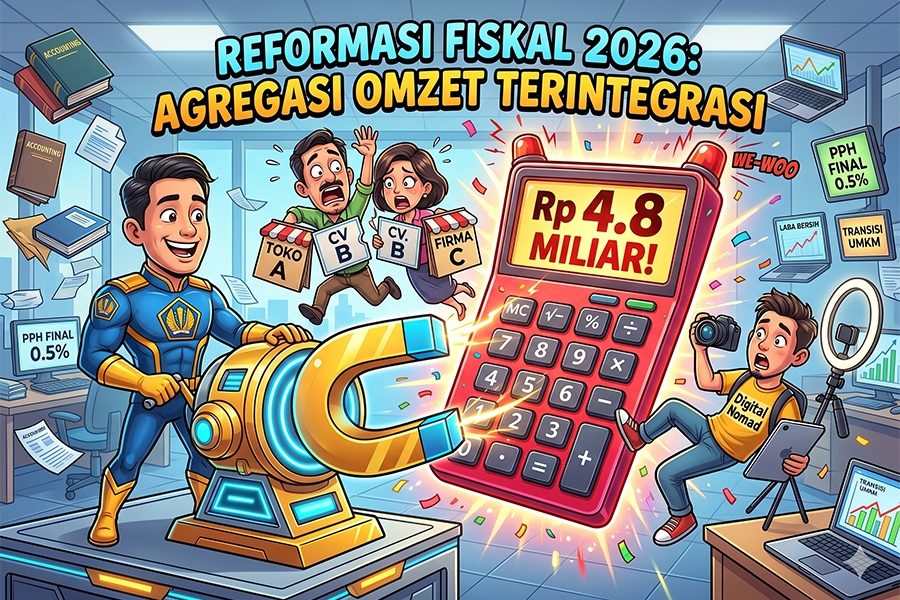
The government has officially overhauled the 0.5 percent final Income Tax architecture for micro, small, and medium enterprises via Government Regulation Number 20 of 2026. This directive revokes low-tariff facilities for general corporate entities and digital freelancers, concurrently implementing a cross-affiliated revenue consolidation scheme. This fiscal maneuver is executed to eradicate business-splitting manipulations while propelling MSMEs toward a more proportional, net-profit-based accounting transition.
National financial authorities have redefined the criteria for 0.5 percent final Income Tax (PPh) incentive recipients by eliminating limited partnerships (CV), firms, and general-scale limited liability companies (PT) from the beneficiary list. Referring to the latest legal framework, this low-tariff privilege is now exclusively dedicated to individual taxpayers, individual companies established by a single entity, and cooperative institutions with a maximum money circulation threshold of Rp4.8 billion annually. This criteria tightening also targets independent worker segments, compelling digital creative professions such as content creators, online public figures, and independent experts to comply with the normal income tax regime. This business entity classification adjustment runs parallel with the government's aggressive strides in sealing financial reporting manipulation loopholes through comprehensive revenue consolidation.
Responding to the rampant orchestration of liability evasion via business entity splitting schemes, regulators now enforce a multi-layered gross circulation aggregation mechanism. Fiscal authorities are mandated to consolidate the total income between husbands and wives, alongside all accumulated turnover from individual companies established by the couple. Should this cross-affiliated entity income accumulation breach the Rp4.8 billion threshold, all final tariff facilities will be automatically revoked. The elimination of these tactical strategies fundamentally overhauls the operational landscape and reporting standards for developing business entities across various sectors.
Amidst these tightened criteria, the government provides compensation by abolishing the time limit for utilizing the 0.5 percent tariff for individual taxpayers and individual companies satisfying compliance prerequisites. Meanwhile, CV and general PT entities now excluded from the final scheme will be directed to utilize the general mechanism, where tax burdens are calculated based on net profit margins following legitimate operational cost reductions, no longer referencing gross revenues. Tax authorities ensure the availability of intensive administrative mentoring throughout the upcoming three to four-year transition period to enable optimal business sphere adaptation. This taxation administrative calibration inevitably introduces profound macroeconomic implications for the broader business ecosystem.
The shift in collection mechanisms from a gross revenue base toward net profits admittedly triggers a surge in compliance costs during the initial phase due to mandatory standard bookkeeping obligations. However, from a strategic analytical perspective, this scheme functionally rescues low-margin business entities from the threat of tax levies eroding working capital. For investors and financing institutions, this forced financial formalization will generate vastly more transparent business footprints, streamlining credit due diligence processes, and accelerating the integration velocity of small enterprises into large-scale industrial supply chains.
This fiscal incentive regime realignment marks the demise of the tolerance era regarding bookkeeping orchestration and propels MSMEs to immediately mature their corporate governance. Business operators are highly recommended to urgently accelerate the modernization of their internal accounting systems to mitigate the risks of ballooning tax overheads, while concurrently capitalizing on the government-provided transition period to recalibrate long-term operational strategies.

















 tpc.consulting
  tpc.consulting
  info@taxindo.co.id