




Active tax collection measures, such as bank account freezes, are powerful instruments used by tax authorities to secure state revenue. However, these enforcement powers are not absolute; they must adhere to the principles of legal certainty and inter-regulatory harmonization, particularly where tax law intersects with bankruptcy law.
A frequent corporate legal issue is the extent to which tax authorities can target the personal assets of directors or shareholders (especially minority shareholders) when a company is declared bankrupt with outstanding tax liabilities. Below is the breakdown:
Tax regulations generally recognize the concept of a "Tax Bearer" (Penanggung Pajak), allowing collection actions to extend to the directors or shareholders of a limited liability company. However, the legal posture shifts fundamentally once the Commercial Court issues a bankruptcy ruling (putusan pailit).
Under bankruptcy law, all rights to manage and settle the bankrupt debtor's estate legally transfer to the Receiver (Kurator) upon the declaration of bankruptcy. Concurrently, prevailing tax legislation—specifically Article 32 of the Law on General Provisions and Tax Procedures (UU KUP), as amended by the Law on the Harmonization of Tax Regulations (UU HPP)—explicitly affirms the Receiver as the legitimate representative of the bankrupt legal entity, authorized to exercise its tax rights and fulfill its tax obligations.
Legal conflicts typically arise when tax authorities pursue premature collection actions against shareholders' personal assets before the formal liquidation or settlement of the bankruptcy estate (boedel pailit) is concluded by the Receiver.
Tax Court jurisprudence and legal reasoning have established clear principles to resolve this ambiguity. To maintain legal certainty, the regulatory framework under the UU HPP establishes three key rules:
While bankruptcy proceedings are ongoing (prior to the closure of insolvency), the responsibility for managing and settling the company's tax liabilities rests entirely with the Receiver as the lawful tax representative, using the available bankruptcy estate.
Targeting or freezing the personal bank accounts of shareholders before obtaining a definitive outcome regarding the value and sufficiency of the bankruptcy estate is legally premature and invalid.
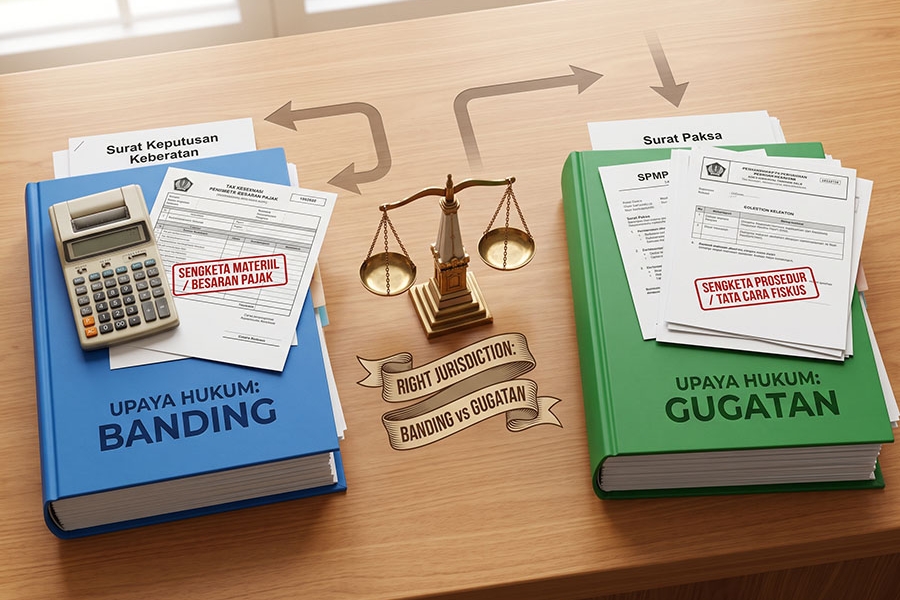
Establishing an individual or entity as a legitimate "Tax Bearer" subject to joint and several liability requires strict adherence to administrative tax collection procedures, rather than direct, summary execution in the field.
Legal safeguards for shareholders—particularly minority shareholders without day-to-day managerial control—are essential to preserve legal certainty and maintain a stable investment climate. Tax authorities cannot disregard the bankruptcy status of a corporate entity to pursue state receivables by bypassing corporate procedures and directly targeting individuals.
Tax authorities must appropriately reconcile overlapping legal regimes—in this case, tax law, corporate law, and bankruptcy law. Proper inter-regulatory application ensures that civil and procedural rights are not compromised by administrative overreach.
From a legal standpoint, corporate bankruptcy fundamentally alters the structure of tax liability. As codified under Article 32 of the UU KUP (amended via the UU HPP), the law designates the Receiver as the authorized representative solely responsible for settling tax obligations from the available bankruptcy estate (boedel pailit).
Consequently, active collection measures—such as freezing the personal bank accounts of shareholders—cannot be executed prematurely before the company's insolvency process has been formally concluded by the Receiver. Clarifying and adhering to these statutory boundaries ensures legal certainty and provides equitable legal protection for investors and shareholders operating within the Indonesian business ecosystem.















 tpc.consulting
  tpc.consulting
  info@taxindo.co.id