



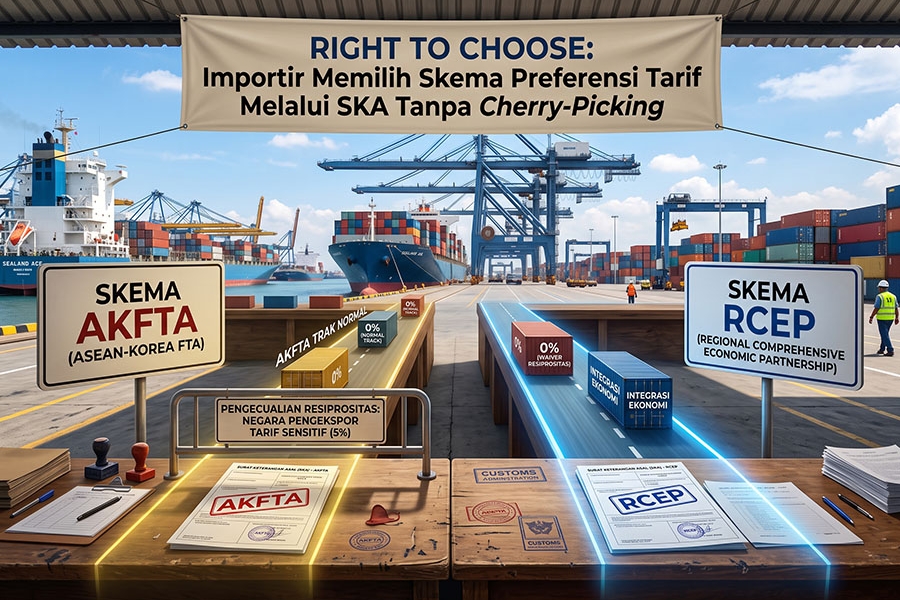
In international trade traffic, Indonesia participates in various bilateral and multilateral Free Trade Agreements (FTAs). These agreements facilitate imports with preferential import duties (even down to 0%) using a Certificate of Origin. However, customs authorities frequently apply different tariff impositions based on specific international legal principles, one of which is the Reciprocity Principle.
The reciprocity principle (reciprocal tariff rate treatment) is an arrangement where an importing country adjusts its import duty tariff to match the tariff applied by the exporting country for the same commodity.
Under the provisions of the Customs Law, the Minister of Finance has the authority to stipulate import duty tariffs that differ from the general tariff (MFN/Most-Favored Nation) based on international agreements. In certain FTA schemes (such as regional strategic partnerships), there is a classification of commodity groups, including:
The reciprocity principle arises when there is a misalignment in classification tracks. If an exporting country places a commodity into the Sensitive Track (so they still collect import duties on Indonesian commodities), Indonesia, as the importing country, has the right to apply a reciprocal tariff as high as the tariff maintained by the exporting country, even if domestically the commodity is scheduled to enter the Normal Track. This measure is a legitimate trade protection instrument under international law for the sake of economic justice among nations.
In disputes at the Tax Court, debates often arise regarding the validity of applying this reciprocal tariff. Taxpayers sometimes argue that reciprocal tariffs should not be imposed if, factually, there has never been any export activity from Indonesia to the exporting country for that specific type of good.
However, the Tax Court emphasizes that the fulfillment of the reciprocity principle is based on formal, agreed-upon written law (lex dura sed tamen scripta) and the binding annexes of ministerial regulations. The imposition of reciprocal tariffs refers to the potential legal tariff within the text of the interstate agreement (by law), and does not require actual proof or physical manifest tracking of the goods' export on a case-by-case basis (by fact). As long as the tariff heading (HS Code) of the goods is legally listed in the reciprocal commodity list under the applicable Minister of Finance Regulation, the customs authority is legally justified in reassessing the import duty tariff.
Legal issues become interesting when the exact same commodity from the same country of origin is covered by more than one international agreement simultaneously. For example, a customs good could be covered under an older regional free trade area scheme (such as the ASEAN-Korea Free Trade Area/AKFTA) while simultaneously being bound by a new mega-regional agreement (such as the Regional Comprehensive Economic Partnership/RCEP).
How does the law view this condition?
The Tax Court considers that the use of a preference scheme is a right to choose for the importer when submitting the Goods Import Declaration (PIB). The resulting legal consequences absolutely depend on the type of Claim Document/Certificate of Origin submitted during importation. If an importer declares their import using the older preference scheme (AKFTA), they must comply with all its derivative rules, including the risk of reciprocal tariff imposition, and cannot unilaterally cherry-pick the tariff benefits from the RCEP scheme without using the RCEP Certificate of Origin from the very beginning.
International trade bound within FTAs does not automatically grant absolute zero percent tariffs. The protection of domestic industries through non-MFN legal instruments like the reciprocity principle remains strongly recognized by customs jurisprudence. For businesses, astuteness in studying sensitive tariff headings and accuracy in choosing the most efficient tariff preference scheme (FTA) from the initial preparation of customs documents are the main keys to avoiding the risk of tariff corrections and bills for underpaid import duties in the future.












 tpc.consulting
  tpc.consulting
  info@taxindo.co.id