




The Ministry of Finance recorded a 20.7 percent surge in tax revenue during the first quarter of 2026, bolstered by the Coretax system's efficacy and a massive recovery in the trade sector. This impressive milestone coincides with the government's aggressive maneuvers in accelerating state expenditure absorption to stimulate the economy structurally. This expansionary fiscal dynamic ultimately triggers a measured budget deficit widening to support the national growth agenda.
The fiscal authority successfully accumulated tax revenues amounting to Rp394.8 trillion throughout the first three months of 2026. This achievement represents the realization of 16.7 percent of the total State Revenue and Expenditure Budget (APBN) target while concurrently printing an annual growth rate of 20.7 percent. This significant surge is predominantly driven by Value Added Tax (PPN) and Luxury Goods Sales Tax (PPnBM) collections, which skyrocketed 57.7 percent to Rp155.6 trillion. Furthermore, personal Income Tax (PPh) and Article 21 Income Tax incrementally rose 15.8 percent, touching the Rp61.3 trillion mark. Finance Minister Purbaya Yudhi Sadewa confirmed that this acceleration in financial compliance serves as a direct manifestation of the successful implementation of the Coretax digital administration system. This technological surveillance transformation effectively bolsters the tax base to capture capital movements across various essential sectors.
The commercial trade sector emerged as the primary pillar propelling the tax ratio, contributing a staggering Rp103.6 trillion. This figure denotes the most aggressive growth at 59.9 percent, reflecting a resurgence in grassroots purchasing power within the domestic market. The manufacturing sector similarly reversed its previous year's contractionary trend by contributing Rp84.2 trillion, charting a double-digit growth of 11.5 percent driven by the optimization of chemical and tobacco processing business lines. Moreover, the finance and insurance industry complemented this positive trajectory with a collection of Rp50.7 trillion in tandem with improving banking intermediation functions. The fundamental recovery across these three real sectors establishes a robust revenue baseline amidst fluctuations in other state income components.
Unfortunately, the stellar performance in the taxation line was followed by a correction in customs and excise revenues, which contracted to Rp67.9 trillion, alongside Non-Tax State Revenues (PNBP) experiencing a minor correction to Rp112.1 trillion. Responding to the available liquidity, the government executed a massive state spending acceleration strategy, propelling expenditures to hit Rp815 trillion, a 31.4 percent year-over-year surge. This aggressive absorption was heavily underpinned by ministry and agency spending of Rp281.2 trillion and non-ministry expenditures valued at Rp329.1 trillion, contrasting sharply with regional transfers that remained somewhat stagnant at Rp204.8 trillion. As a consequence of the aggregate spending velocity outpacing revenue growth, authorities were compelled to widen the budget deficit to Rp240.1 trillion, equivalent to 0.93 percent of the Gross Domestic Product.
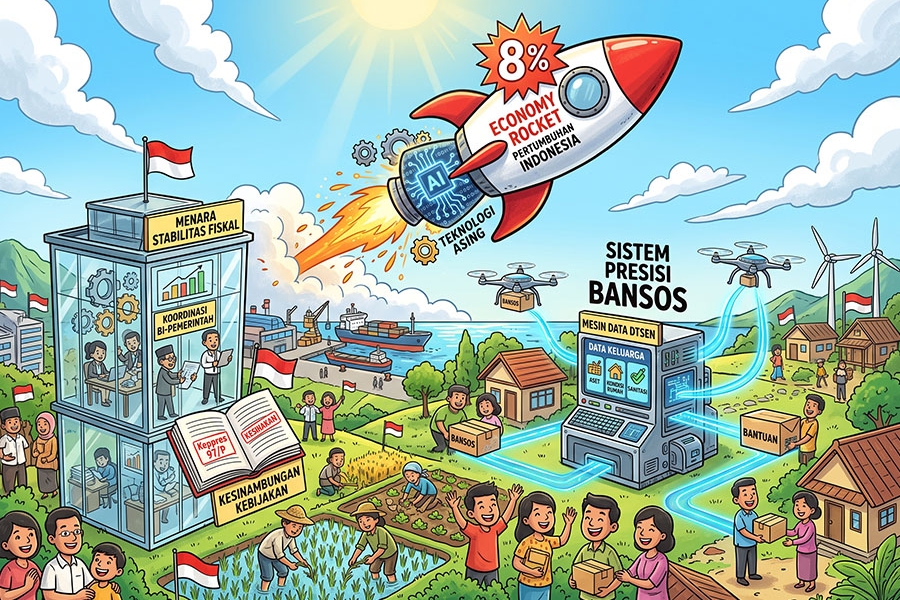
The primary deficit widening amidst a surging tax ratio indicates that the government is exercising a highly pro-growth, expansionary fiscal policy. The successful Coretax transformation, which captured trillions of rupiah from the consumption sector, proves that digital reporting literacy is capable of sealing shadow economy leakages. For the capital market and real corporate sectors, the Rp815 trillion government spending injection in the early year potentially generates a multiplier effect on grassroots purchasing power. However, the budget financing maneuvers, which have already reached Rp257.4 trillion in the first quarter, could technically absorb domestic market liquidity, compelling the banking sector to innovate continuously to retain third-party funds.
The equilibrium between digitalized tax collection and state spending aggressiveness projects sustainable medium-term growth stability. Corporate entities, particularly within the manufacturing and retail sectors, are highly recommended to immediately accelerate operational expansions to capture liquidity spillover from government expenditures, while simultaneously mitigating potential borrowing cost tightening stemming from deficit financing.


















 tpc.consulting
  tpc.consulting
  info@taxindo.co.id