



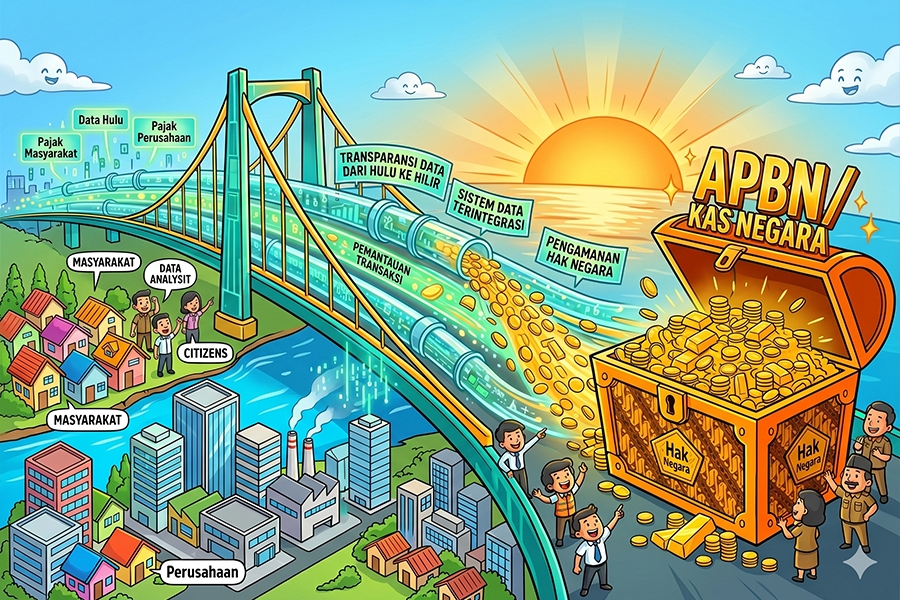
The implementation of the Coretax platform has successfully driven a drastic surge in material taxpayer compliance via integrated automatic pre-populated features. This system successfully identified a significant escalation in underpaid liabilities across both individual and corporate taxpayer segments. This digital transparency directly constricts manipulation maneuverability while concurrently bolstering state revenues amidst early-year fiscal dynamics.
National fiscal authorities recorded over 13 million Annual Tax Return (SPT) submissions by the end of April 2026. The deployment of the Coretax digital architecture triggered a positive anomaly, marked by a sharp surge in the value of public underpaid tax liabilities. The non-employee individual taxpayer segment charted the most massive escalation, skyrocketing 949 percent year-over-year to hit Rp3.02 trillion, while employee-status individuals similarly booked an 83 percent surge with total additional tax collections reaching Rp8.88 trillion,. In the corporate taxpayer sector, these additional tax liabilities also expanded by 18 percent, successfully injecting Rp50.21 trillion in liquidity into state coffers. This highly precise liability mapping establishes a novel fundamental for tax agencies to extract previously undetected revenue potentials.
This elevated reporting accuracy serves as a direct manifestation of the integrated pre-populated data technology embedded within the Coretax ecosystem. The system autonomously consolidates taxpayer financial information from end-to-end, thereby eliminating manual data entry processes while concurrently sealing wealth manipulation loopholes. Finance Minister Purbaya Yudhi Sadewa confirmed that this comprehensive automation renders aggressive tax evasion practices exceptionally difficult to execute. Although this technology has proven highly effective in securing state rights, the government acknowledges lingering constraints regarding the user interface during this transitional phase, which are currently being refined to ensure broad public access convenience. The rectification of this digital infrastructure is projected to further streamline financial information flows approaching subsequent reporting deadlines.
To accommodate the dynamics of this novel technological adaptation, the government granted administrative flexibility to business entities by extending the Corporate Annual Tax Return submission deadline to May 31, 2026. This administrative leeway is engineered to maintain business operational stability amidst obligations to comply with vastly stricter transparency standards. This reporting digitalization maneuver coincides with a crucial momentum, as the state financial structure recorded a budget deficit of Rp240.1 trillion, equivalent to 0.93 percent of the gross domestic product at the close of the first quarter. The integration of this cutting-edge compliance system is ultimately anticipated to patch State Revenue and Expenditure Budget (APBN) financing gaps through enhanced collection efficiencies from the real sector.
The massive surge in autonomously detected underpaid tax values indicates that historical voluntary compliance ratios were frequently compromised by the inaccuracies of self-assessment frameworks. The advent of Coretax disrupts this landscape by pivoting the paradigm from good-faith compliance toward empirical, data-driven compliance. For the banking sector and financial service providers, this mass transparency will significantly streamline customer creditworthiness analyses for both corporations and individuals, as tax footprints now factually mirror actual financial capacities. On a macroeconomic scale, the expansion of this organic tax base will grant the government broadened fiscal maneuverability to cushion debt volatility amidst escalating global interest rates.
The Coretax ecosystem manifests a new era of absolute financial transparency that successfully transforms bureaucratic vulnerabilities into state revenue advantages. Corporate entities and high-net-worth individuals are highly recommended to immediately accelerate their internal accounting compliance and cease asset manipulation practices, considering government oversight algorithms now possess impeccable detection capacities.

















 tpc.consulting
  tpc.consulting
  info@taxindo.co.id