



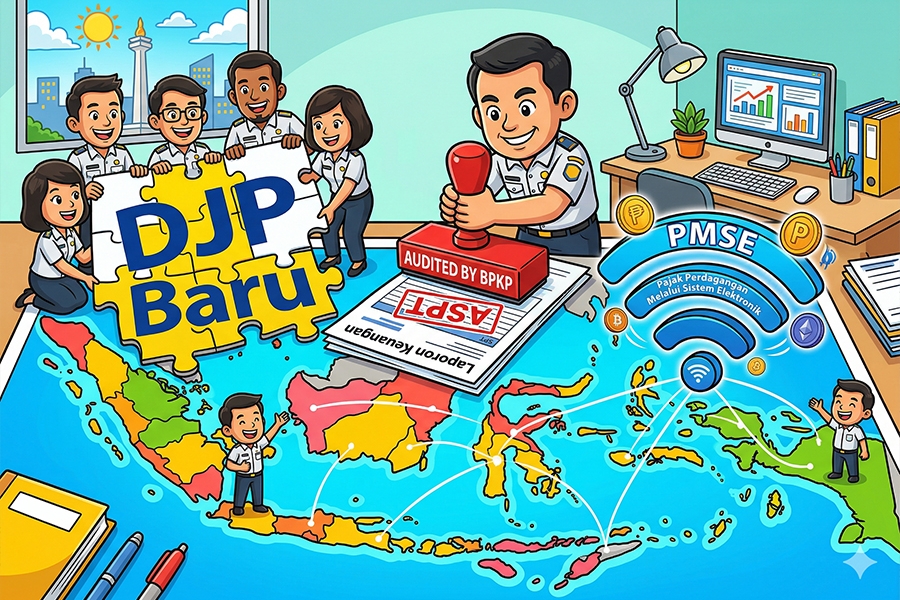
The Ministry of Finance is executing a comprehensive fiscal reform in 2026 to secure state revenues, encompassing the structural overhaul of the Directorate General of Taxes via PMK 18/2026. This measure is fortified by investigative audits with BPKP concerning natural resource tax restitutions and plans to designate local PMSEs as online merchant tax collectors. This strategic maneuver is engineered to forge a transparent taxation ecosystem while rebalancing the business playing field.
Fiscal authorities have revamped the organizational architecture of the Directorate General of Taxes (DJP) through Minister of Finance Regulation Number 18 of 2026. This directive expands service unit classifications into four hierarchies, highlighted by the establishment of Special Tax Service Offices (KPP) catering to foreign direct investments, foreign entities, the oil and gas sector, and publicly listed corporations. This restructuring further bifurcates KPP Pratama into two supervisory clusters and integrates law enforcement functions to slash bureaucratic redundancies. This institutional realignment serves as the government's primary instrument to tighten financial oversight within heavily capitalized real sectors.
In tandem with this institutional optimization, the government addresses alleged revenue leakages by collaborating with the Financial and Development Supervisory Agency (BPKP) to audit tax refunds spanning the 2020 to 2025 period. This external investigation specifically targets the natural resources sector, including the coal industry, following a surge in restitutions that breached Rp361 trillion in the preceding year. Authorities are preparing decisive actions, including criminal imprisonment, for both internal and external individuals proven to manipulate taxation procedures. This multi-layered oversight architecture aims to recover budget deficit pressures while safeguarding state rights.
As an extensification instrument, the ministry is considering appointing local electronic system trading companies (PMSE) to collect merchant taxes across marketplaces in the second quarter of 2026. Given that the economic growth in the first quarter of 2026 is projected to hit 5.5 percent, fiscal authorities will implement this policy provided the positive growth momentum is successfully maintained into the subsequent quarter. This digital tax collection maneuver is initiated to address grievances from offline business operators while simultaneously engineering a more proportional commercial competition between physical markets and cyber platforms.
The integration of these three maneuvers represents the government's radical transformation toward precision fiscal law enforcement and economic equity. The segregation of Special KPPs facilitates authorities in mapping major corporate risk profiles with high measurability, which, when coupled with investigative restitution audits, will massively sever structural tax evasion chains. On the other hand, e-commerce taxation regulations will tactically disrupt the digital business landscape, compelling millions of micro-enterprises to integrate into the formal economic ecosystem, which will ultimately multiply the national fiscal capacity exponentially.
The aggressive maneuvers of fiscal authorities in 2026 confirm the state's commitment to sealing cross-sectoral fiscal loopholes. Commercial corporations and e-commerce merchants are highly recommended to immediately accelerate their internal accounting compliance to mitigate future audit risks, while stakeholders can anticipate the cultivation of a more structured business competition climate.



















 tpc.consulting
  tpc.consulting
  info@taxindo.co.id