



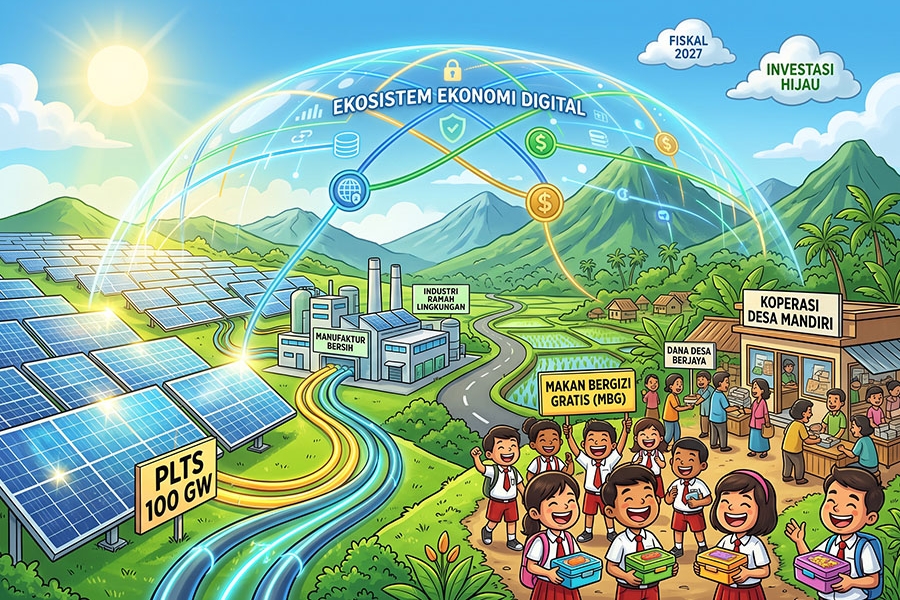
The Government of Indonesia continues to draft long-term fiscal policies while simultaneously strengthening governance across the industrial, energy, and consumer protection sectors. This strategic measure aims to maintain macroeconomic stability, enhance business climate efficiency, and ensure legal certainty in the digital financial market.
The Indonesian Government has allocated the Free Nutritious Meal (MBG) budget under the education function and channeled Village Funds to empower Village Cooperatives in the 2027 Draft State Budget (RAPBN) to enhance human resource quality and accelerate rural economic self-reliance. For the same budget period, the Ministry of Finance targets tax expenditures of IDR 632 trillion, predominantly driven by consumption tax incentives. This integrated fiscal policy focuses on safeguarding public purchasing power while stimulating national manufacturing activities.
In the infrastructure and energy sectors, President Prabowo Subianto has launched the first phase of a 100 GW Solar Power Plant (PLTS) project as a concrete step toward accelerating the national energy transition. This megaproject reinforces Indonesia's position in attracting global green investment inflows and driving future industrial supply chain efficiency. This alignment of efficiency also extends to the digital retail sector, where e-commerce platform operators are enhancing transparency around platform fee structures to enable MSME players to accurately calculate their business profit margins.
Despite rapid economic growth and digitalization, the Indonesian Consumers Foundation (YLKI) has issued strong criticism regarding the unilateral blocking of customer bank accounts by banking institutions. YLKI considers that account blockings without clear criteria undermine basic consumer rights and disrupt daily public transactions. Therefore, national banking authorities must promptly align customer protection regulations so that digital economic growth remains balanced with guaranteed legal certainty.
This series of budgetary policies, tax incentives, and consumer protection dynamics carries strategic implications for various national stakeholders. The allocation of IDR 632 trillion in tax expenditures and e-commerce fee transparency provides business margin certainty and operational efficiency for local enterprises and MSMEs. Simultaneously, the launch of the 100 GW solar power megaproject opens large-scale investment opportunities for investors in the new and renewable energy (NRE) technology sector and its supporting manufacturing industries. At the public level, strengthened budget allocations for the Free Nutritious Meal (MBG) program and Village Funds bolster community welfare in rural areas, while the surge in unilateral account blocking issues requires banking customers to be more vigilant in monitoring their legal perbankan rights and protections.
Overall, the integration of state budget planning, clean energy project acceleration, and digital financial transaction regulation serves as the primary foundation for maintaining national economic resilience. A thorough understanding of regulatory dynamics and market developments is critical for business players and investors to minimize operational risks while maximizing future growth opportunities.













 tpc.consulting
  tpc.consulting
  info@taxindo.co.id