



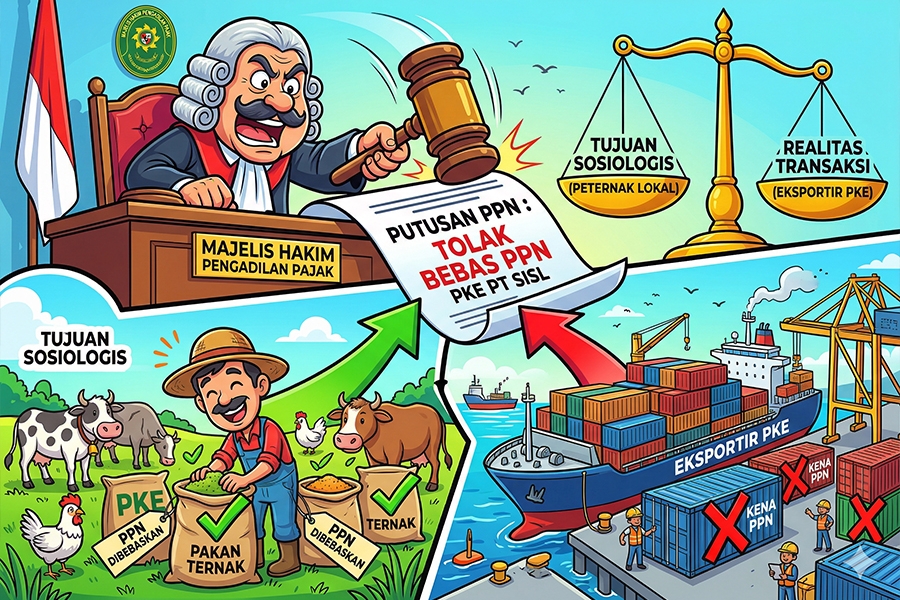
A dispute concerning the classification of strategic taxable goods has re-emerged in the Tax Court, involving the interpretation of the delivery of Palm Kernel Expeller (PKE) or palm kernel meal. The central focus of this case is whether the VAT exemption remains applicable when goods, which are technically animal feed materials, are delivered to an exporter rather than directly to a livestock farmer. An interpretive conflict arose between the fulfillment of objective criteria based on the type of goods and the sociological objective of the tax incentives provided by the state.
PT SISL (the Taxpayer) argued that PKE is essentially a waste product of palm kernel processing used as animal feed, thereby qualifying for the VAT exemption facility under Government Regulation Number 81 of 2015 (PP 81/2015). PT SISL emphasized that as long as the goods are classified as feed materials, the facility is inherent regardless of the buyer's profile.
Conversely, the Directorate General of Taxes (DJP) performed an audit correction based on the argument that the PKE purchaser was a large-scale exporter. The DJP assessed that deliveries intended for export by a third party do not support the independence of the national livestock sector, which is the core spirit of granting such VAT exemptions.
In its legal consideration, the Panel of Judges maintained a strict stance that tax facilities are limitative in nature. The fact that PKE has alternative uses beyond animal feed and was delivered to an exporter led the court to conclude that the technical requirements in the implementing regulations were not cumulatively met. The Panel also considered PT SISL's conduct since 2021, where it began collecting VAT on identical transactions, viewing this as an inconsistency in tax treatment. This decision reaffirms that to obtain a VAT exemption, a Taxpayer must not only prove the type of goods but also ensure that the distribution chain aligns with the regulatory objectives.
The conclusion of this case underscores the importance of accuracy in goods classification on invoices and tax factures, as well as a deep understanding of the Ministry of Finance Annexes that detail strategic goods. This "Reject" verdict serves as a signal for palm oil processing industry players to be more cautious in applying VAT exemption facilities, especially if the buyers of their by-products are not the end-users within the livestock sector.
















 tpc.consulting
  tpc.consulting
  info@taxindo.co.id