



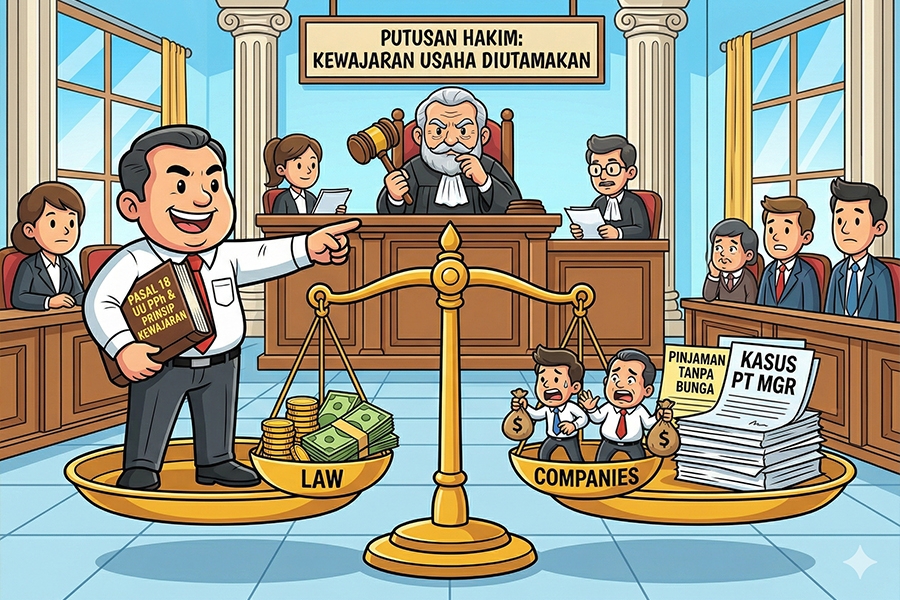
Article 18 paragraph (3) of the Indonesian Income Tax Law (UU PPh) grants the Directorate General of Taxation (DJP) full power to reclassify income from related-party transactions deemed non-arm's length. In the dispute between PT MGR and the DJP, the conflict centered on the interpretation of interest-free loans provided by a subsidiary to its parent entity. The DJP applied a deemed interest income correction, arguing that such an arrangement deviated from the arm's length principle, despite being a purely domestic transaction.
This conflict stems from differing views on Government Regulation No. 94 of 2010 (PP 94/2010). PT MGR believed that as long as there were commercial justifications, such as financial distress at the borrower's end, zero-interest loans were justifiable for group continuity. However, the DGT strictly applied the cumulative requirements of the regulation, which only recognizes interest-free loans if provided by a shareholder (parent) to its subsidiary, not vice-versa. This structural imbalance in the transaction led the DJP to impose a fair market interest rate on the funds provided.
The Tax Court, in its deliberation, upheld the DJP's position, stating that the arm's length principle must be applied to every affiliate transaction without exception, whether cross-border or domestic. The judges emphasized that the interest exemption in PP 94/2010 is a limited exception and should not be broadly interpreted. Since PT MGR acted as the subsidiary providing the loan, it failed to meet the legal qualifications for an interest-free loan. Consequently, the Court validated the deemed interest as taxable income for PT MGR.
This decision serves as a strong warning for corporations in Indonesia that intra-group liquidity management (cash pooling) or affiliated loans must be supported by robust transfer pricing documentation. Disregarding the arm's length principle, even when aimed at supporting a loss-making affiliate, carries a high risk of significant tax adjustments. Companies are advised to review their policies on interest-free loans from subsidiaries to parents to mitigate future deemed income risks.
A Comprehensive Analysis and the Tax Court Decision on This Dispute Are Available Here













 tpc.consulting
  tpc.consulting
  info@taxindo.co.id