



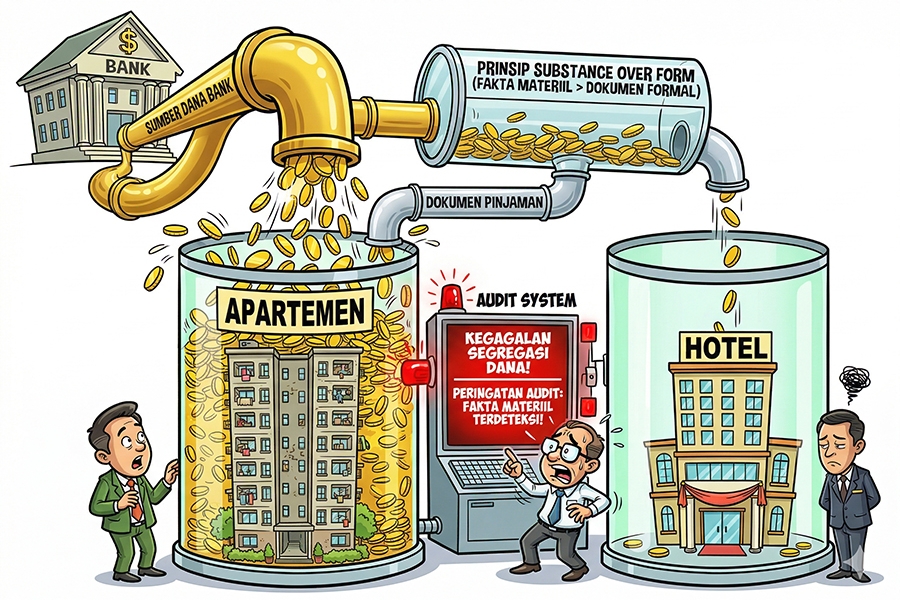
The application of Article 9 paragraph (1) letter a of the Income Tax Law (UU PPh) strictly prohibits the deduction of expenses incurred to obtain, collect, and maintain income subject to Final Income Tax (PPh Final in Indonesian) from Gross Income. In the property sector, this issue frequently arises when a Taxpayer finances the construction of assets yielding both Final Income Tax income (sale of property units) and Non-Final Income Tax income (hotel rental/operations) using a single bank loan. This case highlights how the Tax Court relied on the principle of substance and cash flow testing to reject the appeal by PT SID, whose main dispute was a positive fiscal adjustment to interest expense amounting to IDR 10,110,340,064.00.
The Directorate General of Taxes (DJP) argued that the interest expense must be nationalized (made non-deductible) because a cash flow test revealed that the majority of the loan funds were used to cover the deficit in construction costs for inventories (apartment/condotel units), the sale of which is subject to Final Income Tax. Consequently, the interest expense associated with this portion of the loan cannot be deducted from the Taxable Income (PKP) of PT SID. Conversely, PT SID argued that proportionately, the bank loan was primarily allocated to the construction of the Hotel and Convention Center assets (yielding Non-Final Income Tax income), meaning 97.86% of the interest should have been deductible. PT SID's rebuttal also claimed that the funding needs for the Final Income Tax property were fully met by customer down payments (surplus funds), making the use of bank loans for Final Income Tax purposes only incidental and temporary.
The Tax Court issued a firm legal opinion based on material evidence. The Panel agreed with the DJP after conducting an in-depth review of PT SID's General Ledger and cash flow statements. Factually, the operating cash flow for the construction of real estate inventory (the Final Income Tax object) was found to be in deficit, and this deficit was verifiably covered by the bank loan drawdowns. The Panel's decision explicitly demonstrates the application of the Substance Over Form principle; the formal purpose stated in the loan agreement was set aside in favor of the actual use of the funds. The Panel concluded that the DJP had successfully proven the direct link between the loan and the generation of Final Income Tax income. Therefore, the positive fiscal adjustment correction of IDR 10,110,340,064.00 was valid and in compliance with Article 9 paragraph (1) letter a of the Indonesian Income Tax Law (UU PPh).
This decision carries significant implications, particularly for property developers or companies running multi-phase projects with varying tax regimes (Final Income Tax vs. Non-Final Income Tax). The Tax Court effectively rejected PT SID's argument regarding customer down payment surplus funds and prioritized the audit trail of the actual fund flow. The key takeaway is that Taxpayers must implement a highly detailed accounting system, ideally using specific borrowing and separate bank accounts to finance Non-Final Income Tax projects. If a general borrowing scheme is unavoidable, the Taxpayer must ensure that the allocation of interest expense is calculated accurately, logically, and verifiable, referencing the provisions for allocating common costs.
This Tax Court decision sets a strong precedent, affirming the DJP's authority to use cash flow testing to identify the true allocation of interest expense. The future strategy for Taxpayers must shift from focusing on the formal purpose of the loan to substantial proof through auditable transparency and fund segregation.
A Comprehensive Analysis and the Tax Court Decision on This Dispute Are Available Here













 tpc.consulting
  tpc.consulting
  info@taxindo.co.id