



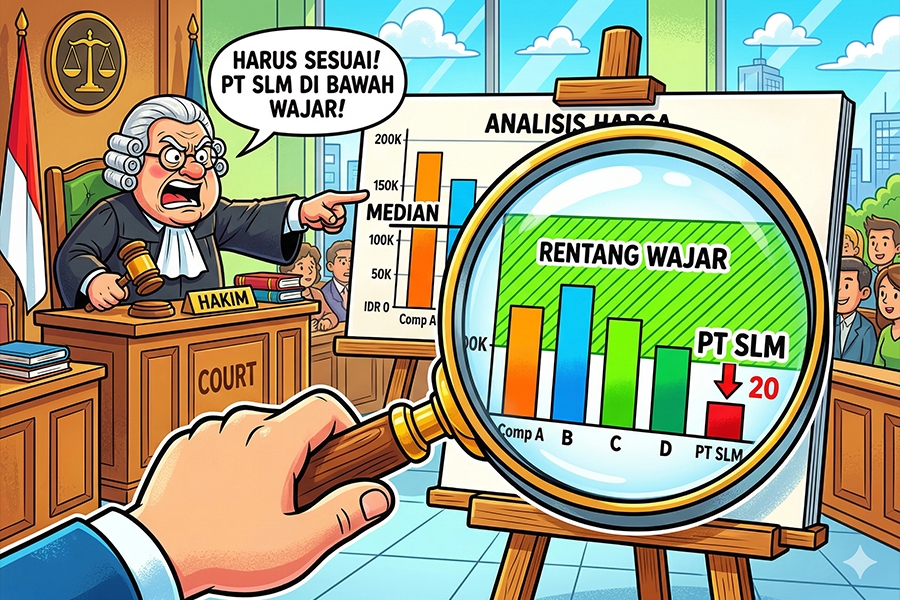
The determination of transfer pricing in affiliated transactions has once again come under intense scrutiny at the Tax Court through the ruling on the PT SLM case. This dispute centers on the correction of the Cost of Goods Sold (COGS) performed by the tax authority due to the company's low operating profit compared to similar companies in the market. Although PT SLM argued that the national ceramic industry was slumping due to stifling industrial gas prices and a surge of imported products, the tax authority remained steadfast in using the Transactional Net Margin Method (TNMM) testing. This testing showed PT SLM's financial position to be far below the arm's length interquartile range.
The core of the conflict emerged when PT SLM attempted to convince the Panel of Judges that the losses they experienced were valid "economic losses" requiring specific adjustments in the comparability analysis. On the other hand, the Directorate General of Taxation (DJP) emphasized that market risks and fluctuations in operating costs are part of the business risks that must be borne by the company's management, rather than a justification for non-arm's length affiliated transactions. The DJP utilized internal data from PT SLM's own Transfer Pricing Documentation (TP Doc) to prove that the operating profit margins in the manufacturing and distributor segments did not meet the Arm's Length Principle (ALP).
In its consideration, the Panel of Judges took a strict stance regarding the burden of proof for economic adjustments. The Judges assessed that the arguments concerning import barriers were inconsistent with the fact that the government had already implemented Safeguard Duty protection policies. Furthermore, comparisons with other industry players demonstrated that operational efficiency still allows companies to record profits even when market conditions are difficult. PT SLM's failure to specifically quantify the impact of external factors on its operating profit led the Panel of Judges to uphold the DJP's correction and set the profit margin at the median point.
The implications of this ruling provide a strong signal for multinational Taxpayers not to rely solely on qualitative narratives when facing transfer pricing disputes. Success in maintaining a low profit margin position depends heavily on the strength of documentation capable of mathematically dissecting the relationship between operational losses and extraordinary factors beyond the company's control. Without measurable evidence and precise comparable data, the tax authority holds full authority to perform profit re-determinations based on prevailing statistical standards.
In conclusion, this dispute reinforces that tax management strategies and the preparation of TP Docs must be carried out proactively and in-depth. Companies need to ensure that every proposed economic adjustment is supported by solid evidence and not merely regarded as routine business risk. Managing strong evidence from the audit stage is the primary key to minimizing the risk of defeat at the Tax Court litigation level.













 tpc.consulting
  tpc.consulting
  info@taxindo.co.id