



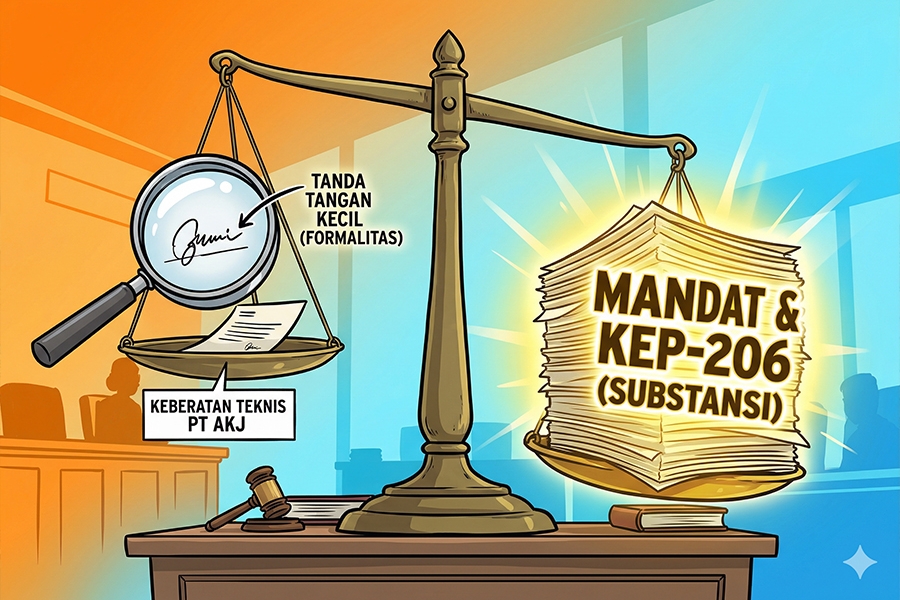
Tax administrative disputes frequently center on the formal procedures for issuing legal documents. In the case of PT AKJ, the primary issue involved the validity of a Tax Collection Letter (Surat Tagihan Pajak/STP in Indonesian) issued as a consequence of a Tax Court decision that rejected PT AKJ's appeal. PT AKJ sought to invalidate the STP by arguing that the audit period had expired and that the document was signed by an official lacking direct attribution authority.
The core of this conflict lies in the interpretation of Article 14 paragraph (1) of the General Provisions and Tax Procedures Law (UU KUP) and the Government Administration Law (UU AP). PT AKJ believes that the Head of the Supervision Section was not authorized to sign the STP. Furthermore, the STP was not preceded by an Audit Result Report (LHP) and timely field examination. Conversely, the Directorate General of Taxes (DJP) asserted that the official in question had received a mandate from the Director General of Taxes in accordance with the provisions of KEP-206/PJ/2021. Furthermore, the STP was purely the result of an administrative review of existing data (the Tax Court decision), and therefore is not bound by the formal duration of a field audit.
In its resolution, the Panel of Judges rejected PT AKJ’s arguments. The Judges affirmed that KEP-206/PJ/2021 serves as a valid legal basis for the DJP to grant signing mandates to subordinate officials for the smooth operation of government duties. Furthermore, the Panel clarified that not all STPs are products of an audit; regarding penalties arising from a rejected appeal, the administrative research procedure is a legally valid path.
The implications of this ruling for Taxpayers highlight the necessity of diligence in distinguishing between types of formal disputes. Relying on procedural flaws regarding signing mandates has become increasingly difficult following jurisprudence that supports the DJP’s bureaucratic efficiency. Taxpayers must focus more on material substance or compliance with administrative application timeframes to ensure their legal rights remain protected.
A Comprehensive Analysis and the Tax Court Decision on This Dispute Are Available Here













 tpc.consulting
  tpc.consulting
  info@taxindo.co.id