



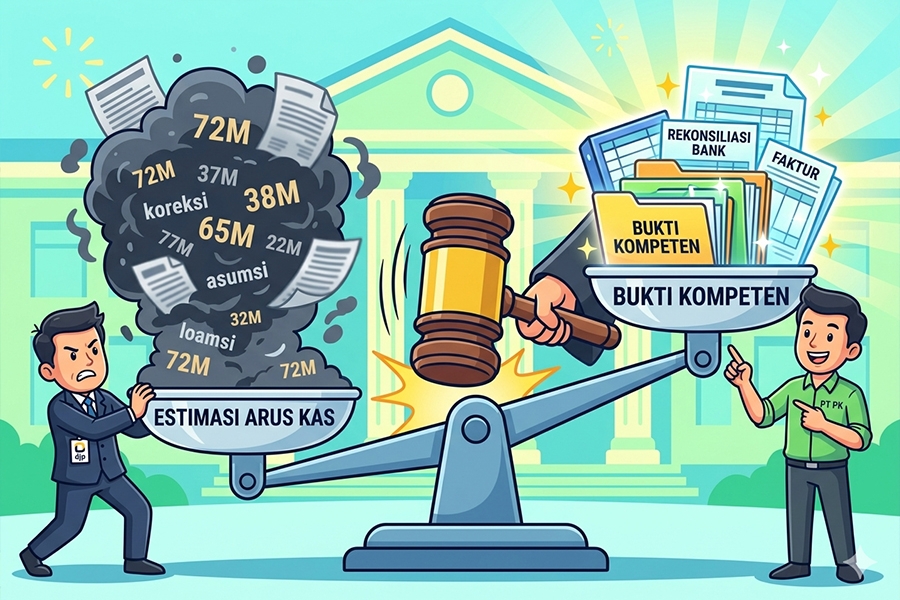
The Directorate General of Taxes (DJP) issued a positive correction to PT PK's Sales Turnover amounting to IDR 72,384,978,514.00 based on indirect audit techniques, specifically accounts receivable and cash flow testing. The DJP argued that credit mutations in PT PK's bank accounts that could not be detailed were deemed additional economic capacity taxable under Article 4 paragraph (1) of the Indonesian Income Tax Law (UU PPh). The DJP emphasized that the burden of proof for the inaccuracy of such data rested with PT PK as the taxpayer, per their interpretation of Article 12 paragraph (3) of the General Provisions and Tax Procedures Law (UU KUP).
PT PK strongly refuted the correction, arguing that the figures were fictitious and not based on actual transaction evidence. PT PK explained that the majority of the bank mutations originated from time deposit withdrawals, refunds of erroneous transfers, and debt settlements via third parties already reported in the opening balance of receivables. PT PK stressed that the indirect method in SE-65/PJ/2013 is merely a tool to find clues, not absolute proof to establish tax liability without additional competent evidence.
In its legal consideration, the Panel of Judges stated that the DJP had erred in applying the burden of proof. According to Article 12 paragraph (3) of the UU KUP, the DJP is obligated to prove that PT PK's return is incorrect. Using cash flow testing without verifying source documents such as sales invoices or contracts was deemed speculative. The Panel found that the DJP even included time deposit withdrawals in the turnover components, which accounting-wise is clearly an asset mutation, not income.
The implications of this verdict reaffirm the principle of legal certainty: tax corrections must not be based on mere assumptions. PT PK's absolute victory serves as a vital precedent for taxpayers to maintain detailed bank reconciliations and account mutation records to debunk DJP's arguments that often rely only on cumulative credit mutation figures without considering the substance of the transactions.
A Comprehensive Analysis and the Tax Court Decision on This Dispute Are Available Here














 tpc.consulting
  tpc.consulting
  info@taxindo.co.id