



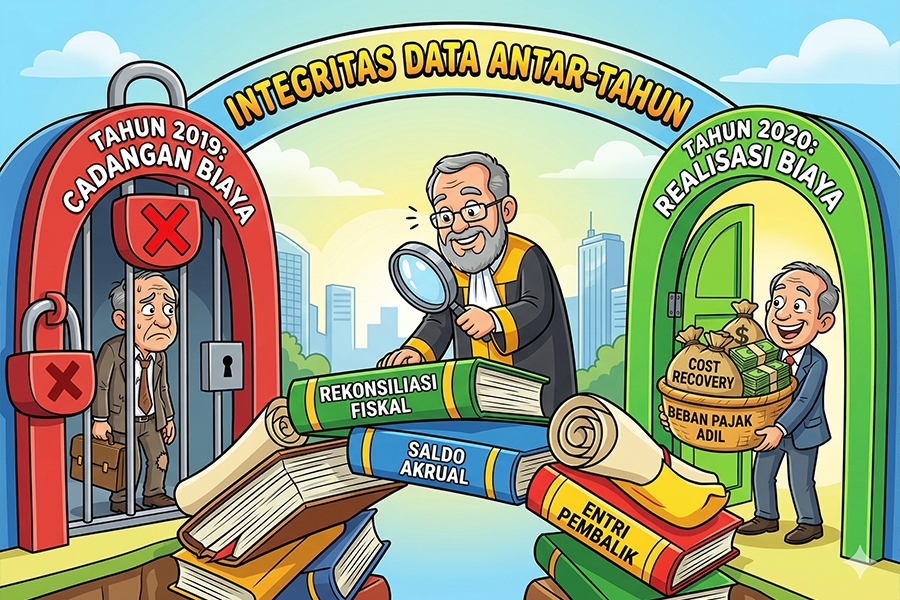
Tax disputes often stem from a misunderstanding of fiscal adjustment mechanisms regarding timing differences, as experienced by PT DIAMGI. In this case, the tax authority implemented a positive correction on operating expenses amounting to IDR 3,924,926,751.00 due to negative values recorded in the positive fiscal adjustment column. The primary issue lay in the interpretation of accounts ranging from Employee Development to Payroll Processing, which the Directorate General of Taxes (DJP) deemed unsupported by competent evidence and inconsistent with the current accounting records.
The core of this conflict involves the treatment of accrual costs which, according to tax regulations under Article 9 paragraph (1) letter c of the Indonesian Income Tax Law (UU PPh), are categorized as non-deductible reserve funds. PT DIAMGI had compliantly performed positive fiscal corrections in 2019 for these reserves. However, when these costs were realized in cash during 2020, PT DIAMGI applied negative fiscal adjustments to balance the tax burden previously paid in advance. The DJP rejected this logic on the grounds that the values in the current year's bookkeeping were smaller than the claimed adjustment values.
The Panel of Judges provided a resolution by prioritizing the principle of material truth and the accrual basis in accordance with Article 28 of the General Tax Provisions and Procedures Law (UU KUP). Through an in-depth examination of internal evidence, including details of opening accrual balances, reversing entries, and fiscal reconciliations from the previous year, the Panel was convinced that the negative fiscal adjustments were valid. Without these adjustments, PT DIAMGI would face double taxation on the same expenses, which contradicts the principle of justice.
The implication of this ruling confirms that the Tax Court recognizes the validity of negative fiscal adjustments as a "recovery" mechanism for costs previously corrected due to timing differences. A crucial conclusion for tax practitioners is the vital importance of maintaining data integrity between tax years. This case proves that consistent and sequential reconciliation documentation is the ultimate weapon in facing corrections that are administrative in nature but carry significant financial impact.













 tpc.consulting
  tpc.consulting
  info@taxindo.co.id