



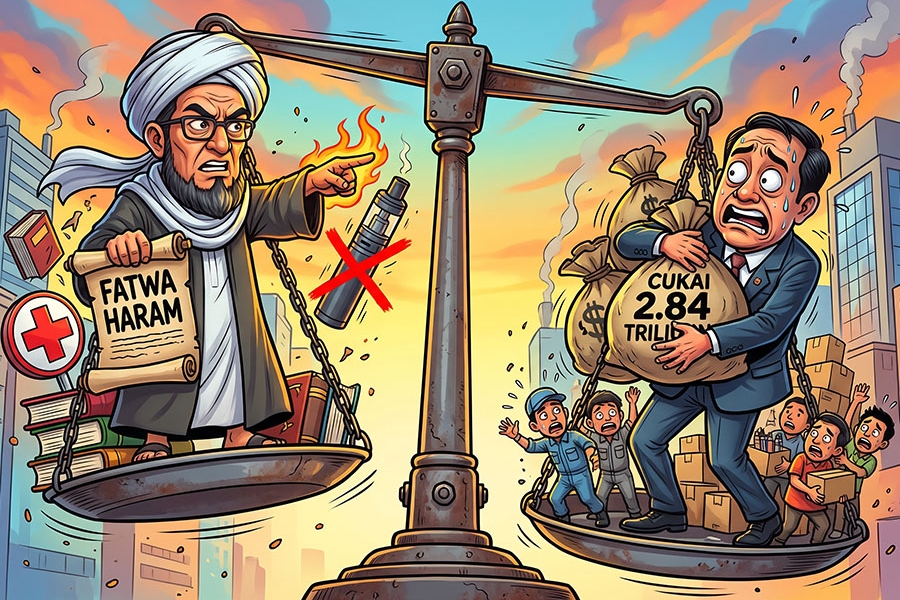
The issuance of the Indonesian Ulema Council (MUI) Fatwa Number 131 of 2026, declaring the use, production, and trade of electronic cigarettes (vapes) haram, has thrust the government into a high-stakes policy dilemma. While aiming to protect public health and curb narcotics abuse, a blanket restriction threatens massive economic fallout, jeopardizing billions in state excise revenue, significant export contracts, and the livelihoods of a massive workforce. The government is now under intense pressure from both the Constitutional Court and industry associations to meticulously weigh health risks against fiscal and macroeconomic realities before finalizing regulatory actions..
The Indonesian Ulema Council (MUI) formalized Fatwa Number 131 of 2026 on November 6, 2026, announcing it to the public on November 9. The fatwa explicitly declares that the use of vapes is haram (forbidden), alongside a strict prohibition on the misuse of the devices for narcotics, psychotropics, and other addictive substances. Crucially, this religious ruling extends to the entire supply chain, forbidding the production and trade of electronic cigarettes. Driven by health risks, environmental impacts, and the device's potential as a conduit for illicit drug circulation, the MUI has formally recommended the Ministry of Finance evaluate related fiscal policies and the Ministry of Industry revoke sector licenses. The council also urged the President and the House of Representatives (DPR) to draft binding legislation to outright ban and penalize vape distribution. However, the fatwa is not legally binding state law; enforcement remains entirely contingent on subsequent government legislation.
This push for prohibition directly collides with the sector's escalating fiscal contributions. State excise revenue from electronic cigarettes has surged steadily, climbing from Rp1.75 trillion in 2023, to Rp2.65 trillion in 2024, and reaching Rp2.84 trillion in 2025. This undeniable financial footprint drew sharp scrutiny during the Constitutional Court (MK) plenary session for Case Number 363/PUU-XXIV/2026 regarding the judicial review of the Health Law. MK Deputy Chief Justice Saldi Isra challenged the government and the DPR to present empirical data comparing the fiscal contributions of vapes versus conventional cigarettes, demanding justification for whether this state revenue is proportional to the severe negative health risks inflicted upon the public.
The threat of a blanket ban has triggered deep alarm across the industry, spearheaded by the Indonesian Personal Vaporizer Association (APVI). The association warned that a long-term demand shock will decimate business actors, particularly MSMEs entirely reliant on vape retail. According to Ministry of Industry data, the electronic cigarette supply chain—spanning production, packaging, distribution, and retail—currently employs approximately 100,000 workers. APVI highlighted that cumulative industry investment has reached Rp31 trillion, with 2025 export values hitting US$518 million. Should the prohibition extend to export-oriented production, the fallout will violently disrupt international trade contracts, shutter factories, and trigger mass layoffs.
Echoing this alarm, the Indonesian Vape Retail Association (ARVINDO) and the Indonesian Vape Workers Association (APVINDO) stressed that regulatory uncertainty is already paralyzing business continuity. ARVINDO reported immediate operational disruptions among several retailers following the fatwa's announcement. In response, all three associations are demanding an open dialogue with both the MUI and the government. APVI is urging the government to initiate a comprehensive study involving health experts, economists, and labor representatives to accurately map the fallout on MSMEs, investment, exports, and employment.
Rather than a destructive blanket ban, the associations are lobbying for precision enforcement: aggressively eradicating illegal, untaxed products, strictly blocking underage access, and severely penalizing the modification of devices for narcotics. They argue that legal certainty for compliant businesses and structured mitigation for workers must be central to any regulatory overhaul.
The government now faces the critical task of navigating a multidimensional crisis. Finalizing the regulatory architecture for electronic cigarettes will require a ruthless, data-driven calculation that balances the absolute necessity of public health protection with the severe socio-economic consequences of wiping out a multi-trillion rupiah industry and a massive workforce.













 tpc.consulting
 tpc.consulting
 info@taxindo.co.id