



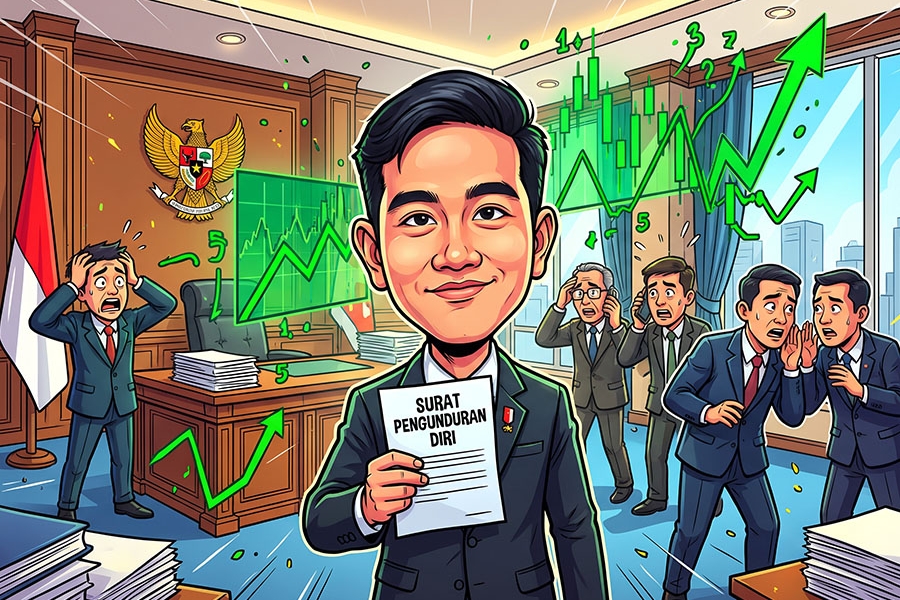
Vice President Gibran Rakabuming Raka’s intention to resign amidst the escalating polemic over Supreme Court (MA) and Constitutional Court (MK) rulings has ignited intense scrutiny regarding Indonesia's political stability and economic trajectory. While the government insists macroeconomic fundamentals remain robust—evidenced by the Jakarta Composite Index (IHSG) rallying 1.02%—economists and business leaders warn that prolonged political uncertainty will inflate investor risk premiums, stall capital expansion, and pressure the state's fiscal space. Bridging this divide requires absolute legal certainty, governmental stability, and policy consistency to prevent elite friction from bleeding into the real economy..
Vice President Gibran Rakabuming Raka reportedly conveyed his intention to resign during a 2.5-hour meeting with President Prabowo Subianto at the State Palace on Tuesday (November 10, 2026). The meeting addressed the political fallout following rulings by the MA and MK, which invalidated the high school equivalency certificate Gibran used for his 2024 presidential candidacy and stated no equivalent graduation documents were found in Singapore or Australia. Gibran requested the opportunity to prove the legitimacy of his documents through the State Administrative Court (PTUN). Concurrently, political pressure in parliament is boiling over, with 50 DPR members across six factions pushing for the Right to Express Opinion (HMP)—a constitutional mechanism investigating alleged legal violations by the President or Vice President.
Despite this unprecedented political tremor, the government rapidly moved to project economic invulnerability. The Coordinating Minister for Economic Affairs stated that the government is closely monitoring the situation but assessed that national economic fundamentals remain highly resilient and parliament remains relatively solid. This confidence was immediately mirrored by the capital markets, with the IHSG closing up 1.02% (51.95 points) to the 5,125.72 level on Tuesday’s trading. The government maintains that as long as political dynamics are managed constructively, they will not exert meaningful pressure on macroeconomic stability.
Political-economy analysts largely agree that the friction remains quarantined at the elite level. Because this dispute centers on legal and political legitimacy rather than a battle over economic resources or macroeconomic policy shifts, it lacks a direct transmission mechanism to the real economy. Until elite turbulence triggers widespread social unrest or arbitrary regulatory changes, the immediate operational impact on businesses and consumers remains negligible.
However, ignoring the indirect risks of this political drama could prove costly. The Center of Economic and Law Studies (CELIOS) warned that the conflict is already distracting key officials and disrupting the government's administrative effectiveness. For foreign direct investment (FDI) and capital markets, political uncertainty is a quantifiable risk. CELIOS highlighted that the yield on 10-year Government Securities (SBN) has already breached 7.7%, a stark indicator that creditors are actively pricing political instability into Indonesia's sovereign risk. If political turbulence incites social unrest, it will inevitably demand unplanned government spending, further compressing an already tight fiscal space.
The business sector is formally echoing these anxieties. The Indonesian Chamber of Commerce and Industry (Kadin) emphasized that political stability, regulatory certainty, and policy consistency are the absolute bedrock for corporate expansion and foreign investment. Kadin warned that a prolonged elite standoff will force investors into a paralyzing "wait and see" stance, freezing long-term capital deployments and potentially triggering volatility in both the rupiah and the stock market.
Ultimately, politics and economic stability are inextricably linked. The resolution of the Vice President's resignation must proceed through transparent, constitutional channels to quickly restore absolute certainty. The government must aggressively communicate that national development agendas—including infrastructure, industrial downstreaming, and job creation—will proceed uninterrupted. For corporate actors and investors, this dynamic serves as a stark reminder to bake political risk mitigation into their long-term feasibility studies, remaining highly agile against sudden shifts in currency markets and fiscal policy.








 tpc.consulting
 tpc.consulting
 info@taxindo.co.id