



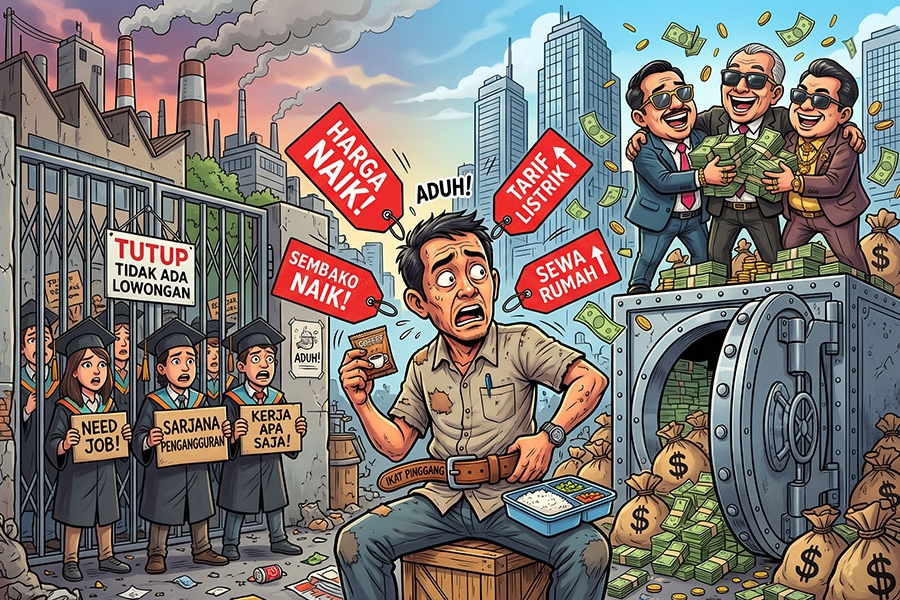
Total public savings across Indonesian commercial banks surged past Rp10,513 trillion as of September 2026, driven by affluent households adopting defensive stances by withholding discretionary spending. Concurrently, open unemployment among Gen Z youth rose to 17.50% due to inadequate formal job creation aligned with entry-level capabilities. These financial pressures are compelling middle-class households to scale down lifestyle standards to survive persistent staple living cost increases..
The current domestic economic landscape exhibits paradoxical dynamics directly influencing household financial resilience across various population segments. On one front, the banking system registers mounting deposit liquidity accumulations, while on the other, the labor market struggles to absorb young workers, triggering daily consumption adaptations at the grassroots level.
The Indonesia Deposit Insurance Corporation recorded an 8.65% annual growth in total bank deposits, reaching a value of Rp10,513 trillion in September 2026. LPS Board of Commissioners Chairman detailed that third-party fund expansions occurred across all account balance tiers. Deposit accounts holding balances exceeding Rp5 billion recorded the highest growth at 11.91%, while accounts holding below Rp100 million expanded by 7.15%.
Economic analysts evaluate that this bank liquidity accumulation reflects precautionary saving motives rather than genuine improvements in public prosperity. ISEAI Senior Analyst and CORE Indonesia Economist noted that high-income earners are deliberately postponing discretionary retail spending to anticipate future economic uncertainties. In contrast, middle-class households face heightened difficulties setting aside savings because daily living expenses absorb larger portions of their income. This consumption-withholding tendency shadowing the real economy directly interacts with intense employment hurdles facing entry-level job seekers.
Statistics Indonesia reported a rise in the open unemployment rate for young citizens aged 15 to 24 years, reaching 17.50% in August 2026. This 0.61 percentage point increase in Generation Z unemployment contrasts with the national unemployment rate, which dropped to 4.75%. ISEAI Analyst highlighted that this labor anomaly indicates macroeconomic growth has not translated into sufficient, quality employment opportunities for new workforce entrants.
Elevated youth unemployment stems from mismatches between educational curricula and digitalized industrial demands, sluggish formal job growth, and restrictive prior-experience requirements for entry-level applicants. Heavy investment concentration in capital-intensive sectors also limits broad-scale workforce absorption. He warned that prolonged youth unemployment risks inducing long-term scarring effects that threaten to transform the national demographic dividend into a demographic burden. Restricted earning opportunities for new job seekers constrain household spending flexibility, compelling families to adopt defensive survival measures.
Banking surveys and sociological field observations reveal a widespread lifestyle downgrade trend among urban households. Consumers increasingly pack meals from home, replace specialty cafe coffee with affordable sachet options, and cut back travel spending to protect wallet liquidity. Bank Indonesia's October 2026 survey documented annual sales contractions across household equipment at 2.9% alongside information and communication equipment at 2.5%.
UNJ Sociologist interprets this development as a renegotiation of acceptable living standards that is openly framed as a rational and positive choice across social media channels. INDEF Senior Economist explained that households actively seek cheaper substitute goods as price inflation for rice, eggs, chilies, and educational tuition exceeds 5%, while annual wage increases linger between 1.5% and 3%. Responding to shifting purchasing power, UNAIR Economics Professor observed that consumer goods manufacturers are rapidly deploying sachetization packaging strategies to keep essential items accessible.
Interconnected trends involving bank liquidity buildup, climbing youth unemployment, and lifestyle frugality adjustments deliver tangible consequences for all economic stakeholders. For retail and manufacturing enterprises, cautious consumer spending demands adopting value-pricing strategies and rebalancing reliance away from premium product lines. Meanwhile, for the broader public and young workforce entrants, disciplined financial adaptation and digital skill upgrades remain essential to protect household purchasing power amid elevated living costs.
In conclusion, revitalizing the domestic economy requires coordinated policy actions that integrate purchasing power protections with accelerated formal job creation. The government is recommended to provide tax incentives for labor-intensive industries hiring young workers, stabilize staple food commodity prices, and expand vocational apprenticeship channels directly linked to industrial demands. Commercial enterprises are advised to optimize operational efficiencies and expand budget-friendly product portfolios to maintain sustainable commercial cash flows.













 tpc.consulting
 tpc.consulting
 info@taxindo.co.id