



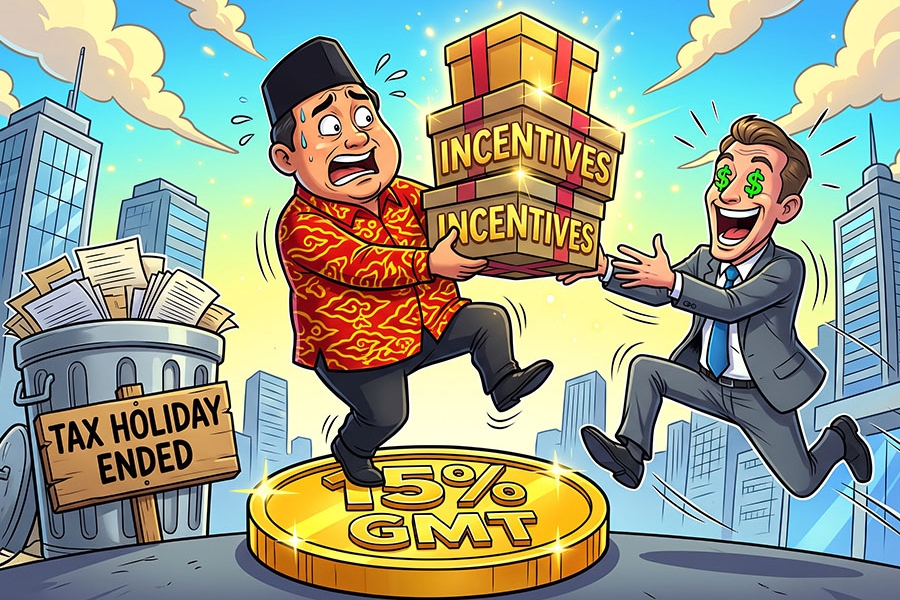
The Ministry of Finance is evaluating three alternative fiscal incentive schemes to maintain Indonesia's investment appeal amidst the implementation of the 15% Global Minimum Tax (GMT). Concurrently, the government plans to sunset the traditional tax holiday facility, as it fails to meet the OECD's qualified tax incentive criteria. Despite projecting relatively small additional tax revenues and high administrative costs, Indonesia remains fully committed to enforcing the GMT to secure its sovereign taxing rights.
The Ministry of Finance is currently reviewing three alternative fiscal incentive schemes to sustain the flow of foreign direct investment following the global rollout of the 15% Global Minimum Tax (GMT). This international tax policy fundamentally disrupts traditional tax facilities, particularly the 100% Corporate Income Tax (PPh Badan) exemption, commonly known as a tax holiday. The International Taxation Director at the Directorate General of Taxes (DJP) explained that the GMT is explicitly designed to halt the international "race to the bottom" where countries compete by offering increasingly lower tax rates. A DJP official further noted that the GMT's impact ripples beyond tax holidays, also affecting tax allowances, investment allowances, and super tax deductions.
The GMT severely restricts Corporate Income Tax exemptions for multinational enterprise (MNE) groups generating consolidated revenues above EUR 750 million. If an entity's effective tax rate falls below the 15% threshold, the relevant jurisdiction can impose a "top-up tax." This structural shift is forcing the Indonesian government to overhaul the fiscal incentives it has historically relied upon to court investors. However, this policy adjustment is inseparable from Indonesia's overarching commitment to enforce the GMT, even if the direct revenue upside is marginal.
The DJP emphasized that Indonesia has actively enforced the GMT since 2025 through Minister of Finance Regulation (PMK) Number 136 of 2024. While acknowledging that the potential revenue from the top-up tax is not massive and carries high administrative costs, the DJP maintains the policy is strictly necessary to protect Indonesia's sovereign taxing rights over MNE groups operating within its borders. This supplementary tax is levied via three mechanisms: the Qualified Domestic Minimum Top-up Tax (QDMTT), the Income Inclusion Rule (IIR), and the Undertaxed Profits Rule (UTPR). Through these mechanisms, Indonesia ensures it captures the tax deficit if a qualifying entity's effective tax rate dips below 15%.
Interestingly, the GMT has not yet triggered a massive repatriation of national conglomerate investments currently parked in low-tax jurisdictions like Singapore. The DJP explained that corporate decisions regarding investment locations are not solely dictated by tax rates; they hinge heavily on legal certainty, regulatory stability, and mature financial infrastructure. Consequently, a global tax floor does not automatically force companies to relocate their investments back to Indonesia. This reality heavily influenced the government's decision to reevaluate the long-term viability of the tax holiday as a primary investment magnet.
Moving forward, the Ministry of Finance signaled that it has no plans to extend the tax holiday facility because it does not meet the Qualified Tax Incentives (QTI) standards established by the OECD. This shift aligns with the introduction of the Substance-based Tax Incentive (SBTI) Safe Harbour in January 2026, which governs how tax incentives are treated under the GMT framework. Unlike a traditional tax holiday that can drag an effective tax rate down to 0%, OECD-compliant incentives are tied directly to tangible expenditures or production activities. These expenditure-based incentives can be factored into GloBE calculations, ensuring their benefits are not instantly neutralized by a top-up tax. The government guaranteed that companies already holding a tax holiday will retain their facility until it expires, though they will be liable for a top-up tax if their effective rate falls below 15%.
This sweeping policy shift demands immediate adaptation from both the government and the private sector. Multinational corporations and investors must urgently audit their tax planning, investment structures, and effective tax rate calculations to gauge their exposure to potential top-up taxes. For the government, the immediate challenge is engineering new SBTI-compliant incentives that are compelling enough to attract high-quality foreign capital without violating the rigorous boundaries of the new global tax regime.













 tpc.consulting
 tpc.consulting
 info@taxindo.co.id