




MSCI's proposal to change Indonesia's capital market classification triggered severe volatility in the Jakarta Composite Index (JCI) and the rupiah, elevating concerns regarding foreign capital outflows. The Indonesia Stock Exchange (IDX) and the Financial Services Authority (OJK) are preparing clarifications while simultaneously strengthening market transparency and supervision reforms. MSCI's final decision is scheduled for June 2027..
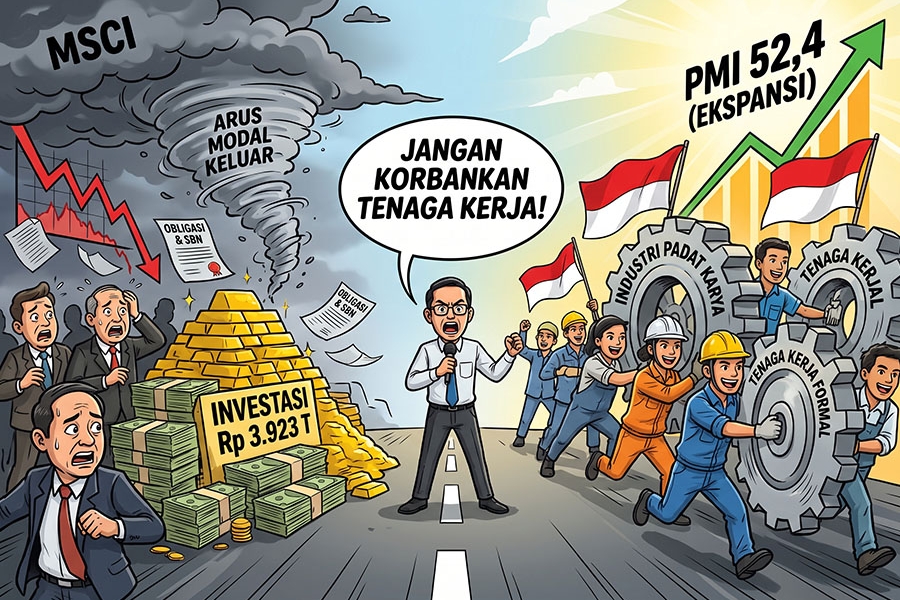
The Indonesian capital market faced immense pressure after Morgan Stanley Capital International (MSCI) opened a public consultation on October 15, 2026, regarding a proposal to reclassify Indonesia from an Emerging Market to a Standalone Market. Although not yet a final decision, the announcement triggered investor anxiety over potential shifts in foreign capital flows. MSCI has scheduled the consultation period to run until April 30, 2027, with a final decision expected at the end of June 2027.
The impact of this announcement became highly visible during trading on Friday, October 16, 2026, when the Jakarta Composite Index (JCI / IHSG) plummeted by 11.57% to the 5,199.96 level, recording its deepest daily decline since the 1998 monetary crisis. The rupiah also weakened, breaching Rp18,000 per US dollar. Several economists warned that foreign capital outflows could heighten pressure on the exchange rate and corporate funding costs. However, amidst the broader market decline, a number of foreign brokers still recorded net purchases on specific stocks, indicating that investor activity did not uniformly move in the same direction.
This market pressure has also heightened attention on Bank Indonesia's (BI) monetary policy, with the Board of Governors scheduled to meet on October 20–21, 2026. With the BI-Rate currently at 5.75%, investors are closely observing potential measures to stabilize the rupiah amid global uncertainty. Several economists assess that foreign exchange market intervention and liquidity management remain crucial, while interest rate adjustments may be considered if pressure on the rupiah persists and elevates inflation risks.
In response to the situation, the Indonesia Stock Exchange (IDX) and the Financial Services Authority (OJK) are preparing a clarification for MSCI to understand the underlying considerations for the reclassification proposal. On October 18, 2026, regulators also held dialogues with market participants to discuss these developments. Concurrently, the IDX and OJK highlighted ongoing capital market reforms, including improved transparency in share ownership, strengthened trade supervision, and stricter rule enforcement against violations. These steps are vital to fortifying investor confidence while the consultation process is underway.
The debate over MSCI's proposal also encompasses the appropriateness of Standalone Market status for Indonesia. In an opinion article, capital market practitioner Hans Kwee assessed that the size of the market, liquidity, and Indonesia's economic conditions strongly support the continuation of its Emerging Market status. He also emphasized the importance of distinguishing transparency and law enforcement issues from underlying economic fundamentals. By comparison, in October 2026, FTSE Russell maintained Indonesia in the Secondary Emerging Market category and removed it from its Watch List. Nevertheless, the decision of each index provider ultimately depends on their respective methodologies and criteria.
For business actors and investors, this turbulence underscores the importance of anticipating market risks and maintaining trust through information disclosure. Companies must account for potential shifts in funding costs, while investors need to evaluate fundamentals and investment risks rather than merely reacting to short-term price movements.
Ultimately, certainty regarding MSCI's classification awaits the final decision in June 2027. During this consultation period, the IDX and OJK must demonstrate tangible results from their transparency and law enforcement reforms, while market participants should make decisions based on measured information. The consistency of these reforms will serve as a critical factor in maintaining and restoring investor confidence in the Indonesian capital market.











 tpc.consulting
 tpc.consulting
 info@taxindo.co.id