


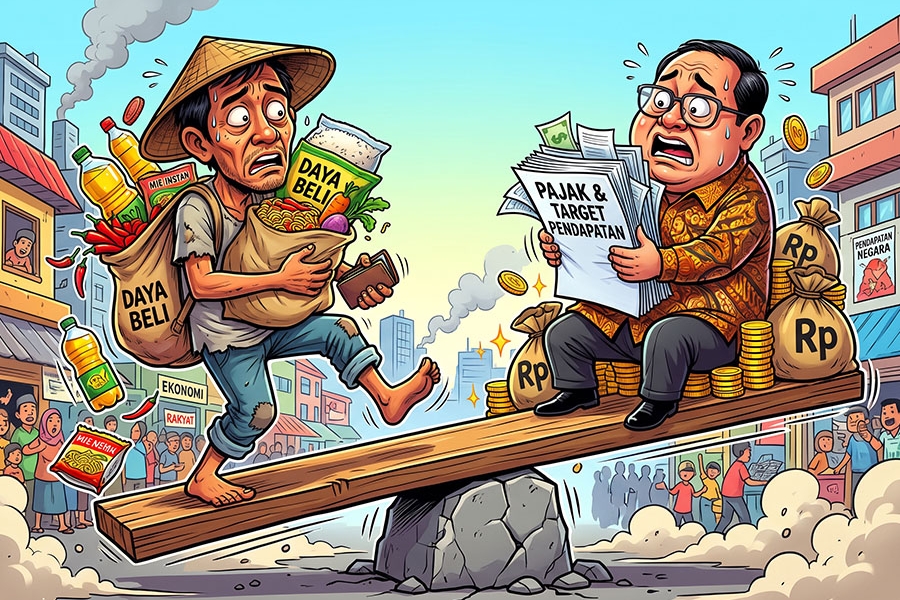
The government is assessing the adjustment of the Non-Taxable Income (PTKP) threshold for the 2027 fiscal agenda after the baseline has remained stagnant for nearly a decade. Several economists emphasize the critical need to balance protecting worker purchasing power with the potential loss of Income Tax (PPh) revenue through a meticulously measured adjustment scheme..
The government has officially included the plan to adjust the Non-Taxable Income (PTKP) threshold in the policy discussion agenda for 2027. The Coordinating Minister for Economic Affairs confirmed that the plan is still under inter-ministerial review, with the government yet to finalize the exact increase or implementation scheme. Currently, the PTKP for a single individual taxpayer stands at Rp54 million per year, or Rp4.5 million per month, based on Minister of Finance Regulation Number 101/PMK.010/2016. For taxpayers with dependents, this threshold increases by Rp4.5 million annually per dependent. After nearly a decade without adjustment, cumulative inflation from 2016 to September 2026 reached approximately 31.5%. If fully adjusted for inflation, the Rp54 million PTKP would equal roughly Rp71 million per year, or Rp5.9 million per month, in 2026. However, this figure is merely an illustration of real value adjustment, not a nominal increase mandated by the government.
The Ministry of Finance is vigorously assessing the impact of a PTKP shift on both public purchasing power and PPh revenue to pinpoint the optimal policy balance. The Directorate General of Taxes (DJP) noted that Indonesia's current PTKP sits at roughly 6.7 times the national poverty line. Its relative value has also shifted dramatically, falling from roughly 130% of GDP per capita when first established to approximately 60%–70% of current GDP per capita. Compared to neighboring nations, Indonesia's PTKP sits solidly in the middle, whereas compared to OECD member nations, its value is considered high. The DJP also assessed that elevating the national tax-to-GDP ratio cannot rely solely on administrative improvements and law enforcement. The government must re-evaluate tax policies that impact the revenue base while weighing spending policies, financing, and macroeconomic conditions. This highlights that adjusting the PTKP is not just about boosting the public's net income, but also managing the severe consequences for state revenue.
Regarding policy alternatives, an economist from the Institute for Economic and Social Research at the Faculty of Economics and Business, University of Indonesia (LPEM FEB UI), argued that the government should consider deploying temporary tax incentives rather than permanently hiking the PTKP baseline. A permanent PTKP hike could drastically slash state revenue, whereas temporary incentives are far more flexible, allowing the government to scale back or revoke them when economic conditions and purchasing power stabilize.
Meanwhile, an economist from the Center of Reform on Economics (CORE) Indonesia assessed that raising the PTKP is not the primary instrument for protecting the purchasing power of low-income citizens, as the direct benefits heavily skew toward formal workers who actively pay Article 21 Income Tax (PPh 21). Informal workers and citizens earning below the current PTKP gain zero direct benefit from the adjustment. For a worker in the 5% tax bracket, a Rp1 million PTKP increase only reduces their annual tax burden by a maximum of Rp50,000. While the nominal savings are higher for workers in higher marginal tax brackets, adjusting the PTKP remains highly relevant for the lower-middle and vulnerable urban middle classes who pay taxes, no longer receive social assistance, and face surging living costs.
CORE estimates that adjusting the PTKP to around Rp71 million per year would restore the real value of the non-taxable threshold to its 2016 position based on cumulative inflation. However, given severely limited fiscal space, a gradual adjustment is considered far more realistic than a massive single hike. CORE also proposed a periodic adjustment mechanism every two or three years based on inflation to maintain consistent purchasing power protection while simplifying revenue impact calculations. To finalize this, the government must run micro-data simulations—utilizing employee income distributions, PPh 21 withholding receipts, and family status data—to project exactly how raising the PTKP to Rp60 million, Rp65 million, or Rp70 million per year would shrink or completely erase the PPh 21 obligations for massive swaths of the formal workforce.
The discourse surrounding the PTKP adjustment carries profound implications for workers' net incomes, household consumption, and personal income tax revenues. Formal workers stand to gain additional net income, while the informal sector remains untouched. For employers, any regulatory shift demands immediate adjustments in corporate payroll tax calculations. On the state revenue front, reducing the tax liability of millions of workers threatens to trigger a severe drop in personal income tax receipts. Therefore, the government must meticulously calculate the distribution of policy benefits against the fiscal fallout before setting the final adjustment figure.
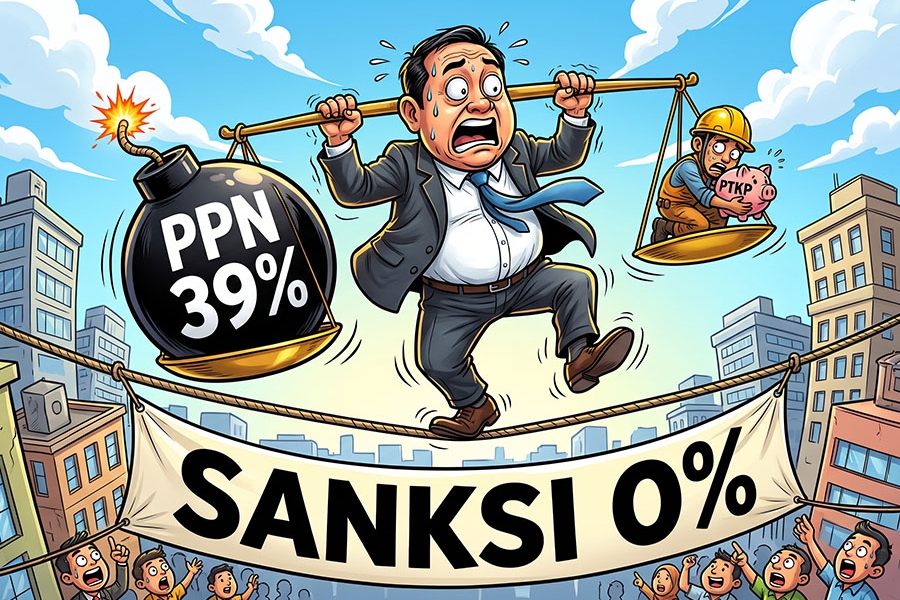
Ultimately, adjusting the PTKP requires a delicate balancing act between protecting public purchasing power and ensuring the sustainability of state revenues. The government must finalize a comprehensive impact study, weigh temporary incentives against permanent PTKP shifts, and strongly consider gradual, periodic adjustment mechanisms to ensure the policy delivers proportional benefits without crippling the state's fiscal capacity.










 tpc.consulting
 tpc.consulting
 info@taxindo.co.id