



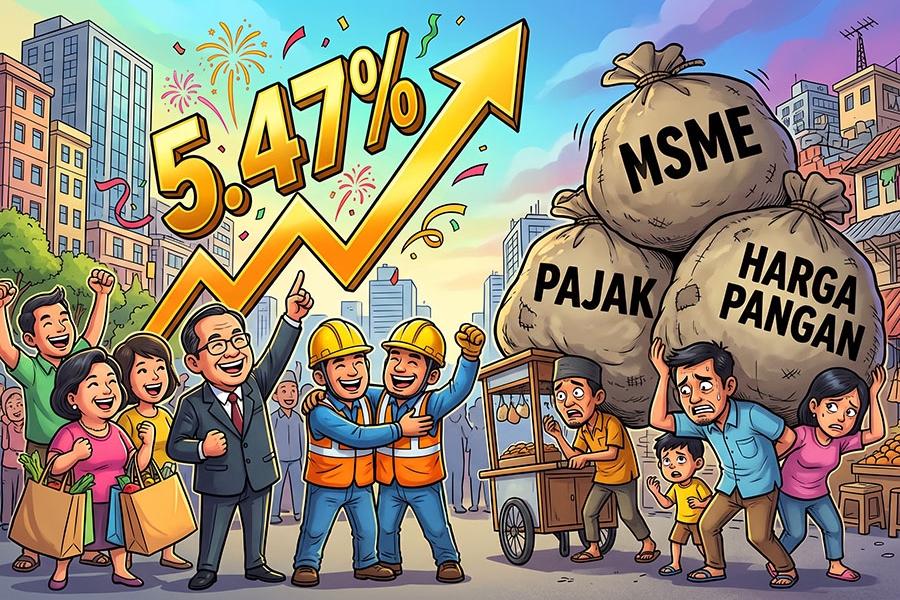
The Central Statistics Agency (BPS) reported that Indonesia's economic growth reached 5.47% in the third quarter of 2026, primarily driven by household consumption, investment, and the robust performance of the processing and construction industries. However, the Indonesian Chamber of Commerce and Industry (Kadin) noted that the benefits of this growth have not been equitably felt by MSMEs and labor-intensive industries. Concurrently, the Institute for Development of Economics and Finance (Indef) highlighted that escalating tax burdens and rising food prices continue to brutally erode the purchasing power of the middle class..
The Central Statistics Agency (BPS) recorded Indonesia's economic growth in Q3-2026 at a robust 5.47% year-on-year (yoy), accelerating from the 5.29% growth recorded in Q2-2026. The Gross Domestic Product (GDP) at current prices (ADHB) reached Rp6,741 trillion, while GDP at constant prices (ADHK) stood at Rp3,633.2 trillion. Quarter-to-quarter (qoq), the economy grew by 1.59%, closely tracking the historical seasonal patterns of previous years.
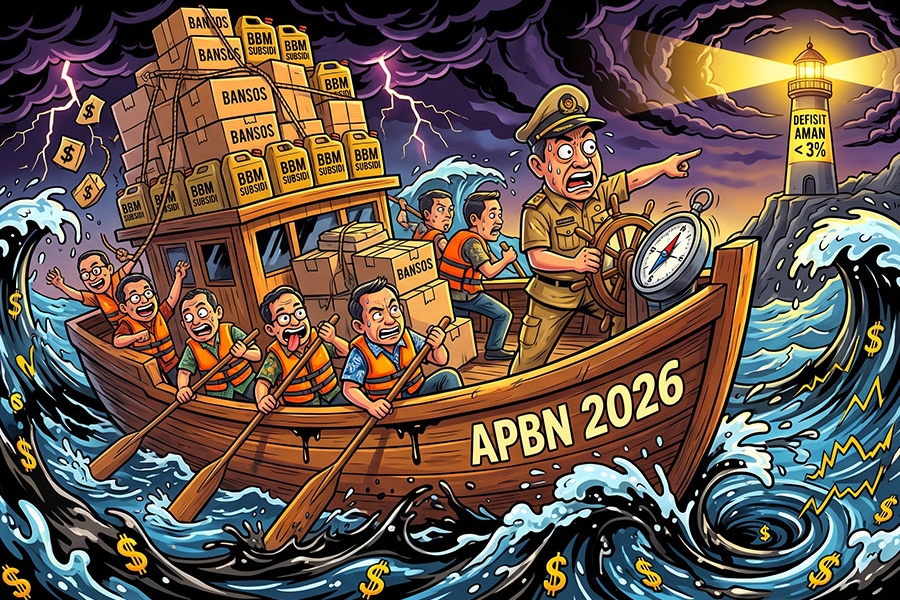
On the expenditure side, household consumption commanded the lion's share of the GDP, contributing 51.97% with a growth rate of 5.04%. Gross Fixed Capital Formation (PMTB), or investment, contributed 30.81% and grew by 6.06%. Combined, these two components accounted for a staggering 82.78% of the national GDP. Meanwhile, government consumption surged by 8.95%, heavily driven by increased personnel expenditure—including salaries and allowances for civil servants (ASN)—as well as spending on goods and services, notably the Free Nutritious Meal (MBG) program.
From the industrial sector perspective, the processing industry emerged as the primary engine of growth, contributing 1.20 percentage points. This sector's stellar performance was underpinned by the food and beverage industry (7.09% growth), chemicals, pharmaceuticals, and traditional medicine (8.10%), and basic metals (9.94%). The spike in the chemical and pharmaceutical sector was largely propelled by increased FAME (Fatty Acid Methyl Ester) production following the mandatory implementation of B50 biodiesel on July 1, 2026. Furthermore, the trade sector contributed 0.94 percentage points, construction 0.62 percentage points, and information and communication 0.49 percentage points. The construction sector's momentum was fueled by both government and private infrastructure projects, including several top-tier national priority programs.
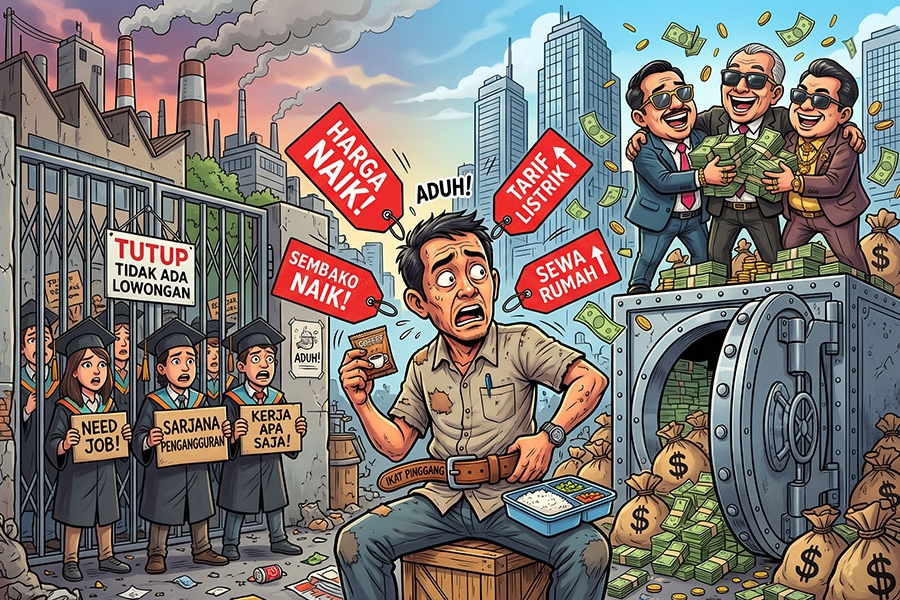
Despite these glittering macroeconomic indicators, the Indonesian Chamber of Commerce and Industry (Kadin) injected a dose of reality, asserting that the tangible benefits of this economic expansion have largely bypassed MSMEs and labor-intensive industries. Kadin explicitly highlighted the alarming stagnation in the agricultural sector, which crawled at 0.46%, and mining, which grew a mere 0.91%. Furthermore, small business actors remain suffocated by exorbitant operational and logistics costs, inflated prices for imported raw materials due to rupiah volatility, and fierce competition from cheap imported products. Consequently, Kadin is aggressively lobbying the government to prioritize fortifying public purchasing power, elevating industrial competitiveness, and ensuring MSME sustainability.
The structural inequality of this economic growth is starkly reflected in the battered purchasing power of the middle class. The Institute for Development of Economics and Finance (Indef) spotlighted the severe pressure this demographic faces from an escalating barrage of taxes—both income and consumption—coupled with spiking prices for daily necessities, particularly rice and household goods. Indef warns that this relentless squeeze is rapidly hollowing out middle-class purchasing power, especially since government social assistance and fiscal stimulus have historically been hyper-focused on the lowest-income brackets. Indef stressed that the financial survival of the middle class must immediately become a central pillar of government policy formulation.
Beyond addressing the purchasing power crisis, the government must also preemptively tackle potential food inflation by closely monitoring domestic food production and climate change risks. The ultimate challenge of economic growth is not merely hitting an aggregate percentage target, but ensuring that the generated wealth is distributed broadly and felt tangibly by the wider public and all tiers of business actors.
Indonesia's 5.47% economic growth in Q3-2026 undeniably marks a positive macroeconomic milestone, heavily supported by household consumption, investment, and strategic industrial sectors. However, this statistical triumph is overshadowed by severe distributional flaws; the benefits remain largely unfelt by the middle class, MSMEs, and labor-intensive sectors.
To rectify this, the government must execute targeted interventions to stabilize food prices, protect middle-class purchasing power from excessive tax burdens, and deploy concrete lifelines for MSMEs. In parallel, business actors must ruthlessly optimize operational efficiencies, fortify supply chain management, and strategically pivot to capture the opportunities generated by the booming sectors driving the national GDP.











 tpc.consulting
 tpc.consulting
 info@taxindo.co.id