



The House of Representatives (DPR) has begun discussing the revision of the State Finance Law designed using the omnibus law method, with discussions covering the management of state wealth, State-Owned Enterprise (SOE) dividends, taxation, and debt management. The government is also carrying out efficiency measures and restructuring of SOEs, including the closure of over 328 SOEs, which is said to save the budget up to Rp50 trillion. Meanwhile, Bank Indonesia projects the rupiah exchange rate to hover in the range of Rp17,300–Rp17,800 per US dollar throughout 2026 amidst pressure from global conditions..
The Indonesian House of Representatives (DPR RI) through Commission XI has begun discussing the revision of Law Number 17 of 2003 concerning State Finance, which is designed using the omnibus law method. The bill is projected to cover around eight laws regulating, among other things, state finance, state wealth, central and regional financial relations (HKPD), and taxation. However, this scope remains conceptual and dynamic. The Vice Chairman of Commission XI of the DPR, who is also the Chairman of the Working Committee (Panja) for the State Finance Bill, projected that this regulation will only serve as an operational foundation for the drafting of the 2028 State Budget (APBN) at the earliest.
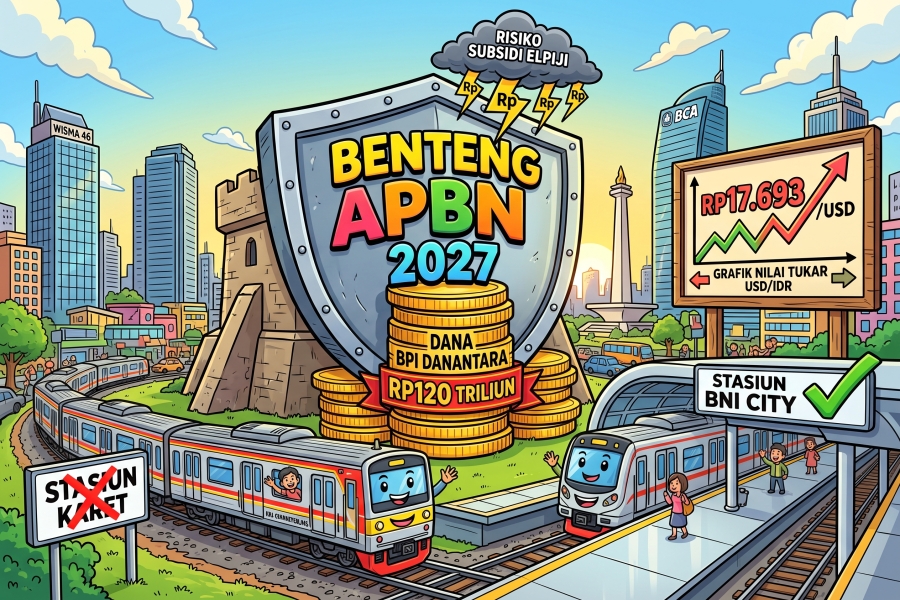
One of the issues discussed in the State Finance Bill is the management of state wealth, particularly following the establishment of BPI Danantara. Under the discussed scheme, SOE dividend deposits, which were previously deposited routinely into the APBN, will be directed to Danantara. Danantara's contribution to the APBN can be made when necessary, while its primary obligation is investment development. The discussion of the bill is also directed at shifting the paradigm of state financial management, which has so far been considered too reliant on processes and accounting, to become more oriented towards substance and the achievement of strategic targets. Furthermore, the bill will delve into the concept of limiting state debt, which will not only be based on ratios but also on the clarity of its designation (earmarking).
In addition to discussions on state wealth management in the State Finance Bill, efficiency and SOE management are also of concern to the government. The President of the Republic of Indonesia stated that the government has closed more than 328 SOEs, saving the state budget up to Rp50 trillion. These savings come from overhead costs, including the salaries of directors and commissioners, building leases, vehicle rentals, and working meetings. The President also mentioned a target of closing up to 750 SOEs by the end of 2026, with the hope that budget savings can reach Rp100 trillion.
Besides carrying out SOE efficiency, the government is also committed to enforcing regulations. PT PI reportedly recorded a 252% increase in net profit despite a 20% reduction in fertilizer prices. This price reduction was accompanied by an increase in fertilizer sales volume. Meanwhile, the government is making efforts to eradicate illegal mining in various regions, including Bangka Belitung. In the news, PT TMH Tbk. was reported to have recorded a nine-fold increase in profit compared to 2025.
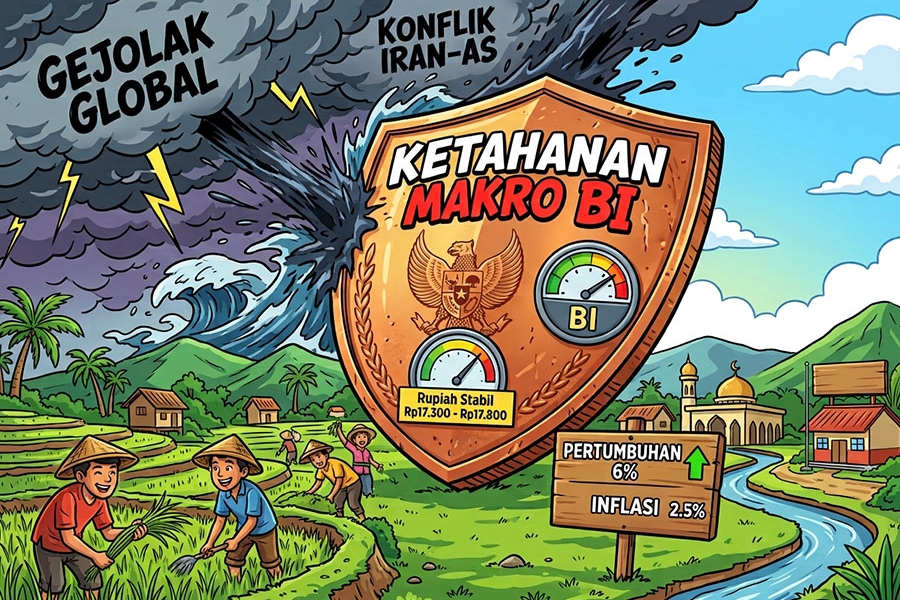
In line with discussions on SOE efficiency and management, economic developments and the movement of the rupiah exchange rate are also receiving attention. Bank Indonesia (BI) projects the rupiah exchange rate to be in the range of Rp17,300 to Rp17,800 per US dollar until the end of 2026. BI also estimates national economic growth to be in the range of 5.2% to 6%. Meanwhile, BI maintained its inflation projection at the target of 2.5% ± 1%, meaning inflation is expected to be in the range of 1.5% to 3.5%.
Previously, the rupiah exchange rate hovered around the level of Rp17,500 per US dollar and briefly approached Rp17,400 per US dollar. However, the renewed volatility in global conditions put pressure on the rupiah exchange rate. According to BI Governor Destry Damayanti, the escalating Iran-US war has also affected the movement of the rupiah in recent days. Nevertheless, Destry stated that the rupiah is still able to hold at the level of Rp17,600s per US dollar.
In conclusion, this series of developments indicates discussions regarding the reform of state financial management, SOE efficiency and management, as well as the progress of economic indicators and the rupiah exchange rate. The discussion of the State Finance Bill still covers several aspects, including the management of state wealth, central and regional financial relations, taxation, and state debt management. On the other hand, the government announced SOE efficiency and restructuring measures, while Bank Indonesia projects the rupiah exchange rate to range from Rp17,300 to Rp17,800 per US dollar until the end of 2026, with economic growth estimated to be in the range of 5.2% to 6% and inflation in the range of 1.5% to 3.5%.
















 tpc.consulting
  tpc.consulting
  info@taxindo.co.id