



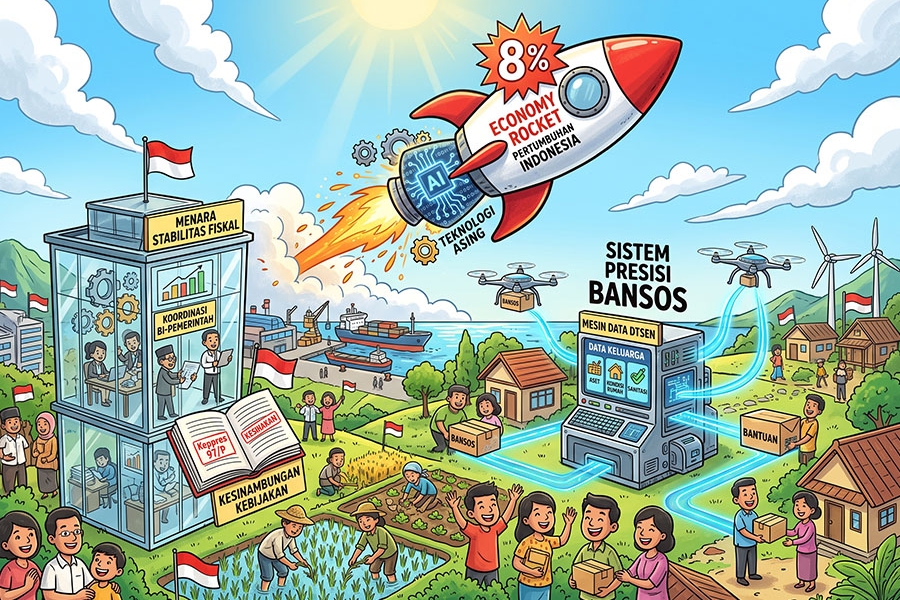
President Prabowo Subianto has officially inaugurated Suahasil Nazara as Minister of Finance, replacing Purbaya Yudhi Sadewa. The appointment is viewed positively for the continuity of fiscal policy, although the leadership change remains a focus for market participants. Concurrently, the government is utilizing the Single National Social and Economic Data (DTSEN) to determine priorities for social assistance distribution amidst budget constraints. Meanwhile, the World Bank assesses that Indonesia has the potential to increase its economic growth to eight percent through broader access to foreign technology, increased utilization of artificial intelligence, improved regulations, and expanded economic freedom..
President Prabowo Subianto officially inaugurated Suahasil Nazara as Minister of Finance, replacing Purbaya Yudhi Sadewa, at the State Palace in Jakarta on Monday, September 14, 2026. The inauguration took place amidst rumors of a cabinet reshuffle after the President previously summoned several ministers of the Red and White Cabinet to the State Palace.
Suahasil, who previously served as Deputy Minister of Finance, arrived at the Palace at around 2:44 PM WIB. When asked about his agenda, Suahasil stated that he came to fulfill the President's summons. His appointment as Minister of Finance was then stipulated through Presidential Decree (Keppres) Number 97/P of 2026 concerning the Dismissal and Appointment of the Minister of Finance of the Red and White Cabinet for the Remainder of the 2024–2029 Term.
In the Keppres, the President stipulated both the dismissal and the appointment of the Minister of Finance. The decree was enacted in Jakarta on September 14, 2026, and signed by President Prabowo Subianto. With this decision, Suahasil leaves his position as Deputy Minister of Finance to lead the Ministry of Finance until the end of the Red and White Cabinet's term for the 2024–2029 period.
The change in the Minister of Finance has also drawn the attention of market participants, who are closely monitoring the direction of fiscal policy and national financial stability.
The Indonesian Banking Development Institute (LPPI) considers Suahasil Nazara's appointment positive for the continuity of fiscal policy. Suahasil's experience as Deputy Minister of Finance is a positive factor because he understands fiscal policy and coordination with Bank Indonesia. Nevertheless, the change of the Minister of Finance still has the potential to trigger short-term volatility in the rupiah and the bond market.
The impact of the change in the Minister of Finance on banking liquidity is expected to be relatively limited as long as government cash management, the issuance of Government Securities (SBN), and monetary policy continue to run in a coordinated manner. To maintain market confidence, the government needs to ensure that deficit discipline, State Budget (APBN) financing transparency, and the independence of Bank Indonesia are maintained. In the medium term, if the fiscal policy direction remains consistent and predictable, the change of the Finance Minister has the potential to strengthen investor confidence, lower the risk premium, and support the stability of the rupiah and the financial sector.
Amidst efforts to maintain domestic financial market stability, the government is also utilizing integrated data to determine priorities for the distribution of social assistance amidst budget constraints.
The government uses the Single National Social and Economic Data (DTSEN) to improve the distribution of social assistance so that it is better targeted. DTSEN is the result of merging several data sources with different characteristics to produce data that can be used jointly in policy formulation. The data covers approximately 90 million families with more than 290 million individuals in Indonesia.
DTSEN is used to rank socioeconomic conditions as a consideration in determining priority beneficiaries. The characteristics utilized include housing conditions, household composition, assets, and access to basic services such as water and sanitation. The government also continuously integrates and updates the data as community conditions can change, for example, due to changes in domicile, death, or shifts in socioeconomic conditions.
However, the Center of Economic and Law Studies (CELIOS) urged the government to temporarily suspend the use of DTSEN for social assistance distribution to ensure data accuracy before it is used as a basis for determining beneficiaries. CELIOS assesses that data errors could result in people who genuinely need assistance failing to receive it.
In addition to improving the distribution of social assistance, Indonesia also needs to encourage structural changes to increase productivity and economic growth.
The Chief Economist of the World Bank assessed that Indonesia has the potential to boost economic growth from around 5% to 8%. To achieve this growth, Indonesia needs to make several major changes, especially by opening wider access to foreign technology, increasing the utilization of artificial intelligence (AI), improving regulations, and expanding economic freedom.
According to him, Indonesia needs to expand the use of AI, not only in the private sector but also within the government. AI can be utilized for various government functions, ranging from agriculture, education, and health to legal and judicial services. The utilization of AI in these functions is considered capable of helping to improve efficiency and productivity.
In addition to access to technology, he emphasized the importance of better regulations and greater economic freedom for Indonesian companies. According to him, companies need more room to make changes and improve efficiency to optimally adopt new technologies. He also highlighted the importance of Indonesia's ability to allocate talent to the right jobs without discriminating based on gender or between majority and minority groups.
In conclusion, this series of developments shows that Indonesia's fiscal management is not only related to policy continuity following the change of the Minister of Finance, but also to efforts to maintain market confidence, improve the targeting of social assistance distribution, and spur economic growth. The appointment of the new Finance Minister is viewed positively for fiscal policy continuity, although the leadership change still has the potential to trigger short-term volatility in the rupiah and bond markets. On the other hand, the use of DTSEN is directed at determining priority recipients of social assistance amidst budget constraints, with data accuracy and updating being crucial issues that require attention. To increase economic growth, Indonesia also needs to expand access to foreign technology, increase AI utilization, improve regulations, expand economic freedom, and improve the quality of human resource allocation.















 tpc.consulting
  tpc.consulting
  info@taxindo.co.id